The four main directions in which nipples look and how noticing this helps when you're breastfeeding
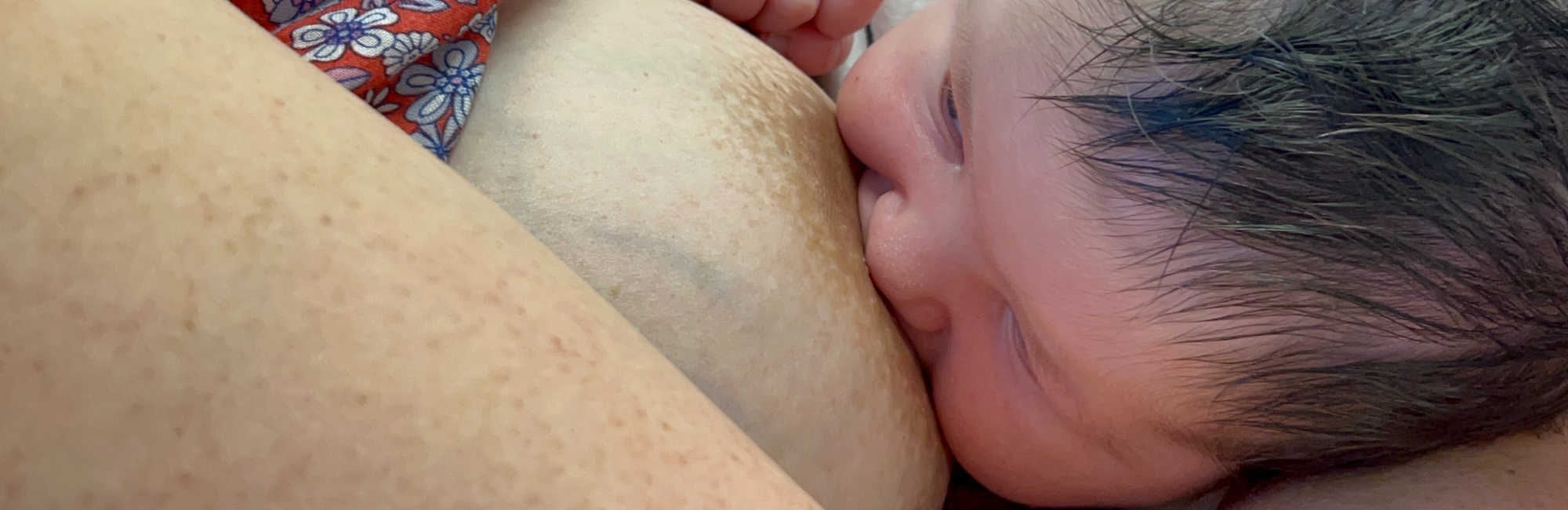
Normal nipples look in different directions
There's no 'right' direction for your nipples to look, because lactating women's breasts and nipples are amazingly anatomically diverse. One or both of your nipples might look
-
Out to the side
-
Towards the ground
-
Somewhat upwards towards the ceiling
-
Directly to the front or even a little towards the midline.
However, finding a stable position for baby to breastfeed without any nipple or breast tissue drag requires different strategies from the gestalt method, depending on the direction in which your nipple looks. This means your baby's fit and hold can be quite different between your two sides. It also explains why many women find that breastfeeding works well on one side, but on the other they may have nipple pain and damage, or the baby has difficulty coming on or staying on.
1. Your nipple looks off to the side
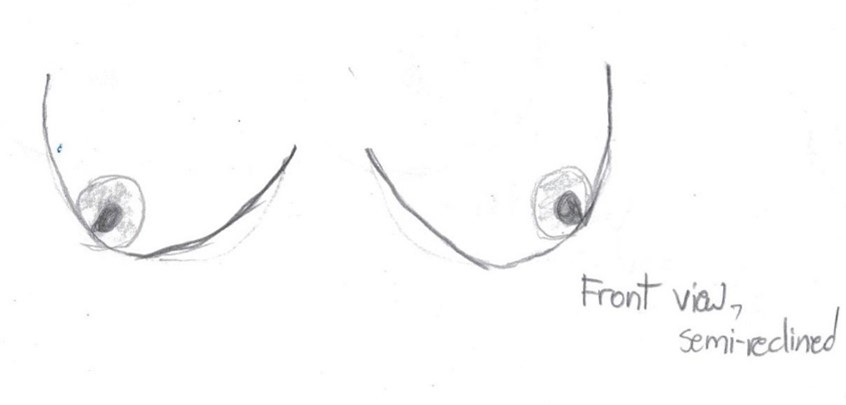
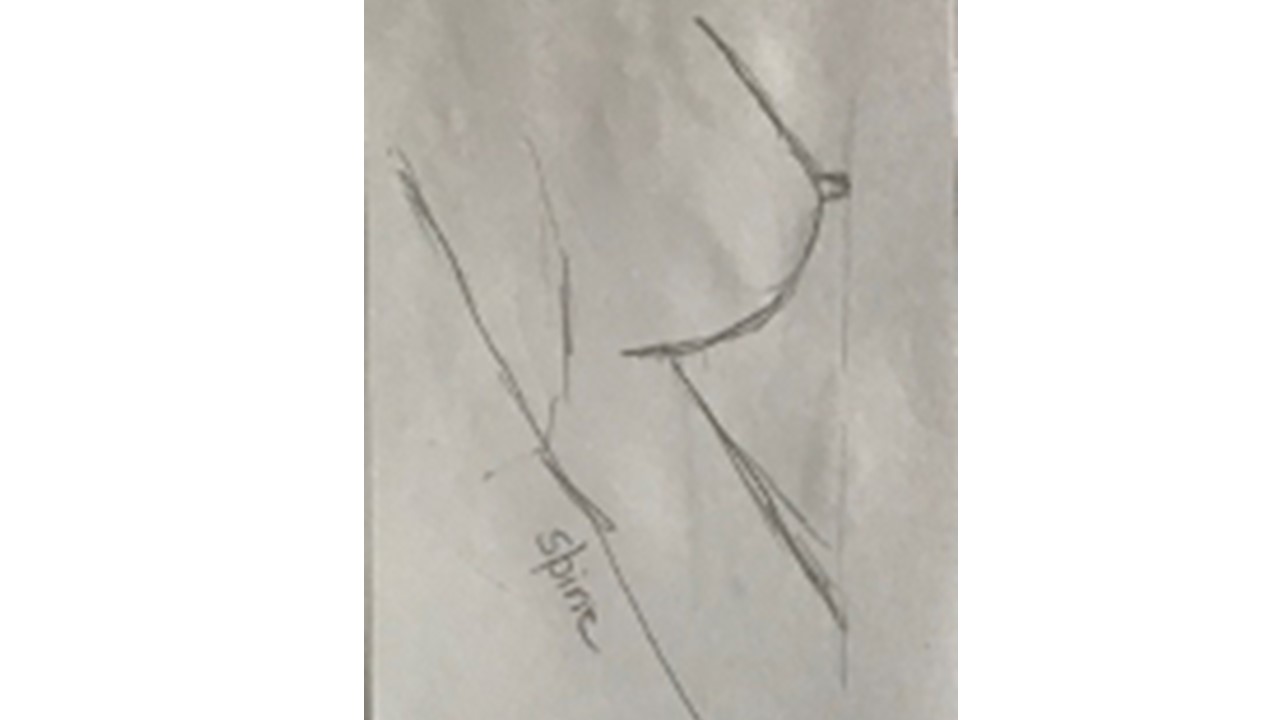
Possible challenge during breastfeeding
Two challenges can arise if your nipple looks off to the side. These challenges might result in baby fussing and pulling off a lot, or nipple pain and damage.
-
Baby pulls your nipple and breast tissue towards midline, causing drag.
-
You try to position baby further off to the side so that there's no nipple and breast tissue drag, but this might result in her
-
Neck bending forward (or at least not tilting her head back enough), or
-
Nose burying in and obstructing airflow.
-
Gestalt method strategies (which may vary between sides depending on where each nipple wants to look)
Tight rib-cage wrap, lifting up the other breast to tuck baby in underneath
-
Place newborns and young babies in a very snug ribcage wrap up, tucking baby up under your opposite breast, which allows baby's head to tilt back a little. This often works best if you lift your other breast, literally tuck baby under, maintaining good spinal alignment between her neck and pelvis (no twisting). Then allow your breast to rest on your baby's body.
-
For older babies, the rib-cage wrap no longer works well. Baby tends to kick off the back of the chair, or is just too long and heavy for the rib-cage wrap to be comfortable. The older baby is best lying more diagonally across your torso, her chest, tummy and pelvis still snuggled up flat against you (to keep her spine aligned and head tilted back). Her lower thigh rests on yours. Still hold a firm paddle-hand between her shoulder blades and apply micromovements.
2. Your nipple looks to the ground
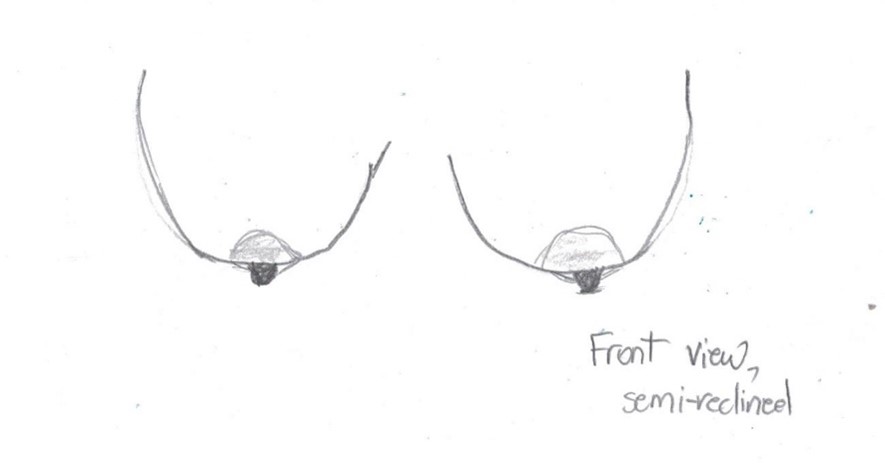
Possible challenge during breastfeeding
Two challenges can arise if your nipple looks downwards, towards the ground or your toes. These challenges might result in baby fussing and pulling off a lot, or nipple pain and damage.
-
Your breast's landing pad may not be not adequately exposed, due to encroachment of your tummy.
-
There's not room for baby's head and body to fit between your breast and torso, so that she's unable to suckle without breast tissue drag. You can see drawings of this challenge here.
Gestalt method strategies (which may vary between sides depending where each nipple wants to look)
Tight rib-cage wrap, lifting up the other breast to tuck baby in underneath
-
Place newborns and young babies in a very snug ribcage wrap up, tucking baby up under your opposite breast, which allows baby's head to tilt back a little. This often works best if you lift your other breast, literally tuck baby under, maintaining good spinal alignment between her neck and pelvis (no twisting). Then allow your breast to rest on your baby's body.
-
For older babies, the rib-cage wrap no longer works well. Baby tends to kick off the back of the chair, or is just too long and heavy for the rib-cage wrap to be comfortable. The older baby is best lying more diagonally across your torso, her chest, tummy and pelvis still snuggled up flat against you (to keep her spine aligned and head tilted back). Her lower thigh rests on yours. Still hold a firm paddle-hand between her shoulder blades and apply micromovements.
Your breast's landing pad needs to be well exposed
-
Being as semi-reclined or as far leaned back as is workable
-
Place a tightly rolled facecloth under the breast. You can find how to do this here.
-
Use baby's face to splint breast in place with symmetrical face-breast bury.
-
Think 'down, under, and in' with your micromovements, to keep baby's mouth at the level your nipple falls, but also at an angle which gives a symmetrical face-breast bury. Baby's face may be looking somewhat upwards as if towards your shoulder, or the ceiling.
Shaping your breast as you bring baby on
If you decide you do need to shape your breast and nipple to bring baby on
-
Try not to move the breast much from where it wants to fall, remembering that there is a risk that breast tissue drag is created as soon as you let go.
-
Return to the gestalt position of baby's head on your forearm and paddle hand between the shoulder blades as soon as you let go.
-
Then immediately begin micromovements to eliminate the breast tissue drag.
3. Your nipple looks towards the ceiling
Possible challenge during breastfeeding
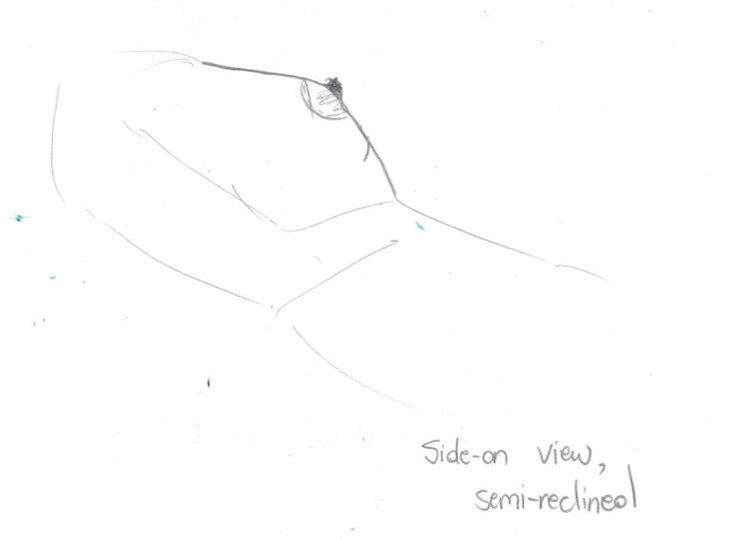
Two challenges can arise if your nipple looks somewhat upwards when you are in the semi-reclined position, which is necessary for best possible biomechanics. This most commonly occurs with a petite breast, discussed here, though not always. These challenges might result in baby fussing and pulling off a lot, or nipple pain and damage.
-
Nipple and breast tissue pull downwards towards ground.
-
Your elbow is a lot lower relative to where your nipple and breast fall and your nipple looks, so that it's difficult bringing baby high enough with your forearm to avoid breast tissue drag.
Gestalt method strategy (which may vary between sides depending where each nipple wants to look)
Don't sit upright as this creates other problems e.g. having to hold baby's weight, which worsens risk of breast tissue drag. Use your forearm or wrist under baby's head for micro-movement angle control, creating a symmetrical face-breast bury. Baby may be looking somewhat downwards, towards the ground. Folded towel between your forearm and side of baby's face and head may help you hold baby at height necessary to avoid breast tissue drag, if your upper arm is long relative to the height of your nipple and it is difficult to bring the baby comfortably to that height.
Not uncommonly, when she is semi-reclined, a woman’s nipple seems to point upwards and the breast tissue is being dragged downwards by the baby’s mouth. The solution here isn’t to sit upright – that means that you will have to hold the baby’s weight, which always worsens the risk of breast tissue drag.
You will simply need to adjust with the micro-movements to get the face-breast bury right, the angle, the height, and the baby may seem to be looking down towards your back.
4. Your nipple looks to the front or even somewhat towards the midline
Possible challenge during breastfeeding
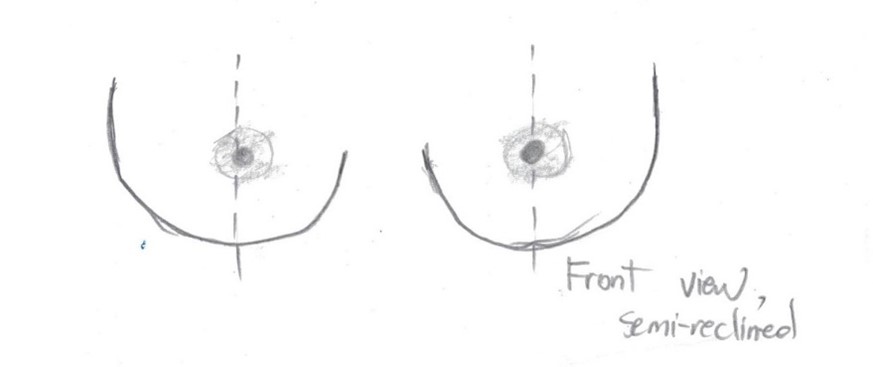
Two challenges can arise if your nipple looks towards the front. These challenges might result in either baby fussing and pulling off a lot, or nipple pain and damage.
-
Your nipple and breast tissue tend to drag off towards the same arm as the breast you are feeding from.
-
Baby's nose tends to bury in with face-breast bury and obstruct her airflow. That is, her head and neck don't tilt back enough.
Gestalt method strategy (which may vary between sides depending where each nipple wants to look)
Tight rib-cage wrap, lifting up the other breast to tuck baby in underneath
-
Place newborns and young babies in a very snug ribcage wrap up, tucking baby up under your opposite breast, which allows baby's head to tilt back a little. This often works best if you lift your other breast, literally tuck baby under, maintaining good spinal alignment between her neck and pelvis (no twisting). Then allow your breast to rest on your baby's body.
-
For older babies, the rib-cage wrap no longer works well. Baby tends to kick off the back of the chair, or is just too long and heavy for the rib-cage wrap to be comfortable. The older baby is best lying more diagonally across your torso, her chest, tummy and pelvis still snuggled up flat against you (to keep her spine aligned and head tilted back). Her lower thigh rests on yours. Still hold a firm paddle-hand between her shoulder blades and apply micromovements.
Babies need to tilt their heads back (or at least, not have their head tilted forward) to drink comfortably
I mention head tilt in the discussions above, but in fact you don't really need to think about whether your baby's head is tilting back at all: this looks after itself if you use the gestalt strategies.
The amount of head tilt a baby requires will depend on the shape of his little chin, as well as where your nipple looks and the shape and density of your breast. Many babies don't need much head tilt, and a breastfeeding baby's backward head and neck tilt is often only very slight, or the cervical spine (spine of the neck) is in a neutral position.
But your baby definitely won't be able to breastfeed comfortably with his neck bent forwards, and this is even more so for a baby with a delicate chin who may need quite a bit of backwards head tilt. Think about trying to drink from a glass of water if your chin is tucked under, and you'll know what I mean.
As a breastfeeding woman, you only need to think about
-
The rib-cage wrap (in younger babies, until they are too long, in which case it is tummy against your body with the baby's lower hip resting on your upper thigh)
-
The symmetrical face-breast bury, and
-
The micromovements (to find where your nipple sensations are most comfortable with zero pain, and your baby is most deeply relaxed, with no fussing).
-
The paddle hand with some pressure between your baby's shoulder blades.
These are the strategies which automatically take care of any head tilt your baby requires for a comfortable suck and swallow.
Recommended resources
The four main directions in which nipples look: what to do
What to notice in front of the mirror before you bring baby on to the breast
The protective powers of nipple and areolar skin when you're lactating
Things to know about your nipple and areola skin and microbiome when you're lactating
Your nipple skin knows how to adapt to the mechanical pressures of breastfeeding (or pumping)
The biological vulnerability of your nipple and areola skin when lactating
Selected references
Douglas PS, Keogh R. Gestalt breastfeeding: helping mothers and infants optimise positional stability and intra-oral breast tissue volume for effective, pain-free milk transfer. Journal of Human Lactation. 2017;33(3):509–518.
Douglas PS, Geddes DB. Practice-based interpretation of ultrasound studies leads the way to less pharmaceutical and surgical intervention for breastfeeding babies and more effective clinical support. Midwifery. 2018;58:145–155.
Douglas PS, Perrella SL, Geddes DT. A brief gestalt intervention changes ultrasound measures of tongue movement during breastfeeding: case series. BMC Pregnancy and Childbirth. 2022;22(1):94. DOI: 10.1186/s12884-12021-04363-12887.