
What's useful to notice in the mirror before you bring baby on to your breast?

1. Your breasts' shape and symmetry
Are your breasts, nipples and areolas asymmetrical?
It is normal and very common to find that your breasts, nipples and areolas are different in size and shape between the left and right sides. The difference in breast and nipple shape means that the way you bring your baby to your body on one side might be different to the way you do it on the other.
2. Your breastfall
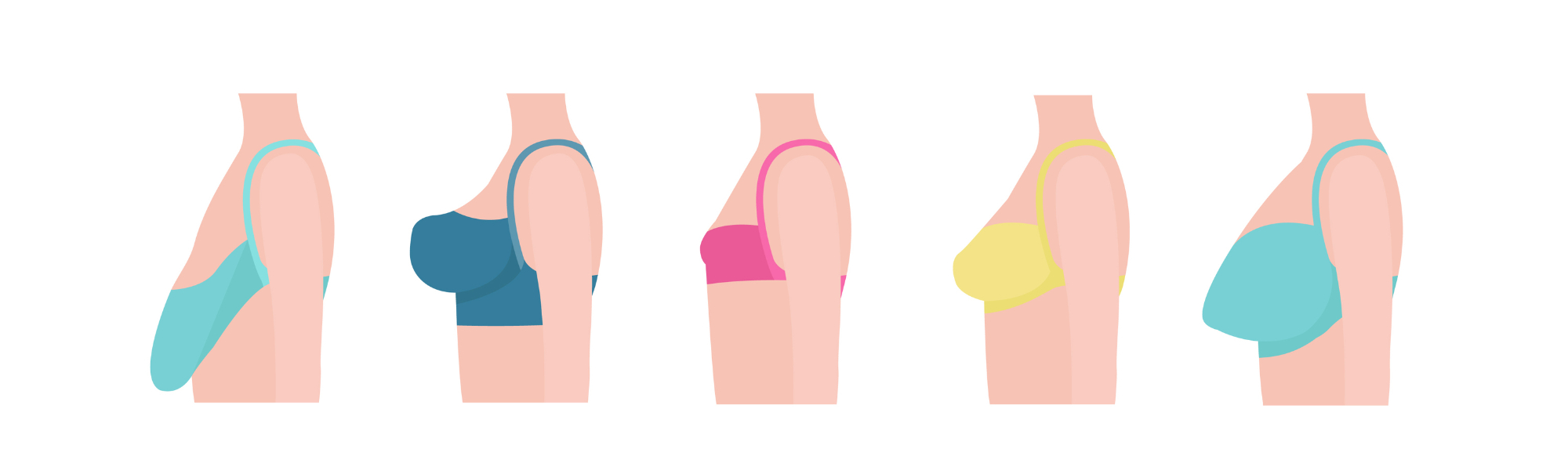
Where do your breasts fall relative to your ribcage and tummy when you are seated and semi-reclined, or leaning back at a 45 degree angle? Where does your nipple fall, relative to your elbow when your arm is resting by your side in the semi-reclined position?
It's helpful to be aware that fit and hold differs between breasts depending on the difference in each breast's fall relative to gravity, and that your baby needs to be held just where each breast and nipple fall (not higher or lower) even though breast fall is often different between sides.
Women naturally have a round abdomen. (Those taunt flat tummies you see everywhere in social media and in advertisements are definitely not the norm). This is especially the case after giving birth. We need to fit your baby into your body in a way that takes into account your lovely round post-birth breast-belly contour.
3. The direction your nipples look
Does one of your nipples look in a direction quite different to your other nipple?
It's normal for your nipples to look in different directions, but it helps to be aware of this because your baby's fit and hold will differ between breasts depending on where your nipples look.
4. Landing pad exposure
Is your breast's landing pad encroached upon, for example, by your tummy or by clothing?
Each of your breasts' landing pads need to be fully exposed - in a ten centimetre diameter around your nipple - for positional stability in breastfeeding.
5. The shape of your nipples
How high or low is the height of your nipple, compared to your areola? How wide is your nipple at its base?
A lower nipple height or wider nipple width may require more careful attention to fit and hold, but are not reasons to think that you and your baby will necessarily have problems breastfeeding.
What to notice and why this helps
| Things to notice about your breasts and nipples before bringing baby on | Why it helps to notice this |
|---|---|
| Where do your breasts and nipple fall in response to gravity when you are taking up the position you plan to breastfeed in? Where does your nipple rest when you're sitting semi-reclined? Does your breastfall differ between your two breasts? What difference does wearing a bra make to your breastfall? | The baby's mouth needs to suckle at the same level as the breast and nipple naturally fall, to avoid breast tissue drag. If your breastfall differs between sides, this will mean that baby fits onto each breast differently. |
| Where do your nipples rest relative to the level of your elbow when your upper arm is resting by your side? | If your nipple sits significantly higher or lower than your elbow (or the length of your upper arm), you may need to experiment with certain strategies to avoid breast tissue drag. |
| In what direction does each nipple look? | Baby's mouth needs to be over the nipple drawing up as much breast tissue as possible without dragging the nipple and breast tissue off in any direction. |
| What is the degree of landing pad exposure for each breast? When you look at your breast's relationship with your tummy before breastfeeding, is there about five centimetres radius of breast skin exposed all the way around the nipple, or does some of that area contact your tummy? Are you wearing a bra or garment that is encroaching on the landing pad? | Make sure that the landing pad is completely exposed to avoid any breast tissue drag. |
Recommended resources
PBL Foundations
What does the gestalt method mean by the 'landing pad'?
PBL Intermediate
Working breasts are diverse on the outside
The four main directions in which nipples look and how noticing this helps when you're breastfeeding
-fotor-20240115155339.jpg)