Your nipple skin knows how to adapt to the mechanical pressures of breastfeeding (or pumping)

Skin adapts to stretching forces
Skin protects our body surface from mechanical injury as we go about our days and nights. Skin is elastic, and changes shape in response to the mechanical forces which constantly press in upon us as we navigate daily life.
Skin needs to stretch, but not to tear when stretched or strained. Amazingly, most human skin can be stretched several times its original size and yet still return to its original, genetically-determined size and shape.1
The weakest building block in skin is the keratinocyte, the cell which makes up the outermost layers of your skin. However, the junction between keratinocytes is strong.
How do cells in skin adapt to repeated stretching?
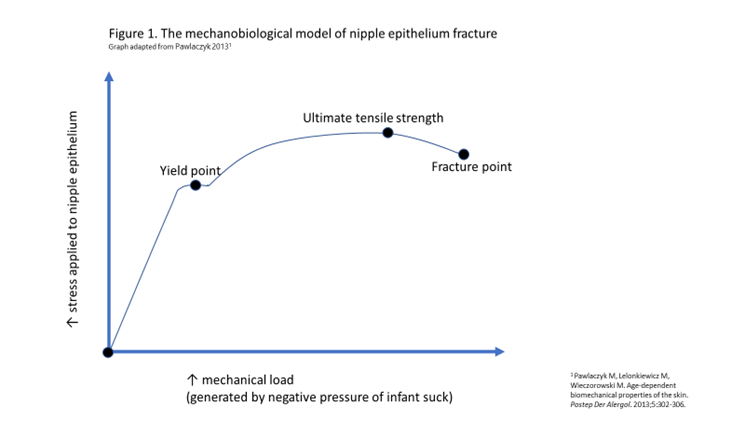
When a mechanical pressure is applied to skin, it gradually and permanently adapts to that mechanical force over time. At first, if there is a low level of mechanical stress, the keratinocyte cell itself absorbs the load.
-
Repeated mechanical stretching causes a strain on the junctions or desmosomes between the keratinocytes. This strain results in biochemical responses, which make proteins in the junction lock, so that it doesn't break apart. More molecules are brought in to reinforce the junction and make it more like a spring.
-
Then, mechanical stretching causes elongation of the keratinocytes in the direction of the acting forces, so that the skin thins.
-
Over time, in response to repeated mechanical pressures, keratinocytes change their orientation to align along the direction of the mechanical force, so that they can better absorb the pressure.3
-
Skin increases its surface area to decrease the mechanical load applied at any one point, in order to avoid fracturing. The number of keratinocytes in the skin increases, so that the skin thickens.
-
More collagen (a structural protein in the connective tissue) is laid down in the dermal layer (under the outer epidermis), to further strengthen the skin.
-
Stem cells migrate to the area exposed to the mechanical forces, resulting in production of more, expanded skin tissue.
Nipple skin adapts in response to the repetitive mechanical pressures of your baby's sucking
Now that we know how your nipple skin has evolved to adapt to your baby's sucking, it's not a surprise that for some women, it takes a little time for their nipples to get used to the mechanical effects of sucking. That doesn't mean you should have to tolerate pain though.
The skin's adaptivity also explains why women report that their nipples visibly change over time with breastfeeding. There may be something to the old idea that our nipples get used to breastfeeding. (But there's definitely no reason to be trying to 'toughen up' your nipples, the way people once said, before your have your baby! This is likely to damage nipple skin and even slow down your nipples' capacity to adapt when the time comes!)
Your nipple skin has evolved, from an evolutionary perspective, to adapt to your baby breastfeeding. Your nipple skin knows what to do! It's been practicing for two million years or more!
What's very important, though, is to make sure you know how to spread the mechanical pressures of your baby's sucking over as much of your nipple, areola and breast skin as it is possible to draw up into your baby's mouth. This spreads out the pressure, and ensures it's not too concentrated on any one area, so that your nipple can make its adaptations.
By eliminating nipple and breast tissue drag, we draw up as much nipple, areola and breast skin as possible into your little one's mouth, and protect your nipple from excessive forces. You can find out about the gestalt method of fit and hold starting here.
Recommended resources
The four main directions in which nipples look: what to do
What to notice in front of the mirror before you bring baby on to the breast
The protective powers of nipple and areolar skin when you're lactating
Things to know about your nipple and areola skin and microbiome when you're lactating
Your nipple skin knows how to adapt to the mechanical pressures of breastfeeding (or pumping)
The biological vulnerability of your nipple and areola skin when lactating