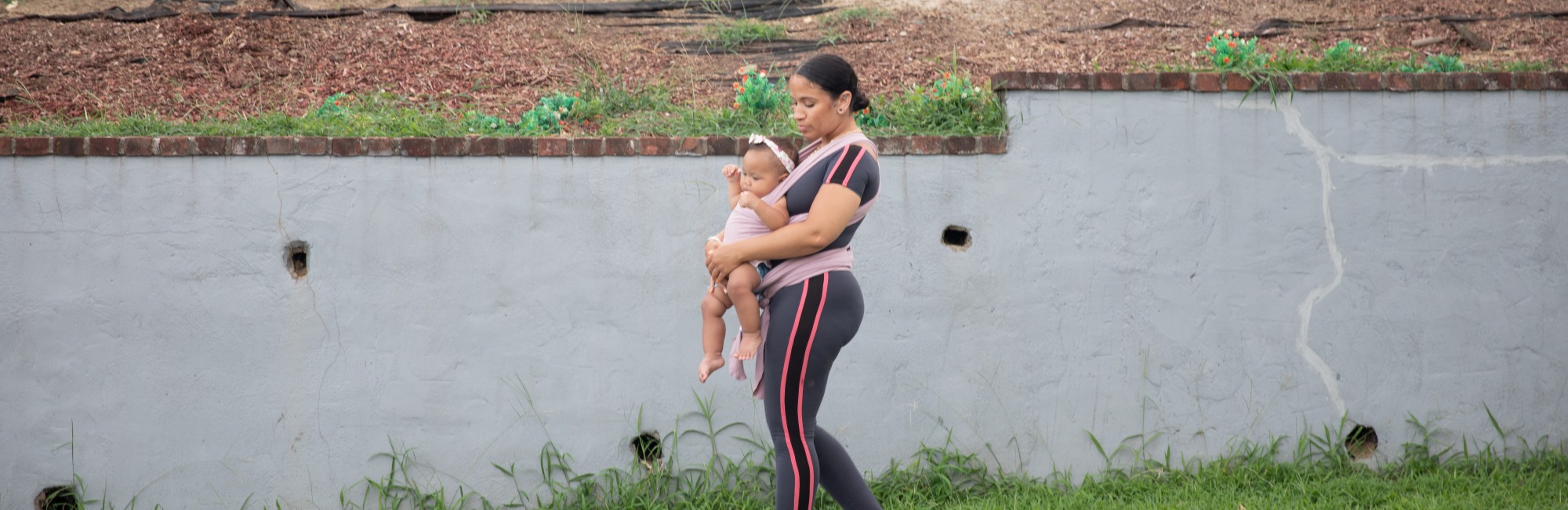
Filling your toddler's sensory tank

One way of thinking about your toddler's sensory motor needs is to imagine he has a rather large sensory tank inside him. We hope to fill up this tank daily with rich and diverse sensory motor experience. This nourishing fuel which runs his active little body and nervous system, and helps keep him dialled down. In the same way a wholesome food diet is important for your little one's development, a richly varied sensory motor diet is also very important for your toddler's development and wellbeing. You can find out more here.
Actually, if we can charge up her sensory tank each day with some very big doses of rich experience, then there's a chance your little one might run on stored fuel alone for a short time later that day. As she uses up that sensory fuel and her little tank empties, she might begin to dial up again, to let us know she's needing more.
A primary carer could think of the day this way. You try to get as much fuel as possible into your toddler's sensory tank when your own energy levels are higher (by getting out of the house for planned social activities or a visit to the park or tasks at the shops or visiting your work place or whatever it is). Then there's reason to hope he'll be more tolerant of a lower sensory environment (like being at home, hopefully self-entertaining and seeking out sensory nourishment for himself) for a while after that, running on the stored power in his sensory tank, if his sensory tank has already been filled up to overflowing that day. This is when toddlers may play happily, at least for a time, with toys and play gyms inside the house.
Of course, there are no guarantees this will work. Some toddlers have much higher sensory needs than others. Having older children in the house makes the sensory motor environment much more interesting so that it's easier to keep your toddler dialled down when you're inside. This is also a reason why many families seek out opportunities for their toddler to enjoy lots of time in social settings with other children.
I wouldn't want this concept of the sensory tank to make you feel you are often struggling against your toddler's sensory motor needs, trying to persuade her to self-entertain but finding she's often unhappy or grumpy inside the home. Sometimes simply surrendering to your toddler's high sensory needs at this time of life is easiest, accepting that active days outside the house work best, especially if your toddler doesn't have older siblings. Only you know what works for you.
Many of us live in a world where the primary carer, often a woman, finds herself caring for a child or children with minimal support from others. A tension can seem to emerge between her own needs and the child's needs for sensory motor stimulation. The problem is that a toddler whose sensory needs aren't being met is much harder to care for, because of the dialling up.
If this is how you're feeling, it could be that it's time to shift the focus back onto you, and how best to meet your own vital needs for rest, restoration, and support. You might find the Caring for you pages of The Possums Sleep Program helpful, for example, by starting here.
Is it time to think more seriously about filling your own tank?
Recommended resources
What is sensory motor nourishment and why does it help with toddler sleep?
What your toddler needs for best possible motor development
How to nurture the flourishing of your baby's or toddler's brain
Outdoor play is good for toddlers and good for sleep
Why a toddler carrier can help with toddler sleep
Selected references
Heffler KF, Acharya B, Subedi K, Bennett DS. Early-life digital media experiences and development of atypical sensory processing. JAMA Pediatrics. 2024:doi:10.1001/jamapediatrics.2023.5923.
Nava E, Giraud M, Bolognini N. The emergence of the multisensory brain: from the womb to the first steps. iScience. 2024;108758:http://creativecommons.org/licenses/by/4.0