
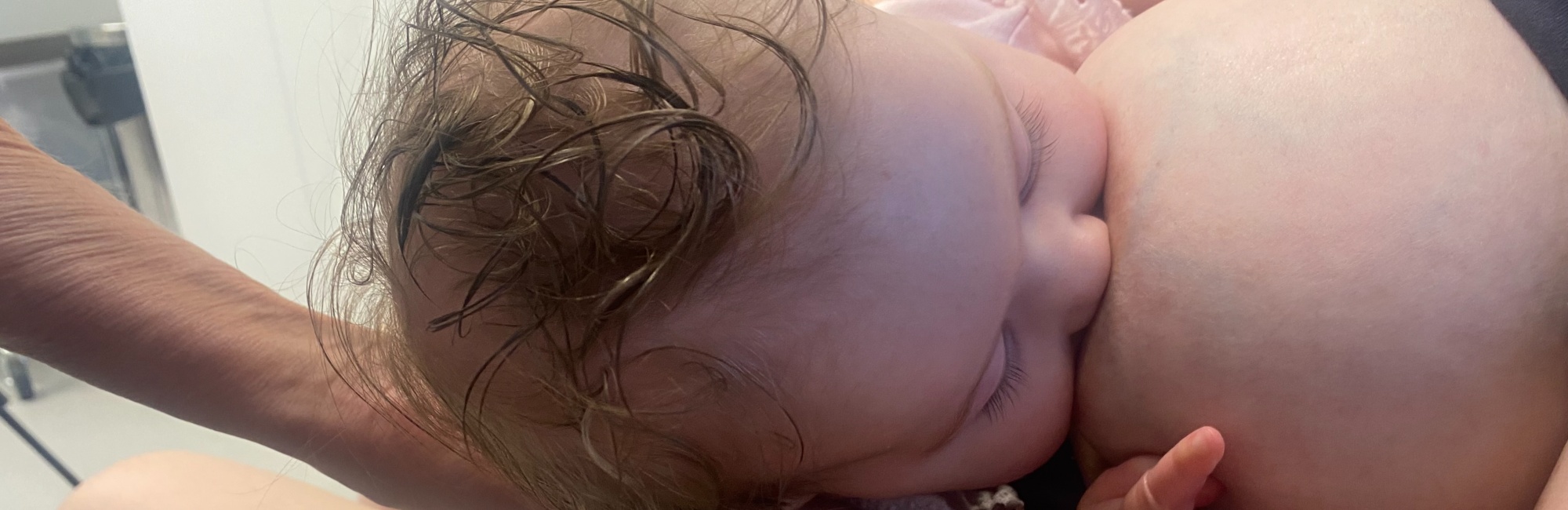
Eight-week-old Jamal who'd previously been unable to feed from his generous-breasted mother has a long drink at her breast then falls asleep in our consultation
When Jemima's newborn wouldn't come onto the breast, she received a lot of unhelpful advice
"Let's say that the pump and I have become close friends," Jemima tells me, wryly. Her firstborn, Jamal, is eight weeks old.
"But he latched and stayed on the breast for a whole 20 seconds the other day," she exclaims, "the longest by far he's stayed on in his entire little life! We even took photos!" Her husband, sitting by her side on my two-seater couch, brings out his phone to show me.
Jemima has seen a number of lactation consultants, three from the hospital, one at a clinic, and one who home-visits. They've worked very closely with her, in appointments up to two hours long. She's tried every possible position. After breastfeeding assessments, each of the lactation consultants have told her there's no positioning problem.
Little Jamal had a scissors frenotomy on his third day of life. However, the problems with coming on to the breast persisted, and the lactation consultants explained that the initial snip wasn't deep enough. They advised a deep scissors frenotomy by a different doctor, which Jemima and her husband, in desperation, proceeded with in his third week of life. Jemima tells me that the lactation consultants also told her she had 'big' breasts and 'flat' nipples, and that her baby had a recessive chin.
When I first see her, Jemima is feeding Jamal expressed breast milk by the bottle, as well as 50 or 60 mls of formula every few days. The baby's weight gain, and urine and stool output are normal. Jemima still tries to offer him the breast directly at least two or three times a day. She says that a nipple shield doesn't help because he has to work too hard at the shield to get milk through - she's been told he is a lazy sucker. When she brings him close to the breast in my consulting room, he begins to cry.
Baby Jamal has a conditioned dialling up at the breast. Jemima's breast is generous. She has not been able to find a stable position for her baby at her breast, from birth.
I work with her to apply the gestalt method. By the end of our consultation, this same little one who has not breastfed for longer than 20 seconds previously, has swallowed substantial amounts of milk directly from his mother (which I know because of the swallowing sounds we hear in tandem with his jaw movements) and is asleep at the breast. Jemima keeps looking up at her husband in amazement.
"I can't believe it," she murmurs, lightly caressing her little one's downy hair, gazing up at her husband, shaking her head just a little. "Can you believe it?" Her husband is tearing up.
You can find out about breastfeeding when your breasts are generous starting here.
How Jemima's baby was able to drink well from the breast and then fall asleep at the breast, for the very first time
In this table below, I explain the things that Jemima and I did together to help her little one have a stable breastfeed without dialling up, or backarching and pulling off. Some women like to experiment with these ideas on their own, but things are likely to go best in a complex situation like Jemima's if you have the help of a breastfeeding support professional.
| The problem | What I did or suggested | Why this worked |
|---|---|---|
| Landing pad encroachment | Semi-reclined positioning | Landing pad encroachment by the abdomen results in breast tissue drag; lying back at 45 degree angle helped expose the landing pad |
| Two rolled up facecloths to expose the landing pad | Landing pad encroachment by the abdomen results in breast tissue drag; facecloth use exposed the landing pad | |
| Conditioned dialling up at the breast - strategy used in the clinic | Nipple shield use | Accustomed to silicon contours of bottle teat, so baby was more likely to come on and have positive experience at the breast |
| Conditioned dialling up at the breast - strategies for daily life at home | Grow positive experiences at the breast, stop trying and never coerce if baby is dialing up | Avoids reinforcing negative associations |
| Enjoy time when baby is sleeping or resting or not doing much at breast | Helps grow positive associations with the breast | |
| Nipple and breast tissue drag | I hold Jemima's forearm as she practices dropping baby to the level of her nipple (vertical micromovements), experiments with angle control and also horizontal micromovements | Eliminates nipple and breast tissue drag |
| Jemima's upper arm is short relative to her breastfall. that is, her elbow sits higher than her nipples, so that she holds baby higher than nipple (even with good landing pad exposure) | Baby's head rests on Jemima's wrist, as she uses her other free hand in a 'paddle' shape between baby's shoulder blades for support | Eliminates breast tissue drag, gives Jemima control of micro-movements |
| Baby's lower arm caught between baby and mother's body | Gently ease lower arm to wrap around Jemima's side | Helps the baby get low enough to avoid breast tissue drag. Otherwise baby's eyes tend to be looking towards floor. Once baby's arm is wrapped, baby's eyes look up somewhat, towards ceiling |
| Jemima's breast falls out to the side | We ease her breast forward with her other hand before bringing baby on and then her upper arm stabilises the breast in that position | Baby doesn't have to go so far out to the side, which tends to promote tilting head forward, which makes it hard for baby to drop jaw and swallow comfortably |
| Asymmetric angle at face-breast interface causes breast tissue drag | 'Down and in and control the angle' | Baby's eyes looked at an angle that slopes up towards ceiling somewhat |
| Although Jemima didn't need to do this, some women in this situation find it easiest if they lift and shape the breast | Education about the high risk of breast tissue drag and how to avoid this if she uses this lift and shape technique | The woman lifts and shapes her breast but minimises possibility of breast tissue drag, uses careful micromovements once baby is on, and splints her breast in place with baby's face |
Jemima's story is an amalgam of multiple cases which have presented to me in the clinic, and is not derived from any specific or identifiable mother-baby pair. All patient stories told in Possums Breastfeeding & Lactation are fictional, but closely built from many real cases I've addressed in the clinic over many years.
Recommended resources
PBL Intermediate
How Janine uses a rolled up facecloth to better expose her generous breast's 'landing pad'
Why it's often best not to shape your breast with your hand though some women need to
Woman-centred language and weight-inclusive care of breastfeeding and lactating women
