The shape of a woman's breasts and nipple-areolar complex (her macroscopic anatomy) is located on a glorious spectrum of normal anatomic trait variation
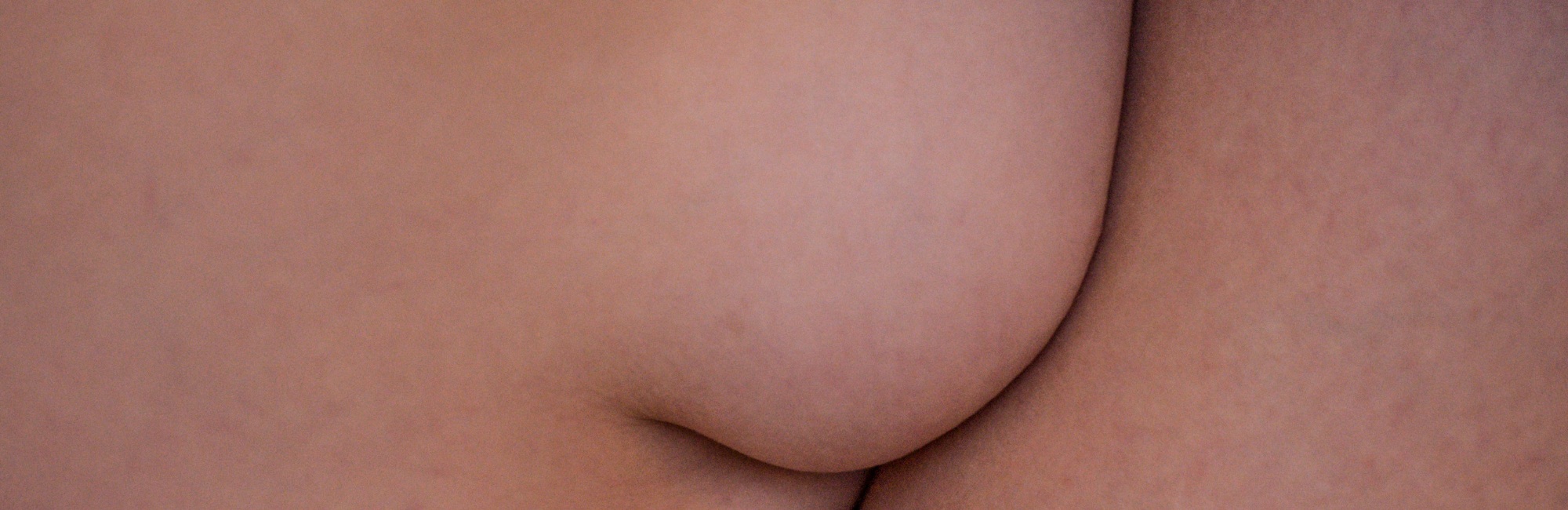
Maternal breast and nipple-areolar complex anatomy are on spectrums of normal human anatomic trait variation
Anatomical variation encompasses the spectrum of structural differences observed within the human body, influencing organ morphology, tissue composition, and physiological function.
The shape of a woman's breast and nipple-areolar complex (NAC) lies somewhere on the gloriously broad spectrum of human anatomic trait variation, usually associated with normal function. Some breast and NAC anatomic variants on the spectrum of trait variation may be more likely to be associated with impaired function. One example at the extreme end of the spectrum of variations is referred to as mammary hypoplasia.
The relationship between breast and NAC shape and capacity to directly breastfeed or produce enough milk to exclusively meet an infant's caloric needs is unpredictable, including in the case of mammary hypoplasia. This is because the breastfeeding mother and her baby form a complex biological system, with multiple anatomic factors interacting all at once, and compensating for each other. Every mother has the right to state-of-the-art clinical breastfeeding and lactation support, to optimise her milk production and her capacity to directly breastfeed if this is her desire, regardless of her biological traits.
Table 1. Normal macroscopic variability of the lactating breast
| Anatomic feature | Variability | Comment |
|---|---|---|
| Breast volume | A. One systematic review showed a range ('empty') at 4 weeks postpartum between 1.1-2 litres. B. Another study showed that breast sizes range from 180 cm3 to 2060 cm3 in the postpartum (cup sizes Aus 8A - 22G; US 30A-44G) | Although Deferm et al 2025 showed that some breasts are double the volume of others, this doesn't correlate with my clinical experience of postpartum breasts. Jin et al 2024 studied 609 Australian women between 1-6 months postpartum and found breast sizes range much more dramatically than that, with some some breasts more than 10 times the volume of others by cup sizes, which is closer to my clinical experience where I estimate breast sizes varying by a factor of 20 fold |
| Nipple shape | 60% cylindrical, of these 25% narrower at the base than at the face; nipples have either a mostly circular or oval face | |
| Nipple width at base | Californian women measured 15-34 mm wide; Japanese women 6-23 mm wide | Increases by about 2 mm in pregnancy |
| Areolar size | Most areolas aren't circular in shape, but are of variable shape. Can vary in width from 2-7 cm | Some areolas are more than 3 times the size of others |
| Number of areolar sebaceous glands | 0-40 | Some women have no areolar sebacious glands, others have 40 |
| Areolar density | When the areola is compressed at the base of the nipple, 35% of women have dense areolas; 64% have pliable areolas | |
| Nipple height | Range 0-20 mm in Japanese women, 5-20 mm measured in predominantly Caucasian Californian women. Average nipple projection in study of 385 Turkish women was 6.5 mm | Some nipples are 20 times the height of others. Average nipple height or projection is not necessarily as high as some health professionals might think of as 'normal'. Nipple height increases by about two millimetres in pregnancy. Nipple height/length increases post-breastfeeding relative to prior, and increases overall with parity, maternal age, previous breastfed infant. |
| Direction nipple looks | Out to the side, towards the midline, towards the ground, upwards (most noticeable in semi-recline); often varies between breasts | |
| Glandular tissue can extend into the axillae | Some women experience tight painful glandular tissue in the axillae with engorgement, particularly when their milk first comes in. As long as this isn't an unrelated or new lump, which should be checked out medically, this swelling and discomfort typically settles down once breastfeeding is established. | |
| Accessory nipples | Up to 5% of women | If there is some swelling with milk in the early days, leave it well alone and any milk secretion will quickly settle. |
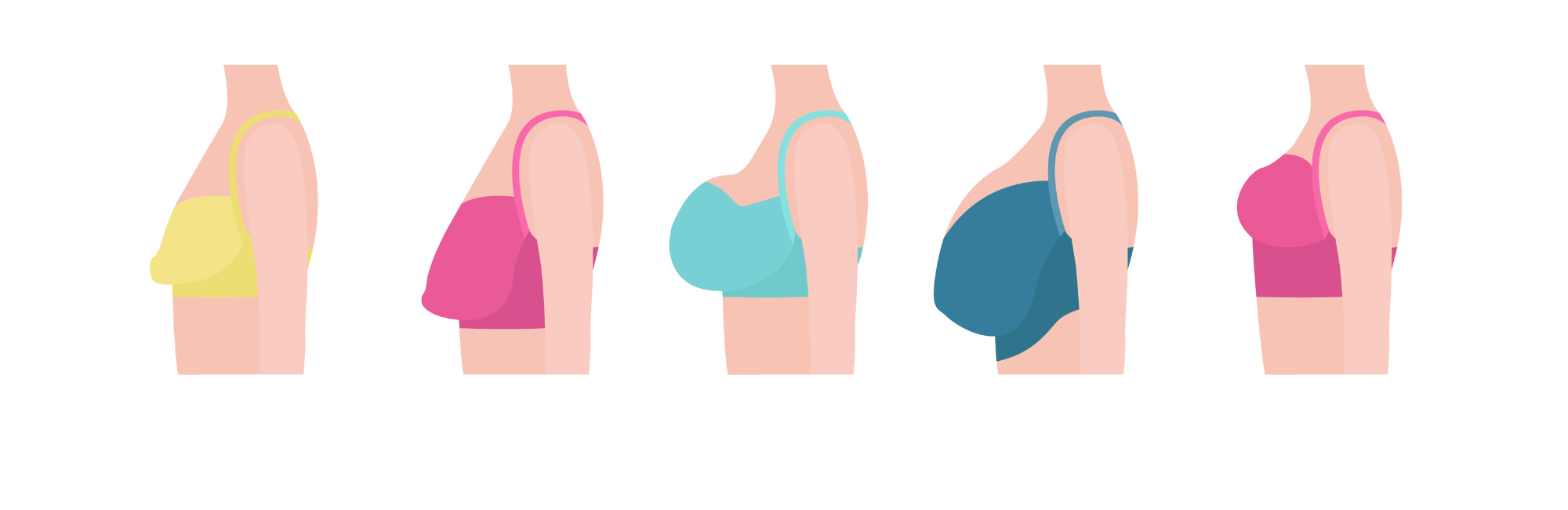
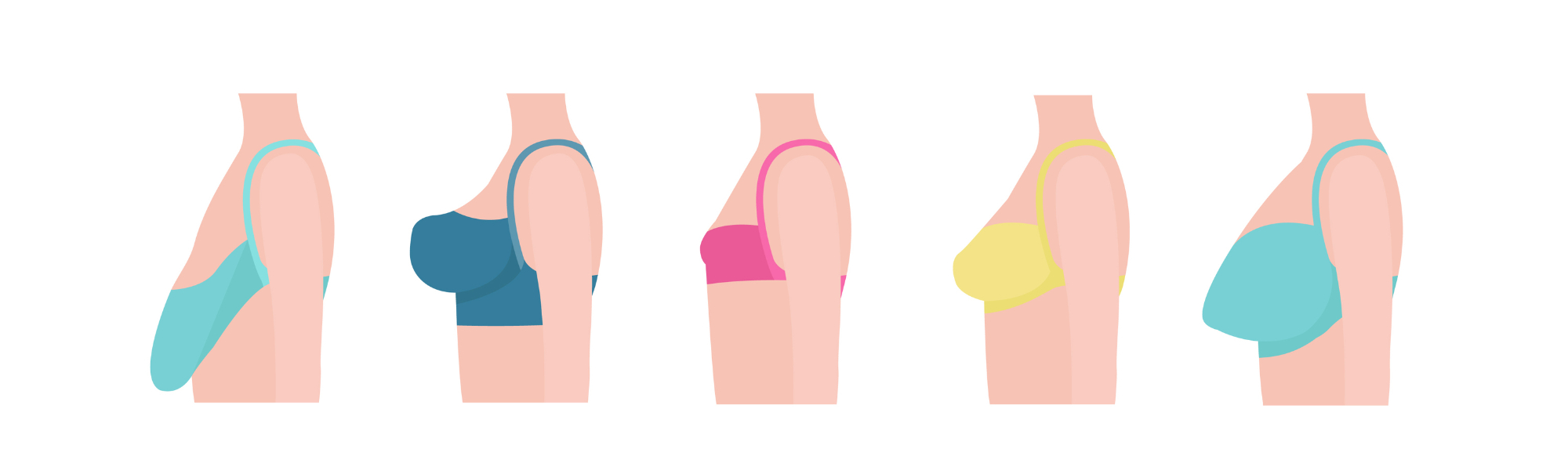
Recommended resources
You might be interested in a book by Laura Dodsworth called Bare Reality: 100 women, their breasts, their stories, which honours the radical diversity of the appearance - size, shape, colour - of women's breasts.
The size of your breasts doesn't predict how much milk you'll make
Selected references
Avşar DK, Aygit AC, Benlier E, Top H, Taşkinalp O. Anthropometric breast measurement: a study of 385 Turkish female students. Aesthet Surg J. 2010 Jan;30(1):44-50. doi: 10.1177/1090820X09358078. PMID: 20442074.
Deferm N, Dinh J, Pansari A, Jamei M, Abduljalil K. Postpartum changes in maternal physiology and milk composition: a comprehensive database for developing lactation physiologically-based pharmacokinetic models. Front Pharmacol. 2025 Feb 3;16:1517069. doi: 10.3389/fphar.2025.1517069. PMID: 39963246; PMCID: PMC11830814.
Geddes DB. The anatomy of the lactating breast: latest research and clinical implications. Infant. 2007;3(2):59-61
Jin X, Lai CT, Perrella SL. Maternal breast growth and body mass index are associated with low milk production in women. Nutrients. 2024;16(2854):https://doi.org/10.3390/nu16172854.
Mimouni G, Merlob P, Mimouni FB, Bin Nun A, Kasirer Y. Nipple/Areola Dimensions in Early Breastfeeding. Breastfeed Med. 2022 Jun;17(6):506-510. doi: 10.1089/bfm.2021.0265. PMID: 35687116.
Ramsay DT, Kent JC, Hartmann RL, Harmann PE. Anatomy of the lactating human breast redefined with ultrasound imaging. Journal of Anatomy. 2005;206:525-534
Robbins M, Rinaldi K, Brochu PM, Mensinger JL. Words are heavy: weight-related terminology preferences are associated with larger-bodied people's health behaviors and beliefs. Body Image. 2025;53:101860 https://doi.org/101810.101016/j.bodyim.102025.101860.
Thanaboonyawat I, Chanprapaph P, Lattalapkul J, Rongluen S. Pilot study of normal development of nipples during pregnancy. J Hum Lact. 2013 Nov;29(4):480-3. doi: 10.1177/0890334413493350. Epub 2013 Jul 3. PMID: 23824173.