Breast stroma is a mechanically and hormonally sensitive microenvironment which facilitates mammary gland activity through wound-healing or inflammatory immune responses
What makes up the mammary gland stroma?
Human stroma in general is a vital, sensing tissue, crucially sensitive to pressure or mechanical changes, alive with cells, and throbbing with networks of messenger signals or chemicals, including cytokines.
The mammary gland stroma is a broad term encompassing the supportive extracellular matrix and cellular components which surround and interact with the mammary epithelial tissue. The complex microenvironment of breast stroma includes
-
Connective tissue (including fibroblasts), the primary component of lactating stroma
-
Adipose tissue, the primary component of non-lactating mammary stroma. During lactation, half of the intraglandular fat is found amongst the glandular tissue within a 30 mm radius at the base of the nipple.
-
Blood vessels and haematopoietic cells
-
Immune cells such as macrophages, lymphocytes, plasma cells, mast cells
-
Mammary stem cells
-
Lymph vessels and nodes
-
Nerves
What are the functions of mammary gland stroma?
The following functions of mammary gland stroma were taught to me in medical school.
-
Stroma provides a supportive framework for the mammary glands and ducts.
-
The blood and lymphatic vessels within the stroma are responsible deliver nutrients and remove waste products and excess fluid.
However, it's now understood that mammary stroma is a complex and dynamic microenvironment which also
-
Contains an abundance of immune cells, as part of the mammary immune system. These immune cells
-
Act locally or systemically through a variety of mechanisms including the immediate inflammatory or wound-healing responses
-
Provide adaptive and innate immune responses.
-
-
Interacts with the epithelial cells of the glands and ducts through complex signalling networks. The stromal microenvironment regulates mammary gland development by paracrine and cell-cell interactions. For instance, adipocytes and preadipocytes within the stroma secrete paracrine factors which influence mammary epithelial cell viability, migration, and secretory activity.
-
Mediates hormone action and synthesizes growth regulatory molecules. Stroma responds to hormonal signals during the menstrual cycle, pregnancy, and lactation, helping to regulate breast tissue differentiation, proliferation, and remodelling.
What is mammary connective tissue?
Mammary gland connective tissue is one component within the stroma. The connective tissue portion of stroma is mostly collagen and fibroblasts.
Stromal connective tissue is made up of
-
Inter-lobular connective tissue, which surrounds the larger ducts and lobules and is the more collagen rich, dense and fibrous connective tissue in which adipose tissue is embedded. This fibrous connective tissue also forms suspensory bands, anchoring the breast to the skin and chest wall. A loosely defined framework of fibrous connective tissue is suspended between these superficial and deep fascial layers in irregular dense bands. These fibrous bands support the breast's glandular and adipose tissues and stabilise the breast. They naturally lengthen as the years pass
-
The intra-lobular connective tissue, a loose but highly vascular connective tissue, highly responsive to mammary epithelial signals. This looser connective tissue wraps around the alveoli, and contains blood vessels, fibroblasts, abundant lymphocytes, macrophages, fibroblasts, plasma cells, and lymphatic vessels.
-
Adipose or fatty tissue, which contributes to the overall size and structure of the breast, but which decreases in volume during lactation.
The resting stromal density and tension exerted on lactiferous ducts and lymphatic vessels varies from woman to woman, influenced by genetic predispositions.
The extracellular matrix of mammary gland stroma
In general, an extracellular matrix (ECM) is the non-cellular component of a stroma. An ECM is never static, but is a biologically active component of human tissues, which directs cell fates.
Mammary ECM plays a critical role in both development of the human mammary gland, in maintenance of tissue homeostasis, and in structural support. It is comprised of collagens, proteoglycans, glycoproteins, and elastins. The ECM contains basement membranes and complex networks of molecules, primarily proteins and polysaccharides, which surround and support cells, providing structural, mechanical (mechanical) and biochemical cues for tissue organisation and cell behaviour. The mammary ECM is constantly remodelled and modified through a dynamic and reciprocal interplay with adjacent cells.
-
ECM regulates cell adhesion, migration, differentiation, and influences cell signaling and growth.
-
The ECM provides the microenvironment which sustains stem cell quiescence and facilitates the maintenance of stem cells through regulated self-replication and retention of multipotency.
Myoepithelial cells effectively maintain the right luminal cell polarisation and further separate them from the adjacent stroma by making an integrated fence.
-
The basement membrane is a thin layer of secreted and assembled extracellular matrix that underlies all epithelia and endothelia in the body, and also surrounds skeletal muscle fibers and peripheral nerves. The basement membrane of the alveolus is a complex, lattice-like structure lying between the epithelium and stroma, and clearly influences both. It is dynamic, with both lysis and resynthesis going on to result in constant basement membrane remodelling.
-
Principal basement membrane constituents include collagens, fibronectins and proteoglycans. Enzymes capable of degrading the basement membrane may be found in stromal cells, myoepithelial cells and blood vessels. Contact with adjacent epithelial cells determines their polarity, contributes to their differentiation, and helps control their secretory functions. At the same time, the epithelial cells are capable of stimulating the formation of a basement membrane.
-
A lactose molecule has a molar mass of approximately 342.30 grams per mole (g/mol) and a single lactose molecule is estimated to be around 1.18 nanometers (nm) in size.
-
A basememt membrane in the mammary gland is a nanoporous matrix. Cancer cells use force-driven and protease mechanisms to invade the basement membrane.
Mechanical forces are fundamental to an understanding stromal function
-
The mammary ECM transmits cellular and tissue-level mechanical force, which shapes tissue development and tunes cellular activities, resulting in constantly remodelled tissues. This process is called tensional homeostasis, in which ECM and cell tension or mechanical pressures interact in a dynamic reciprocity.
-
The interstitial fluid pressure and capillary filtration control the rate of lymphatic drainage from stromal tissue.
Mammary gland stromal stem cells
The mammary gland is a complex organ undergoing significant and cyclical remodeling during the reproductive years, which is supported by resident stem cell populations. We discuss epithelial mammary stem cells earlier in this section.
Here, I mention stromal stem cells, which are crucial for mammary gland development, homeostasis, and regeneration, with diverse populations of stromal stem cells contributing to both the epithelial and stromal compartments of the breast.
Mammary gland stromal stem cells are
-
Characterized by specific markers
-
Can contribute to both stromal and epithelial lineages, demonstrating significant plasticity
-
Contribute to the dynamic and complex communications in the mammary microenvironment, including between epithelial and stromal components.
-
Essential for normal mammary development and physiological change
-
Also of significance in breast cancer pathogenesis.
Adipocytes, mechanosensing, and increased breast cancer risk
Fatty tissue is made up of fat cells, or adipocytes. Fat is found in three places in the breast:
-
At the back of the breast, just in front of the pectoral muscle and its fascia
-
Immediately under the skin and its superficial fascia. About two-thirds of the fatty tissue in the breast is subcutaneous, that is, under the skin (though there is no subcutaneous fat at the base of the nipple and under the areola.)
-
Intermingled with glandular tissue. The amount of fatty tissue intermingled with glandular tissue is highly variable between women. Half of the intraglandular fat was found amongst the glandular tissue lies within a 30 mm radius at the base of the nipple.
Adipocytes are crucial for mammary gland development and remodeling during the lactation cycle. Prior to pregnancy, adipocytes are a dominant part of the breast stroma. They are diminished in numbers during lactation, as glandular tissue becomes dominant in the breast. Adipocytes again become more dominant after weaning.
How do adipocytes function in the mammary gland?
In the human body, adipocytes have long been recognised as lipid storage in the form of triclyerides, which supply energy to other tissues in conditions of need (e.g. starvation). For a long time, adipocytes were thought of as inert cells which functioned only to store excess energy in this way.
But adipocytes are now recognized as extremely active cells that are involved in cellular communication, inflammation by secreting mediators known as adipokines, metabolism, and systemic homeostasis.
In the mammary gland
-
Adipocytes provide precursors to milk.
-
Adipose tissue has an endocrine function.
-
Adipocytes are mechanosensitive. They generate and respond to forces in their surrounding environment, affecting cellular processes such as differentiation, insulin transport, and lipid accumulation.
Although there are few cellular- or tissue-level models, there is growing interest in simulating the mechanical behavior of adipocytes and adipose tissue under applied loads.
Emerging research concerning obesity, adipocytes, and increased risk of breast cancer
Obesity affects 42.4 % of the US population, for example, and increases risk for various cancers, including breast cancer. Obesity has been predominantly viewed as an inflammatory condition, but has been recently acknowledged as having mechanobiological underpinnings. There is growing research interest in how adipocytes sense mechanical cues and the signaling pathways involved.
Obese breast cancer patients have higher tumor grades, poor treatment response, heightened propensity for metastasis, and elevated mortality. Breast cancer development is accompanied by stromal fibrosis, resulting in extracellular matrix reorganisation and stromal stiffening. Researchers hypothesise that obesity introduces significant alterations in normal breast tissues extracellular matrix.
In the context of prolonged high fat diet, the non-lactating mammary gland displays a reduced number of ductal side branches, enlarged adipocytes, and altered mammary stroma consistent with inflammation and fibrosis, indicated by the presence of macrophages surrounding hypertrophic adipocytes and collagen fibers. In the context of high fat diet, the extracellular matrix shows a chronic inflammatory process characterised by adipose tissue hypertrophy and aberrant extracellular matrix remodelling, resulting in fibrosis and stromal stiffening.
These alterations are thought to compromise breastfeeding, alter milk composition, and predispose to an increased risk for breast cancer development.
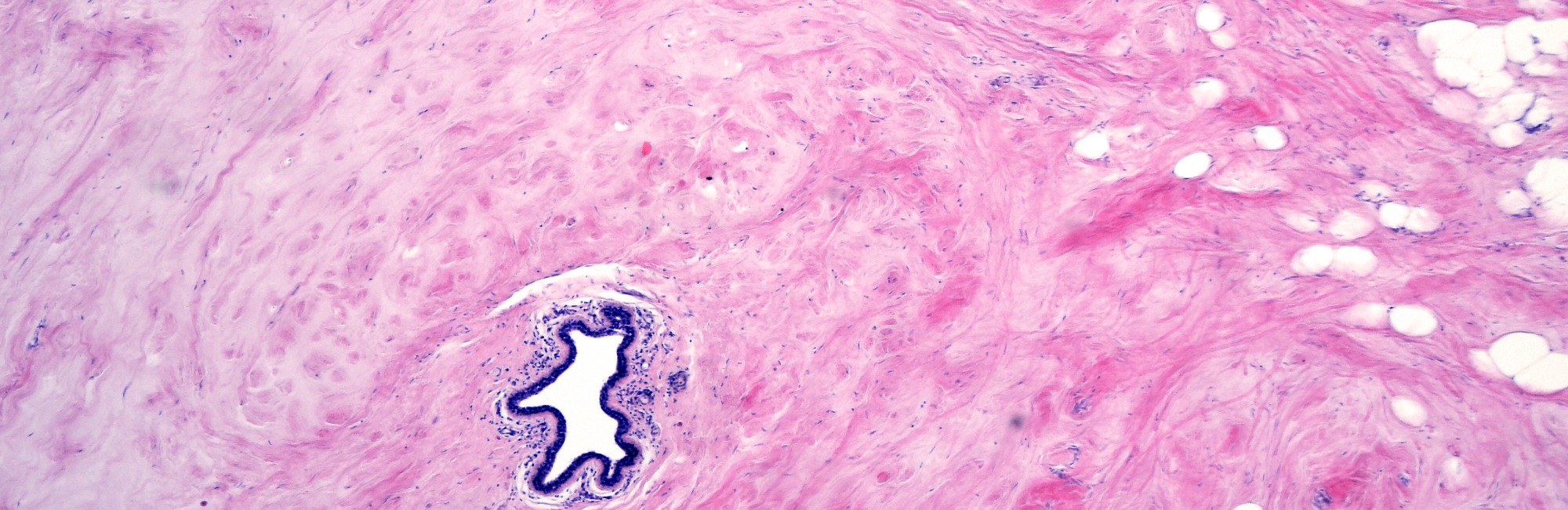
In the image of breast stroma at the top of this article, a single lactiferous duct is visible (bottom of the image to the right of centre), with adipocytes identifiable in the right quarter of the image.
Recommended resources
The breast stroma microbiome: composition and perturbations
Selected references
Colleluori G PJ, Barbatelli G, Cinti S. Mammary gland adipocytes in lactation cycle, obesity and breast cancer. Rev Endocr Metab Disord. 2021 Jun;22(2):241-255. doi: 10.1007/s11154-021-09633-5. Epub 2021 Mar 22. PMID: 33751362; PMCID: PMC8087566. Mammary gland adipocytes in lactation cycle, obesity and breast cancer. Review of Endocrine and Metabolic Disorders. 2021;22(2):241-255.
Fu NY, Nolan E, Lindeman GJ, Visvader JE. Stem Cells and the Differentiation Hierarchy in Mammary Gland Development. Physiol Rev. 2020 Apr 1;100(2):489-523. doi: 10.1152/physrev.00040.2018. Epub 2019 Sep 20. PMID: 31539305.
Maller O, Martinson H, Schedin P. Extracellular matrix composition reveals complex and dynamic stromal-epithelial interactions in the mammary gland. J Mammary Gland Biol Neoplasia. 2010 Sep;15(3):301-18. doi: 10.1007/s10911-010-9189-6. Epub 2010 Sep 2. PMID: 20811805.
Maller O, Drain AP, Barrett AS, Borgquist S, Ruffell B, Zakharevich I, Pham TT, Gruosso T, Kuasne H, Lakins JN, Acerbi I, Barnes JM, Nemkov T, Chauhan A, Gruenberg J, Nasir A, Bjarnadottir O, Werb Z, Kabos P, Chen YY, Hwang ES, Park M, Coussens LM, Nelson AC, Hansen KC, Weaver VM. Tumour-associated macrophages drive stromal cell-dependent collagen crosslinking and stiffening to promote breast cancer aggression. Nat Mater. 2021 Apr;20(4):548-559. doi: 10.1038/s41563-020-00849-5. Epub 2020 Nov 30. PMID: 33257795; PMCID: PMC8005404.
Mortazavi SN, Hassiotou F, Geddes DT, Hassanipour F. Mathematical modeling of mammary ducts in lactating human females. Journal of Biomechanical Engineering. 2015;137:071009-071001-071007.
Ramsay DT, Kent JC, Hartmann RL, Harmann PE. Anatomy of the lactating human breast redefined with ultrasound imaging. Journal of Anatomy. 2005;206:525-534.
Wellnitz O, Bruckmaier RM. Invited review: The role of the blood-milk barrier and its manipulation for the efficacy of the mammary immune response and milk production. Journal of Dairy Science. 2021;104:6376-6388.