
The mechanical effects of nipple + breast tissue drag on breastfeeding
Here is what happens when your baby is suckling at the breast but there is nipple and breast tissue drag.
-
Less breast tissue is drawn up into baby's mouth.
-
The vacuum increases inside baby's mouth as the jaw drops, because baby is trying to draw in more breast tissue, acting against the opposing force of the breast tissue drag.
-
The baby's tongue shape alters, because the tongue is moulding around or conforming to athe lesser amount of nipple and breast tissue inside the mouth. The tongue changes shape without changing volume.
-
Movement of baby's tongue alters (e.g. on ultrasound measures) because the surface of the tongue is responding to or conforming to the smaller amount of breast tissue in baby's mouth.
-
When baby's jaw comes up, the place where highest part of mid-tongue contacts the palate alters. When there is a lot of breast tissue in the mouth, the tongue contacts the palate further back.
-
There is less expansion of the breast tissue in baby's mouth, because there is less volume of breast tissue in the mouth.
-
There is more nipple slide between sucks (in towards the juntion of the hard and soft palate when the tongue drops and somewhat out towards baby's gums as the tongue comes back up).
-
The tip of nipple does not come as close to the junction of the hard and soft palate.
-
There is more compression of the milk ducts due to stretching forces.
-
There may be less milk transfer due to the compression of the ducts which occurs with breast tissue drag.
-
The stretching forces are focused on smaller surface area, which risks breaks in epidermis of nipple (in cracks or ulcers).
-
The stretching forces might bend or deform the nipple body itself, resulting in inflammation or micro-bleeding deep inside the stroma of the nipple.
These changes typically show up as nipple pain and damage (for you), or fussy behaviour at the breast (for your baby).
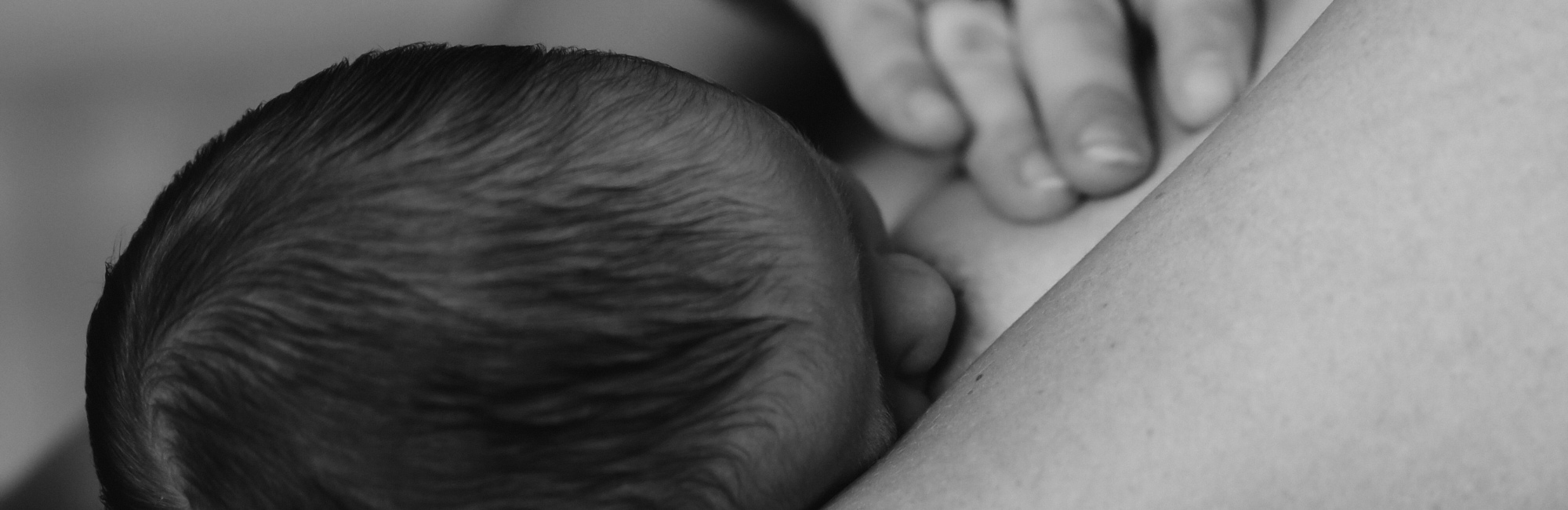
In the photo at the top of this page, the mother and baby might be experiencing the effects of nipple and breast tissue drag. The woman is pressing down on her breast. Perhaps her baby's nostrils are blocked off unless she does this? But if baby isn't able to breathe freely through the nostrils, fit and hold work including micromovements are required, since it's exhausting having to press on your breast all the way through a feed, and the pressure can also result in breast inflammation (blocked ducts or mastitis), or nipple pain). There are ways to position the little one so that he beathes freely, without needing to press or shape the breast tissue. Also, the baby's head is resting directly on the mother's upper arm, which means she doesn't have as much control over micromovements as she'd have if the baby was in the gestalt positon. You can find out about the gestalt method of fit and hold here.
Selected references
Douglas PS, Keogh R. Gestalt breastfeeding: helping mothers and infants optimise positional stability and intra-oral breast tissue volume for effective, pain-free milk transfer. Journal of Human Lactation. 2017;33(3):509–518.
Douglas PS, Geddes DB. Practice-based interpretation of ultrasound studies leads the way to less pharmaceutical and surgical intervention for breastfeeding babies and more effective clinical support. Midwifery. 2018;58:145–155.
Douglas PS, Perrella SL, Geddes DT. A brief gestalt intervention changes ultrasound measures of tongue movement during breastfeeding: case series. BMC Pregnancy and Childbirth. 2022;22(1):94. DOI: 10.1186/s12884-12021-04363-12887.
Mills N, Keough N, Geddes DT, Pransky S. Defining the anatomy of the neonatal lingual frenulum. Clinical Anatomy. 2019;32:824-835.
Mills N, Lydon A-M, Davies-Payne D, Keesing M, Mirjalili SA, Geddes DT. Imaging the breastfeeding swallow: pilot study utilizing real-time MRI. Laryngoscope Investigative Otolaryngology. 2020;5:572-579.
-fotor-2024062416850.jpg)