Working breasts are diverse on the outside

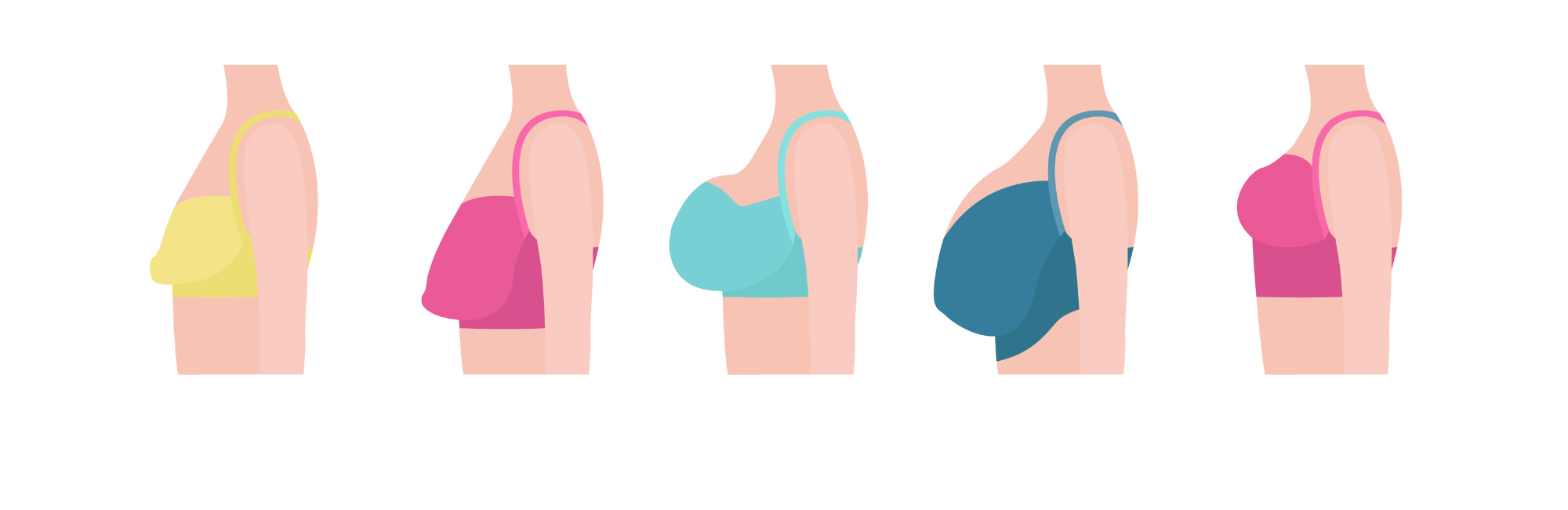
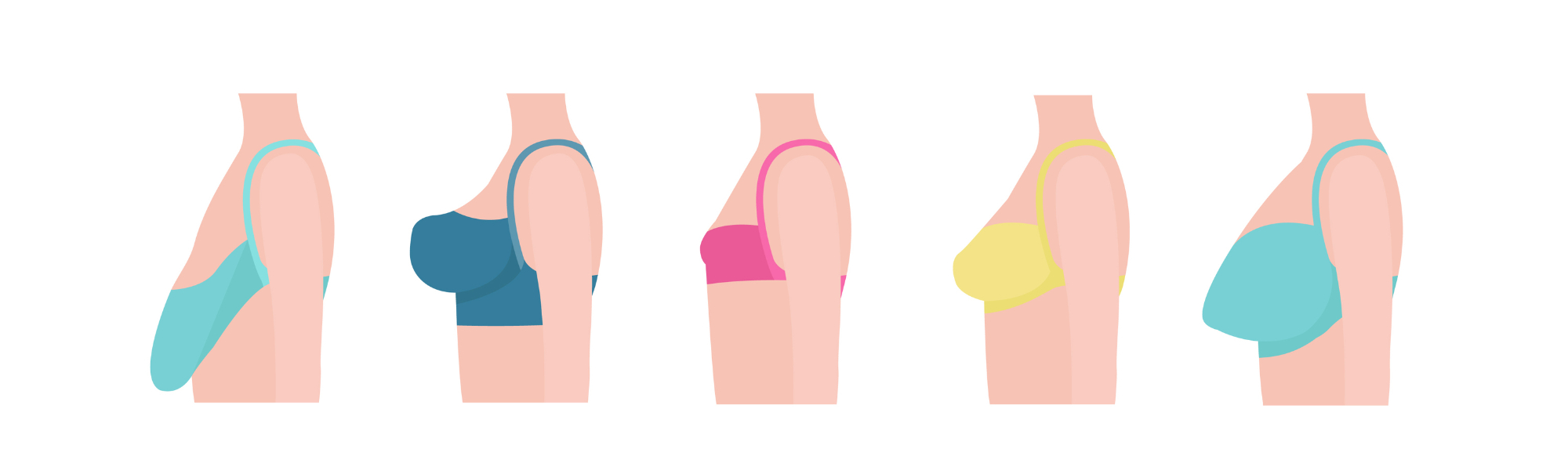
Normal is a highly diverse human condition
Women's breasts are amazingly variable in shape, size, and skin colour. Breast shape and size usually even differ between our own two breasts. Female nipples and areolas are highly variable in size, shape, and colour, too. This glorious human diversity is to be celebrated and enjoyed!
When we think about the anatomy of the lactating breast, one theme emerges over and over: that normal is a highly diverse human condition!
-
Averages aren't helpful as we try to make sense of breastfeeding (or of many other things, like baby sleep needs). Only a very small proportion of us are at the midpoint in any spread of normal anatomic measurements. Most of us are somewhere else along the long rise and fall of the 'bell curve' of normal distribution rather than in the middle!
-
Often, too, when there is data available about normal mother and infant biology, it comes from studies conducted in high income Western countries, who are just one cultural subset of humans. I look forward to the day when we have much more data about functional anatomy in lactation from the diverse cultural groups of the global majority.
In the meantime, we can say with certainty that normal is a highly diverse condition in breastfeeding mothers and babies. From an evolutionary perspective, breastfeeding has ensured the survival of Homo sapiens spp for 300,000 years regardless of the female human's diverse anatomic variations, down the millenia and across cultures.
The amount of milk held by a lactating breast varies between women
The amount of milk available to your baby when your breast is full depends on
-
Your innate glandular tissue volume, which differs from woman to woman (but is not dependent on the size of your breast)
-
Where you are at in your breastfeeding journey (breast milk volumes over a 24 hour period are less in the first two weeks than they are over the rest of the first six months in exclusively breastfeeding women, for example)
-
The breastfeeding pattern that you and your baby have developed
-
And even which breast your baby is feeding from.
What matters is how much milk your baby receives over a 24-hour period, rather than how much milk baby receives in any single breastfeed.
The texture of your breast tissue varies over the day, over the course of your breastfeeding journey, and between women
-
Working breasts - breasts which are making milk - often feel quite lumpy. These lumps fluctuate with feeds, and should be left alone (not massaged in any way). You need to have any lump that lasts for longer than a week checked out by your doctor.
-
Your lactating breasts may feel firm when you touch them, or they might feel soft and elastic with lots of give, or they might have a texture that is anything in between. Some women's breasts are innately very firm, other women have much softer or more elastic breast tissue, regardless of whether they are lactating or not. Again, the elasticity of our breast stroma is highly variable.
-
Usually, the tightness or fullness of your breasts will change throughout the day and night, depending on your baby's breastfeeding patterns.
-
Also, after breastfeeding is established, it's common not to feel much fullness or tightness at all, because your breasts are calibrated to meet your baby's needs.
It's important to have your doctor check out any lump which persists more than a week. Your doctor will organise ultrasound imaging to make sure the lump is not something to worry about. Unfortunately, malignancy in a lactating breast can spread very rapidly if it isn't detected early.
The elasticity of your breasts increases over time
The skin of the breast, the ligaments inside the breast, and the milk ducts all do stretch downwards over time in response to
-
Changes in breast volume (e.g. with pregnancy and lactation)
-
Increasing age.
Is this stretching in response to the constant effects of gravity over time? That would make sense, even though from the perspective of research, this has not been definitively clarified. It does seem clear though that bras don't prevent this stretching down of our breasts, despite what you might have heard!
This change in the elasticity of our breasts is one reason why a certain approach to fit and hold may have seemed to work quite well with one child, but causes all sorts of problems with the next baby.
Recommended resources
You might be interested in a book by Laura Dodsworth called Bare Reality: 100 women, their breasts, their stories, which honours the radical diversity of the appearance - size, shape, colour - of women's breasts.
The size of your breasts doesn't predict how much milk you'll make
What's useful to notice in the mirror before you bring baby on to your breast?
The size of your breasts doesn't predict how much milk you'll make
The connective tissue inside your breast (known as stroma)
Your breasts' glandular tissue
How much breast milk does your baby need to thrive?
What's useful to notice in the mirror about your working breasts before you bring baby on?
It helps to notice your breast-belly contour (illustrated by breast-belly contour S for Sally)
Where does your nipple look? Here's what you need to know about each of the four main directions
The shape of women's breasts and nipple-areolar complexes comprise a glorious spectrum of anatomic trait variation. Do certain maternal anatomic variations cause breastfeeding difficulties?
How do you know if you have Insufficient Glandular Tissue?
Anatomic factors which interact to affect how your baby sucks at the breast: an overview
Selected references
Geddes DB. The anatomy of the lactating breast: latest research and clinical implications. Infant. 2007;3(2):59-61
Jin X, Lai CT, Perrella SL. Maternal breast growth and body mass index are associated with low milk production in women. Nutrients. 2024;16(2854):https://doi.org/10.3390/nu16172854.
Ramsay DT, Kent JC, Hartmann RL, Harmann PE. Anatomy of the lactating human breast redefined with ultrasound imaging. Journal of Anatomy. 2005;206:525-534
Deferm N, Dinh J, Pansari A, Jamei M, Abduljalil K. Postpartum changes in maternal physiology and milk composition: a comprehensive database for developing lactation physiologically-based pharmacokinetic models. Front Pharmacol. 2025 Feb 3;16:1517069. doi: 10.3389/fphar.2025.1517069. PMID: 39963246; PMCID: PMC11830814.