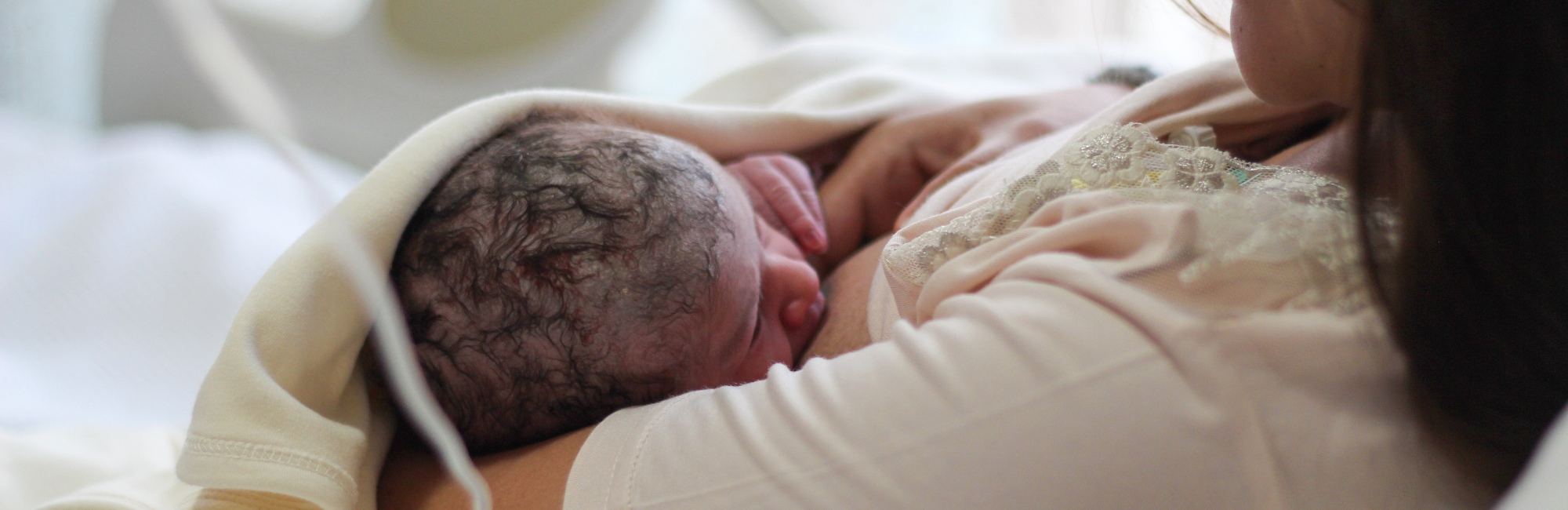
Day 1. Sina asks for help to prevent nipple pain from the first hours of her secondborn baby's life but things don't go to plan: colostrum, breast elasticity, early nipple shield use

Disclaimer: the case below is an amalgam of multiple cases that have presented to me, and is not derived from any specific or identifiable mother-baby pair who have seen me as patients. Needless to say, all names are fictional.
Leilani is born
This tiny human is only eight hours old when I first meet her. Her name is Leilani. She's is a beautiful 3100 gram bundle, with flushed skin and rosebud mouth who waves her skinny little limbs like a sea anemone when she gazes into her father's smiling eyes. A small bruise blossoms on her right cheek from the forceps that were used to draw her out of the incision in her mother’s womb, during a scheduled caesarean section earlier in the day.
Sina hopes for a better experience this time because breastfeeding hadn't gone well with her firstborn
Sina asked if I would visit her in hospital immediately after Leilani’s birth, because of the terrible breastfeeding difficulties she'd endured with her eldest. Memories of the first days after Akuma’s birth still haunt her: midwives coming and going, each advising a different approach to fit and hold, a cascade of worsening nipple pain and damage from the first hours after the birth.
By Akuma’s third day of life, Sina’s nipples were bleeding and ulcerated, “with bits of flesh missing”, she recalls. Midwives and lactation consultants squeezed her breasts, pushing the screaming baby on. Others insisted that laid back breastfeeding was the answer. But no matter what she tried, Akuma wouldn’t take the breast. Sina mostly fed him her expressed breastmilk for the next six months.
Little Leilani had taken her mother’s breast during skin-to-skin time immediately after her birth earlier in the day, and it hadn’t hurt. But later, still in the recovery suite, a midwife squeezed Sina's breast and pushed the baby on.
“I knew it wasn’t right,” Sina says, “I knew you’d disapprove …!”
“Luckily, babies are remarkably resilient,” I laugh, “and mostly it’s about patterns over time rather than any particular incident…” It seems to me that focussing on Leilani’s resilience is what matters right now, though I immediately think of the many families I've seen who trace their baby’s conditioned dialling up at the breast to one particular moment of well-meaning but distressing force, applied by a health professional who was trying to help get the baby on the breast.
Sina’s husband JJ stands on the other side of her hospital bed. He's a tall muscular man of Pacific Islander heritage with densely detailed tattoos. He says encouragingly: “I told Sina: just don’t react, be polite. Then just do it your own way.”
Sina has some difficulty exposing a ten centimetre landing pad for her baby's face-breast bury
“The problem is that I haven’t got a landing pad,” Sina explains. She’s been looking at the gestalt method. I'm a little concerned, since to my mind every woman can create a landing pad with her breast, once she knows how, and Sina's been so determined to breastfeed this next baby that she's been preparing. With her permission, I take a look at her breasts and how they fall in response to gravity.
It’s true that what I would call Sina's landing pad, that area about five centimetres in radius all the way around the nipple, where the baby’s face needs to bury deeply to feed, is partly hidden even though she is lying back semi-reclined on the hospital pillows. Her breasts and areola, particularly on the left, rest on her tummy, which remains full and soft and round.
Sina's breasts could not be labelled either petite nor generous, but we'll need to be mindful of her landing pad challenge. Also, the face of her right nipple sits only a few millimetres higher than the surrounding areola right now. This is, presumably, why the midwives had tried squeezing her breast, to make the nipple more prominent. But that strategy often backfires, as it has with Sina.
Leilani has been quite dialled down in the brief hours since she came into this world, sleeping but also alert and engaged for periods of time.
Sina brings the baby between her exposed breasts, vertically in what has been called the laid back position, and when her little one starts to bob and search with her mouth for the nipple, Sina helps her. Once Leilani falls down onto the cushioning ledge of mother’s lovely round tummy, Sina gradually moves the baby’s bottom and legs horizontally across her own ribcage. Then Leilani’s little mouth bobs against the breast and nipple, but she becomes increasingly frustrated, arching back.
With permission, I lift up Sina’s left breast to get the best possible ribcage wrap by tucking Leilani underneath it, and suggest that we bury Leilani’s face into the upper part of Sina’s right breast so that she can bob and find her way down. Sina experiments patiently, though the baby is less patient and is starting to dial up.
Sina's breast tissue is at the high end of the spectrum of elasticity
I notice that Sina’s breasts are elastic, and tend to fall out to the side. Sina tries to support her breast with her upper arm, but then Leilani’s forehead presses into her mother’s upper arm, which makes it difficult to control how Leilani comes onto the breast. You can see a photo of a fit and hold like this at the bottom of the page.
We try a small rolled up cloth, tucked up tightly under Sina’s feeding breast, snug against her ribcage. (You can find out how we did this here.) The tight ribcage wrap under her left breast helps biomechanically, and Sina creates a gap between her baby’s forehead and her own upper arm. Although there is some dialling up from the baby, Sina continues to experiment with slow and mindful micromovements. I notice that she takes a big deep breath occasionally, calming herself. Soon, Leilani is on and suckling.
Sina has JJ help her experiment with her semi-reclined position. He patiently raises and lowers the upper part of the electric bed in response to her instructions. They find about 75 degree elevation, into a semi-upright sitting position, works best.
“Gravity really helps,” Sina observes. By that she means, being semi-reclined really helps the baby fall deeply into her body and she doesn't have to carry any weight. There's no pain as Leilani suckles. Sina is concentrating on tiny little micromovements in response to the tiniest change in sensation or Leilani's behaviours.
In a while, I leave. The first hours after a baby’s birth are a precious time for a family, and as much privacy as possible is important.
But for a woman whose nipples are already being damaged from the first experience of suckling (and who might already have been subjected to the major surgery of a caesarian section), this precious time can be quickly marred by pain and distress. One day, I am certain, skilful prevention of nipple pain and damage after a woman has given birth will be a health system priority.
Is it ok to use nipple shields before a woman's milk has come in?
Sina phones me later that night. An evening feed caused her quite a lot of pain, both sides, and she is increasingly worrying that it will be like last time. With her husband’s help, I make sure she has access to two nipple shields, a size 24 and a size 28, to experiment between the two. I'm concerned to make sure she doesn't develop a crack or ulcer.
But she calls me back a little later. A midwife has told her that she can’t use nipple shields until her milk has come in.
“Is that true?” Sina asks.
“It is true that nipple shields are over-used in our maternity hospitals, when underlying fit and hold problems haven't been addressed,” I explain. “But if a woman, despite her best efforts, has worsening nipple pain in a situation like yours, with a history of serious breastfeeding problems after the birth of your first child, I believe we need to try to avoid that trajectory the next time. We don’t want nipple damage to worsen. My perspective on this is that you can definitely use the shield while you and Leilani continue to practice getting the fit and hold right, if you'd like to!”
Focussing too much on colostrum can undermine breastfeeding success overall
I know that the midwives have been taught that the colostrum is thick and sticky and won’t pass through a nipple shield. But colostrum passes through the holes in the nipple shield in the same way it passes through the ducts: slowly and in tiny quantities, drawn through the holes by the vacuum in the baby’s mouth. Perhaps the midwives feel more confident helping a woman hand express colostrum and syringe feed, so that they're sure the woman has got that highly protective colostrum into the baby! But often that's unnecessary.
There will be some or even a lot of residue left inside the nipple shield (which could still be scooped up by a syringe or even a cleaned finger and fed to the baby), and there may be less colostrum passing through the shield into the baby’s mouth. But a newborn suckles for sensory closeness as much as for nutrition. This very frequent suckling is important for long-term establishment of supply. We want to protect the breastfeeding ecosystem as best we can, right from the beginning, to ensure the mother is pain-free.
Protecting the stability of breastfeeding overall, for the coming days and weeks into the future requires urgently protecting a woman's nipple from damage in the context of frequent and flexible suckling from the first day. This protection is more important than achieving a specific dose of colostrum in the first three days. Protecting breastfeeding overall provides by far the best possible protection of the baby’s gut and immune system.
“Colostrum is on a spectrum of milk that is gradually, from birth, becoming less concentrated as you move into transitional milk. To my mind it doesn't help to be too focussed on getting in the initial colostrum by breastfeeding without a shield, and then accidentally making it much more difficult for you to transfer later colostrum or transitional milk into your baby. And anyway, volumes of colostrum vary tremendously between mother-baby pairs,” I say.
I believe we have to think about colostrum in a more nuanced way – it doesn't make sense to try to get as much colostrum in as possible in the first three days, without paying proper attention to the many other crucial factors which contribute to the overall success of breastfeeding.
In the photo below, the little one is likely to be causing nipple and breast tissue drag. If the mother has no unpleasant or painful sensations at all in her nipple or breast, we don't need to interfere. But at the first unpleasant feeling, I would hope that this woman experiments with bringing the little face of her precious newborn into a deep face-breast bury, so that baby's upper lip isn't visible. The woman can also experiment with micromovements so that she has control over how her little one comes on to the breast, getting rid of breast tissue drag. This goes best if the baby's head is resting on her forearm, not tucked up in the crook of the mother's arm with baby's head resting on her upper arm.
You can find out about the gestalt method, starting here.