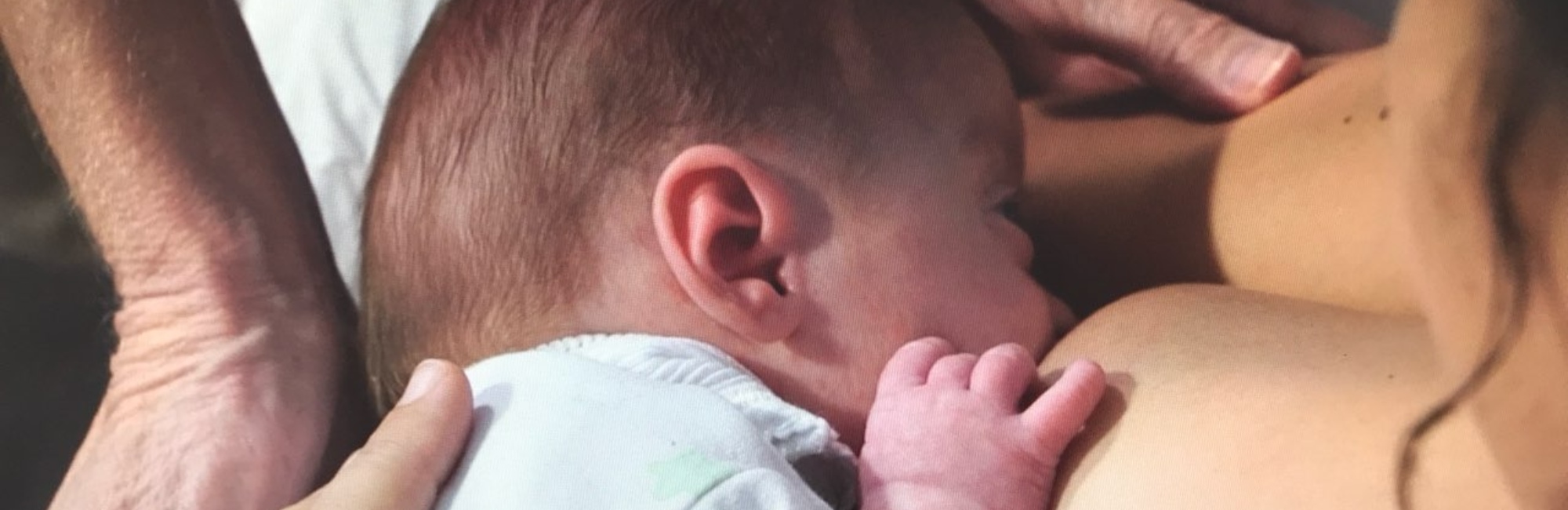
Day 2. Sina continues to experiment as she breastfeeds her newborn: the gestalt method, musculoskeletal pain, more about nipple shields

Disclaimer: the case below is an amalgam of multiple cases that have presented to me, and is not derived from any specific or identifiable mother-baby pair who have seen me as patients. Needless to say, all names are fictional.
We work on fit and hold together
When I come back in the morning, Sina is in good spirits, if tired. She tells me the night had its challenges. She’s done a lot of experimenting. She has wedging of the nipples when the baby comes off after feeds. In the end, she hadn’t felt she needed the nipple shield, dissuaded I think by the midwives. She’d also found the cloth under the breast a nuisance. It seemed to get in the way of the baby’s arm, which was resting under the breast and a little around her side.
Sina was particularly worried because after that painful feed the previous night, she’d had a deep stabbing pain that seemed to go right through to her right shoulder-blade. There was a small line of excoriated epithelial damage on the face of her nipple, without a visible crack, but this report of pain radiating into the shoulder-blade made me suspicious that it was musculoskeletal. Firstly, though, I needed to help with the breastfeeding.
“It’s crazy,” Sina says, “but if I hold my breast like this “ – she shows me what she has been doing, supporting the breast in from the side with one of her hands – “Leilani seems to be able to come on. Then I let go once she is suckling.”
“That’s fantastic!” I say. “Experimenting and finding out what works is exactly what you need! You know, lots of women find they need to shape the breast a little, to bring the baby on. The main thing is to understand that as soon as you let go, and gravity acts on the breast, you are likely to have nipple drag. Try to minimise how much you lift or change the fall of the breast, but do what seems to work. Then as soon as you move your hand away from your breast, use micromovements to get rid of any breast tissue drag.”
Leilani comes onto the right breast easily. As she feeds, Sina reports pain that she rates as level of two on the painscale of zero to ten, with ten the most severe pain possible. With her permission, I place my hands under her forearm, and ask her to let me take the weight. Together we let the baby’s head drop millimetre by millimetre, lower and lower, to the level where her breast and nipple naturally fall. At the same time, I help change the angle of Leilani’s breast-face bury, easing Sina’s forearm just that little bit further towards the back of the baby’s head, so that she can both let baby fall lower, at the same time as she uses angle control to maintain a symmetrical face-breast bury. Not that she can see this, she is operating by feel, with my help.
“That’s better, maybe a one,” she observes. Because she’s been using her left hand to hold the right breast in from the side, it is important to experiment with micromovements horizontally too. When the baby comes off, I see the nipple fall both downwards and a little towards the midline. Ah! Ongoing breast tissue drag!
But in a while as we work together, Sina’s pain is down to zero.
Sina tries side-lying and the baby seems to like it. But the mattress on the narrow hospital bed sags in to the centre, so that the baby’s face is turned to look downwards a little, rolled in towards Sina. This wouldn’t be safe for sleep at night, and would also cause breast tissue drag. What a shame that maternity hospitals don’t have firm wide mattresses, suitable for side-lying breastfeeding! What a shame that maternity hospitals don’t prioritise wide breastfeeding friendly couches, two-seaters, so that chair arms aren’t going to interfere with a tight ribcage wrap, or the baby’s feet, or a woman’s need to move her arm and elbow with micromovements!
Even the three-inch plastic clip which clamps the umbilical cord worries me, because it interferes with the baby’s capacity to move on her tummy across her mother’s body. Newborns are little prone-feeding mammals. The cord clamp must scratch and hurt! I ask myself why cord clamps haven't been designed with that elemental process, breastfeeding, in mind? Surely if we can send robots to Mars, we can design a device that works similarly but which does not have sharp edges and prominences when a baby is flat on his tummy against his mother’s body?
I see Leilani’s little tongue extend well over her lower lip, and there is no prominent frenulum. In this situation, many lactation consultants would be recommending bodywork therapy straight away, given the use of forceps and the caesarean birth. But fitting into her mother’s body is the only bodywork this baby requires.
“I wish I didn’t have a fat tummy that gets in the way,” Sina says.
“But you have a lovely normal post-birth tummy”! I say laughingly, and she smiles wryly. “But because it is normal to have a round tummy with a little soft ledge, the ribcage wrap works very well for newborns once a woman lies back semi-reclined ….”
Sina has musculoskeletal pain so we discuss how to repair and prevent this
“Now, let’s deal with that radiating pain you described last night,” I say. With Sina’s consent, I began to feel the muscles of her back, around her shoulder blade.
“Oh, that’s it!” she says suddenly. “In there! It feels like a knot!”
When I press firmly on that sensitive place of muscle tension she confirms that the same deep pain, which had been radiating into her chest, is triggered. We practice relaxing her shoulder, by supporting her elbow onto a bundle of folded towels while she's feeding. We place the towels under her elbow at exactly the same height which had resulted in zero out of ten pain, and once the elbow is supported she consciously relaxes her shoulder. Soon, Sina is taking deep breaths, relaxing and opening back her shoulders.
Her husband JJ has been sitting quietly in a corner of the room, watching, sometimes texting on his mobile phone. There have been a lot of texts coming in from friends and family, with congratulations for the arrival of their little daughter. He comes over eagerly when I suggest he could do some trigger-point treatments on the tender area next to Sina's shoulder blade, pressing in with his thumb as deeply as she finds helpful, waiting until she says the pain has passed before releasing. Then they search for a similar tender spot in a nearby area.
“That’s so good…!” she murmurs, encouragingly.
Women often hunch their shoulders in and bend forward, in a protective and nurturing position around their baby, but this can create muscular pain. It can also make it more difficult for the baby to settle onto the landing pad of the breast. Relaxing back into the deck-chair position, opening back her shoulders, letting the shoulders fall down instead of held up high and tight makes a big difference. It’s important to support her elbow at the same time as she uses her forearm to support baby’s head and experiment with micromovements. Conscious muscle relaxation with deep breathing, making sure that the woman’s upper body is not bending off to the side but is vertically upright, though semi-reclined: these steps protect a breastfeeding woman from musculoskeletal pain.
I discuss with Sina how to use a nipple shield if she needs to
After a while I help Sina sit back up again. Then I fit the shield, and confirm that Sina could continue to experiment between the size 24 and 28. I explain that she could moisten the shield first with some water, later on with some milk, if she wishes, though there is no need to try to put milk in the shield.
She doesn’t need to invert the shield and try to draw up nipple into it before she feeds, the way she'd heard. The baby will draw up lots of breast tissue into the shield once suckling is underway. Sina needs only place the hat of the shield over nipple, with the nipple more or less centred underneath it, and the cut out piece in the shield’s brim under where Leilani’s nose will be. It doesn't matter if the wings of the shield fold up against the baby's face, which often happens.
I pinch the end of the shield to show Sina that we don’t want the shield collapsing in. That will stop the milk flowing through the holes, and we make sure this doesn’t happen by applying micromovements as the baby suckles so that the shield fills with as much nipple and breast tissue as possible, avoiding any pinching or folding in of the silicone.