Days 10 - 29. Sina asks for more help as she repairs her nipple pain and damage and transitions back to exclusively breastfeeding: the gestalt method, again, and lots else besides
Disclaimer: the case below is an amalgam of multiple cases that have presented to me, and is not derived from any specific or identifiable mother-baby pair who have seen me as patients. Needless to say, all names are fictional.
We meet again on the tenth day of Leilani’s life
I spend an hour and a half with Sina in her and JJ's brick home on the southside of the city. Jacaranda trees are in bloom in the front yard. Their living room has the lived-in look of any household with a three-year-old and a baby. A toy kitchen cupboard and stove, brightly coloured plastic bowels and crockery, and plastic tubs of duplo and other toys are at small child height. Everything else has been placed safely on the benches. Akuma is out with his father at an orchestral performance for children.
Sina greets me with Leilani snuggled in against her in a soft mauve wrap. It’s the first time she’s used it, she says. “I’m not sure I’ve got it right”. But the baby is happily asleep, snuggled up and safely vertical.
“Looks fine to me,” I say casually. It takes women time to get the hang of the wrapping! Many find the sewn newborn wraps, which hold the baby vertically, less complicated, but whatever works for any parent is perfect (as long as parents know about how to baby carry safely. You can find out about this here.)
“Before you know it, she’ll be in a structured or buckled carrier, anyway,” I say.
“I’ve got a different structured carrier this time,” she says. “I could never make the one I had for Akuma work. And then it started to hurt my back.”
“As long as it takes the weight on your hips, so that your back and shoulders aren’t strained”, I muse.
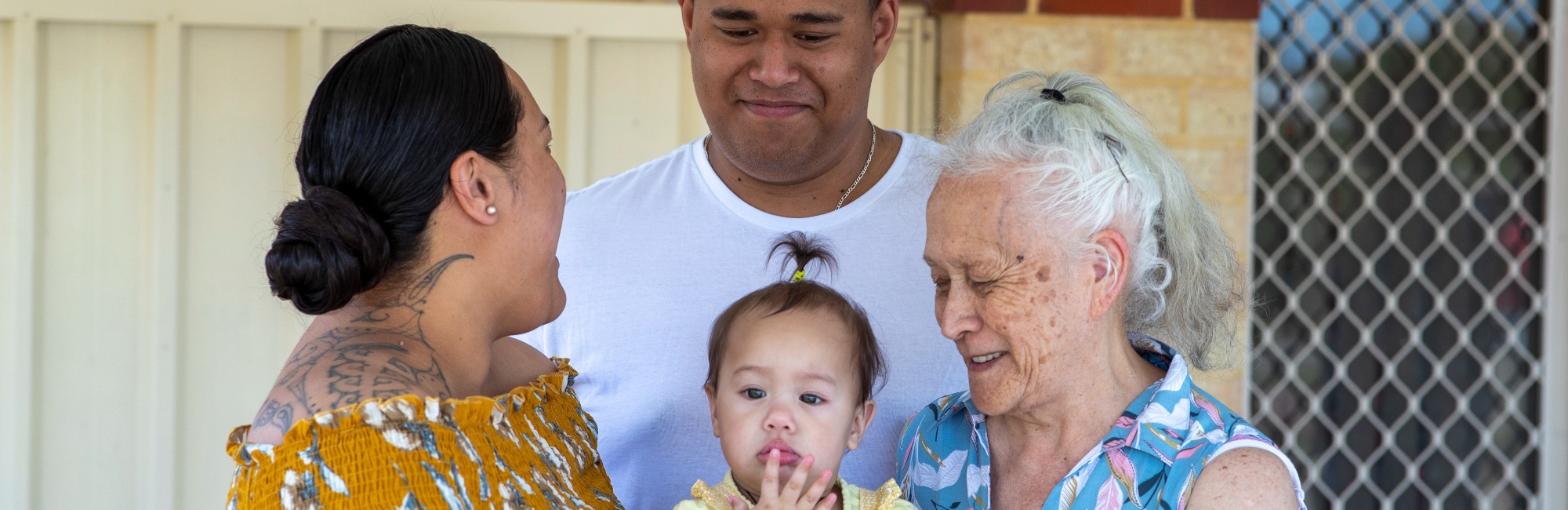
Sina settles cautiously in a spacious armchair, baby still snuggled up in the wrap, and we start to talk. Her mother hovers, offering cups of tea.
“Leilani mightn’t feed now that you’re here,” Sina says.
“That’s no problem,” I explain, “because we can talk through all the useful things anyway, regardless of what the baby wants to do.”
"You have a very beautiful granddaughter!" I say to Sina's mother and she beams.
"A very beautiful daughter, very hardworking, a very good mum!" Sina's mother says, and we smile together.
"I know, she's wonderful," I say. Then the white haired woman quietly slips out of the room.
Sina tells me what’s been happening.
Sina and JJ had commenced some formula supplementation on day four
Late on day four, a midwife said that they needed to start formula.
“I cried for about twelve hours,” Sina says. “My husband was so good. He said: you don’t want to go through what you went through with Akuma again, so it’s ok, we can use formula.”
Sina’s nipples had developed ulcers. Healing that kind of damage as quickly as possible is, I believe, the best way forward. Pumping, which is repetitive and frequent application of a vacuum even at low levels and for short periods, typically delays healing, even when the flanges are applied in a way that makes sure there is no nipple and breast tissue drag in a direction different to the pump vacuum.
“When the midwife told me that, I felt a grief as if I was being separated from her," Sina says. "There was the cut to the umbilical cord, and now the use of formula. But my husband kept reminding me of the exhaustion and how miserable it was always trying, trying, trying so hard last time, and the pain each time I tried, and after about twelve hours of crying I was alright, I stopped crying.” As she tells me this, her eyes fill with tears, again.
“Oh don’t mind me,” she says in a while, “I’m just a crier.”
“I think you’ve made all the right decisions,” I say. And this is true – there is no right or wrong in this situation, just what works for the family (and keeps the baby safe.) “What’s important now is that you can experiment with breastfeeding in a way that is without pain, and with no sense of pressure.”
I ask the usual questions. Leilani is passing three or four palmfuls of stool in a 24 hour period, much more than five heavy wet nappies. By day three her weight had fallen to 11% of her birth weight, and then in the day after that – once formula had been introduced – Leilani had gained 90 gm. She hasn’t been weighed since then.
“But she feels heavier,” Sina comments.
“Yes, that’s good to know.” And Leilani's throughput (urine, poo) continues to be excellent. I check her over - she's still a content little thing, settled almost all of the time. Her slight jaundice is gradually disappearing, too.
“The midwife said she needed to gain 150 gm/week but I was thinking, no, 300gm/week.”
“Well, I always say about 200-250 gm/week – but the main thing is that she is settled, with good throughput. If a baby is only gaining 150 gm/week but everything is going very well otherwise, with good throughput and a dialled down bub, then that’s fine. Most babies are happiest with more weight gain than that in the first month or two. How often have you tried her at the breast?”
“I put her on once four days ago, but there was still a scab on the left. I used a shield and it hurt at first but then settled. But when I took her off the scab had gone and the shield was full of blood! It looked horrific! So I tried too early. I gave it another couple of days.”
“Well, it doesn’t hurt her to swallow blood,” I comment. “She would have been fine, it’s just you I worry about.” Sometimes baby’s posset up milk after a damaged nipple has bled, and the vomit has blood in it. Although consistent blood in the vomit needs a GP’s assessment, it’s commonly due to nipple damage and bleeding during breastfeeds.
“Then I tried again two days ago. It hurt at first then settled and didn’t hurt much. And even twice yesterday.”
I ask her to tell me what she’d been doing, what seemed to work. She said she knew she was doing it "wrong" but it seemed to work.
“Nothing is wrong,” I explain. “Lots of women do still find they need to shape the breast in some way – the main thing is knowing how that increases the risk of breast tissue drag, and then using micromovements as soon as you take your hand away.”
If Sina wanted to feed on the right, she’d hold the baby with her right forearm, and use her left hand on the outer part of her breast, to draw the breast closer to the midline, which is where Leilani seemed to be able to attach. But Sina then had to hold the breast there the whole time. As soon as she let go, the nipple hurt a lot. But if she held it there, after a while the feed wasn’t hurting.
“Bad wedging though when she comes off.” She isn't using a nipple shield.
Sina feels that her nipples are too flat for a nipple shield
“The shield leaves this big gap between the nipple and it’s top,” she says. “I think it’s too big. My nipples are flat.”
“To me, your nipples aren't particularly flat,” I say cautiously. "They are a few millimetres higher than the surrounding breast tissue, the right more so than the left – very normal. It doesn’t matter that there is a gap between the nipple and the top of the shield. The main thing is that there is enough room for the nipple to expand. A shield that is too small has the nipples press up against the wall once the baby is suckling and drawing it up, and that means that the ducts can’t open and expand as we need.”
We talk about normal nipples. I explain that some women have a nipple four millimetre wide, others more than three centimetres wide at the base, and all are normal.
When I say this to women, I always think of a lovely woman who saw me many years ago with her second baby when the little one was six weeks old, a second child, and she’d had low supply and similar weight concerns with her first baby. She’d always used a nipple shield with the first due to pain. When she saw me, I noticed after she’d had the baby on how the shield was completely filled with the nipple, the nipple walls up snug and adhering to the sides of the shield. She thought this was normal but I believed that part of the problem was that this interfered with her being able to draw up enough nipple and breast tissue, because it compressed the ducts so that they couldn't expand and transfer as much milk as the baby needed, which then also dialled down her supply.
But this lady – perhaps because she’d been told by so many people that this was right, that the size was right, that the problem was innate undersupply not all those other factors that cause undersupply – simply didn’t believe me. She flatly refused my efforts to suggest she needed to try a bigger size shield. I have often thought how I might have handled that consultation differently, to better help her. I've often reflected on what I might have said to lean in and make her feel better heard, or to offer her an explanation that made better sense to her. She didn’t ever come back.
I explain further. “See, we're not just drawing up the nipple, we want to get as much breast tissue up into the shield as we possibly can. The only things we don’t want are the shield folding over or squashing in, so that the milk can’t flow through the holes, and we certainly don’t want the nipple and breast tissue pulling up high against the holes. That gives us ‘leggo’ nipples, which is very bad, causes much more damage and pain.” We both grimace at the thought.
“It’s something to experiment with,” I say. “Only you will know, and it might be that sometimes you use a shield, sometimes you don’t, depending on how your nipples are feeling. It’s true that babies get used to shields, but it could help keep you breastfeeding overall. And when I think about what happened with Akuma last time, and now this early bout of damage, I’ve been inclined to think it’s worth using them from now, at least some of the time.”
We discuss how some women had a perfectly successful breastfeeding relationship and used shields the whole time. Sina knows someone who’d always fed with shields and was still breastfeeding now that the baby had become a toddler.
“Tuck it in your bra when you go out, whip it on. You don't even worry about moistening it, if you don't want to.”
We work again on fit and hold, using a facecloth roll, her bra, and a nipple shield
“Will things get easier as her mouth grows? I worry about that wedging.”
“Oh it’s true, it gets easier and easier as her mouth grows,” I explain. “You see, you have a few little challenges all coming together. There are so many factors that affect how a mother and baby fit together. And if we have enough factors interacting together, problems like pain and damage can emerge. Women’s breast tissue elasticity is highly variable, and your breasts are perfectly lovely and normal but more elastic.”
“They fall right out to the side,” she observes.
“Many women’s breasts are exactly the same,” I explain, “but it does pose certain little challenges, which we can address with the strategies you and I are talking about.”
She nods.
“And then some of us have landing pad challenges too,” I continue. Sina says that she didn’t continue to use the cloth, she found it too awkward. She felt it was getting in between her and the baby. In my mind I’m thinking that means that it wasn’t being used in the best way, but I don’t say anything.
“I’d also been wondering,” I do go on to say, “if we shouldn’t try an old-fashioned nursing bra to support your breasts, to help hold them in from the side. For a lot of women, those bras might bring the nipples too much to the midline and interfere with the landing pad, but it could be something to experiment with in your particular situation.”
“That’s interesting!” Sina exclaims. “For some reason I had to wear a dress yesterday with a bra, I can’t remember why. Maybe we had a visitor. But I put on one of the singlet bras. And the breastfeeding seemed to go better. That was when we had our second feed. But I just pulled the straps down over my upper arms.”
Leilani begins to wake, and we decide to have a go with the breastfeeding. Sina puts on her singlet bra. I show her how to roll the flaps inwards very tightly, and then tuck the roll high up under her breast, where it meets the ribcage. I feel this still doesn't expose enough of the landing pad of her breast above her tummy, so we also use a rolled-up facecloth, which she has ready with two bands holding it in place. The roll is about 5 inches long, and 1.5 inches wide. We tuck it up very high and firm, on top of the roll of her bra. We look together at how it sits under her breast but is not protruding forwards towards her midline, where it could interfere with Leilani coming in close. The roll also doesn't stick out to the side, where it might interfere with baby’s arm and shoulder snuggling around Sina's side. Sina can see that we now have a good landing pad, and that the cloth roll won't get in the way of Leilani coming in close.
Sina has the strap of her bra pulled down over her upper arm, and although this will not work for all women, that strap actually supports her breast enough to protect the breast from falling right out to the side. Importantly though, we can do it in a way that means the strap isn't cutting into the landing pad, interfering with the baby’s capacity to achieve a good deep face-breast bury.
We notice together how, in this situation where we have a good landing pad exposed, that her nipple still looks out to the side at an angle of about 45 degrees from her midline. “Very normal,” I comment. But Sina is amazed. “I hadn’t realised how much the nipple pointed off to the side.”
“Well, I wonder if this explains why it hurts every time you let go of your breast – maybe there's breast tissue drag the moment you stop holding your breast in. What do you think?”
“But it was completely unsustainable, holding my breast like that”, she says. I nod.
We put the shield on.
“Do I have to wet it?” she asks.
“No,” I explain, “moisture might help it stick better but what matters is that this is as easy for you both as possible.”
We simply place the shield over the nipple. I show her how you could stretch it a bit as you put it on, that maybe that helps it stay on a bit, probably doesn’t - really, we can be very relaxed about it.
The first time, I help her bring the baby onto the right breast by lightly holding the shield in place while she got organised with the baby’s head on her forearm.
“This is the only part that’s different when you’re using a shield. If you didn’t have the shield you could place her face into the upper half of your breast above the nipple, and let her reflexes turn on.”
“Mouth over nipple, that’s all we need to worry about,” I say. I notice how Sina brings Leilani on, and how as she buries the baby in, she accidentally drags the breast up higher than where it wants to fall in response to gravity. We also bring Leilani further towards Sina’s right upper arm (not allowing the forehead to press into the upper arm though) with horizontal micromovments, because that's the direction Sina's right nipple naturally looks.
Sina has the baby's head low on her wrist, and I suggest that we move baby up onto the softer flesh of Sina's forearm (again, with a gap between forehead and upper arm) though this means she's holding her arm out in the air. With Sina's permission, I take the weight of her forearm and we work together. I hold the shield lightly in place as she brought the baby on “any old way really, just mouth over nipple” and then I murmur, over and over for a while, "just let your arm go floppy, let me take the weight". I feel her shoulders tighten and automatically drag the baby up higher than her breast with it's nipple shield wants to fall.
In this way, I hope Sina might find the courage to experiment feed after feed with the micromovements, because by working together, her neural pathways are learning what a positionally stable, pain free feed feels like. I hope she'll develop a muscle memory, a body memory, of how to do it.
I move her forearm in the three directions, subtly, as she lets me carry the weight of her arm and the baby's head. At first her pain is 4/10. We move Leilani millimetre by millimetre towards me and her right arm, experimenting, waiting for the baby to commence another little burst of suckles.
"Three out of ten."
"Let’s try a little more – a two millimetre movement."
"Two out of ten."
"OK let’s try more."
We get to one out of ten, so the main problem has been not having Leilani far enough out towards Sina's upper arm (but still avoiding having baby’s head pressed against Sina's upper arm.)
“We can do this without Leilani's nose burying in and blocking off air flow because we have a tight ribcage wrap.”
We’ve lifted Sina's left breast and literally tucked Leilani up under it, gently placing a breast pad between the baby and the breast to catch any milk.
“Her nose kept burying in when I went that way other times,” Sina exclaims. “I was trying to get the chin buried in and her head tilted back - ”
“That’s why we’ve got the tight ribcage wrap, and the paddle hand. You don’t even have to think about her head tilting back, just think: nice tight ribcage wrap under the breast, little bit of steadying pressure between her shoulder blades, micromovements.”
There's no need to count baby's swallows or suck-swallow ratios or use a stethescope to hear swallows
I can hear, as we work, that the little one is swallowing. I never count swallows with women, never particularly focus her attention on it – though I make sure that each woman knows how to identify that little ‘k’ sound of a swallow. I never auscultate either.
Listening to baby swallow, either by ear or with a stethoscope up under the chin, is like staring at an ant on the ground when there is a fire coming over the hill. It's not the main game. If we're dealing with a healthy baby, who doesn’t have diagnoseable neurological deficits, baby will be able to swallow.
Many babies are diagnosed these days by their bodywork therapists with cranial nerve dysfunctions which aren’t dysfunctions at all, but subtle variations and asymmetries that don't require external exercises and fixing, but which require relaxed symmetrical positionally stable breastfeeding, over and over and over again.
The job of those of us who are helping mothers is to hold to the ‘gestalt’ of it, the whole picture, and time is precious in our consultations. We need to teach the woman how to get rid of breast tissue drag and how to offer her breasts frequently and flexibly. Then, over time, the little one will swallow, sometimes the suck-swallow-suck-swallow of a hungry baby and a lovely full breast, othertimes the suck-suck-suck-suck-suck-suck-swallow. The ratio of sucks and swallows is highly variable, and the ratio of swallows to breathing is also highly variable.
If we direct a woman’s attention to how much the baby is swallowing in any breastfeed, we load every feeding experience with pressure. Now is the time my baby should be transferring milk, she thinks, and then she may be inclined to use a little pressure, to bring the baby back on even though the baby is signalling by dialing up that she is finished.
We place a rolled up towel under Sina’s elbow. Finding the right support at just the place where the elbow sits having established no breast tissue drag is an art. But it is vital to give a woman that support, because otherwise her arm is held out in the air, and she'll weary, and there will be breast tissue drag again. With good firm support under that elbow (support like a pile of towels or a buckwheat pillow) she can continue to use her forearm for micromovements, but relax her shoulder. This is vital for physical comfort.
“When you are out, and we want you out of the house, it is about workability, not perfection,” I’m always saying. “Just do what you can when you’re out!”
After a period of beautifully stable, 0-1/10 sucking, I suggest to Sina that we pause. Because she is so prone to tissue drag, I want to give her a break and review.
She takes the baby off, struggling to break the seal.
“Just slip your finger in quickly, one quick sweep in even to the gums – we just don’t want her to hurt you,” I explain.
The baby comes off, and we lift the nipple shield off gingerly, too. There is a ridge of blanched wedging about 3-4 mm wide running from 1 o’clock to 7 o’clock across the face of the nipple.
"Oh no," Sina says, "the wedging!"
“It does tell us that there is some breast tissue drag still happening,” I explain reassuringly, “ but the main thing is what you are feeling. Some women with a perfectly happy painfree breastfeeding relationship still have some wedging early on. The main thing is that right throughout the feed we are using the micromovements to get you down to zero.”
Leilani falls back in a lovely milk coma over her mother’s forearm, little eyes partly closed, relaxed and happy. We talk some more. Sina is keen to try without the shield, and when Leilani begins to stir, I suggest we change her over to the other side.
We use the rolled up face cloth, checking to make sure it still gives the right amount of landing pad exposure. I suggest burying the baby’s face into the upper half of the breast, which turns on her reflexes. Soon, after some bobbing and oral seeking and with the help of her mother’s forearm under her head, Leilani has her mouth over the nipple, shaking her head a little, dialing up. Sina tries bringing the baby in deeply a couple of times and for a moment we thought she was on. I was working with Sina’s forearm, inviting her to relax completely and let me take the weight, working together, to find a position without breast tissue drag.
Babies do become used to the silicone of nipple shields and teats but they may still have an important role once problems have emerged
But it seems to me that Leilani had already become used to the silicone teat of either a bottle or the breast. And given the importance in this consultation, psychologically, of experiences that were painfree and easy, I suggest that we put the shield back on. Leilani then takes the breast easily.
I kneel on the couch adjacent to Sina, adapting my work to the position she and her baby are in, leaning over, “just relax your arm and let me take the weight”, holding her forearm, feeling the weight of her forearm relax into my hands, and then showing her the very subtle movements we needed to make, me using visual cues and checking in with Sina about her experience on the painscale.
We do the same on the right and again, Sina is surprised at how far away from the midline of her body we have Leilani when she finds zero.
“Now, going forward Sina, it is simply using your judgement. You can offer frequently and flexibly, and Leilani doesn’t need to be on for long. Although it’s biological for babies to fall asleep at the breast, you might decide to protect your nipple and slip her off without waiting for her to fall off.”
We take the baby off the left breast too after a while. “I don’t normally hurry babies off myself,” I said, “although there’s no rule and you can make the feed very quick when you want to. We don’t have to worry about ‘emptying’ the breast, the way you might hear. You can take her off whenever you’ve had enough, because you are offering her the breast frequently and flexibly. But today I’m wanting to protect your breasts from any further tissue damage.”
Again, there was substantial wedging and blanching, but Sina had been largely at zero or occasionally at one on the painscale, as we worked together.
“So now you can go into the days experimenting,” I explain. “There’s no pressure on you because you’ve got the formula back-up. We’ve seen that she has the capacity to be an excellent little pump at the breast, so you would only go back to pumping if you felt that was the kindest to your nipples and they needed a break. But for many women, even pumping on the lowest setting can exacerbate nipple damage anyway.”
It seems to me that Sina needs days now to simply experiment. She is equipped with all that she needs to know. It might take time, but I think to myself that she’ll be exclusively breastfeeding in the end.
The twelfth day of Leilani’s life: Sina texts
I’m loving the shield. Have had lots of feeds with no tissue damage and no fear. Amazing! Thank you!!!
The sixteenth day of Leilani’s life: Sina and I exchange texts
Hi Sina, I thought I’d check in on how you and little Leilani are travelling? Cheers, Pam
Thank you for checking in. Much to my surprise I’m pretty much breastfeeding 100% of the feeds now! Leilani has made it back to her birth weight plus another 120 grams!
The twenty-ninth day of Leilani’s life: Sina texts
Just went to the GP this morning and guess what? Leilani now weighs 5.1 kg! 400 gm a week! All going well with breastfeeding. I’ve even done 3 feeds in the park! Still using shields but only breast milk. Thank you so much.