Your baby makes a seal against your breast, then jaw and tongue drop together to create a vacuum during breastfeeding
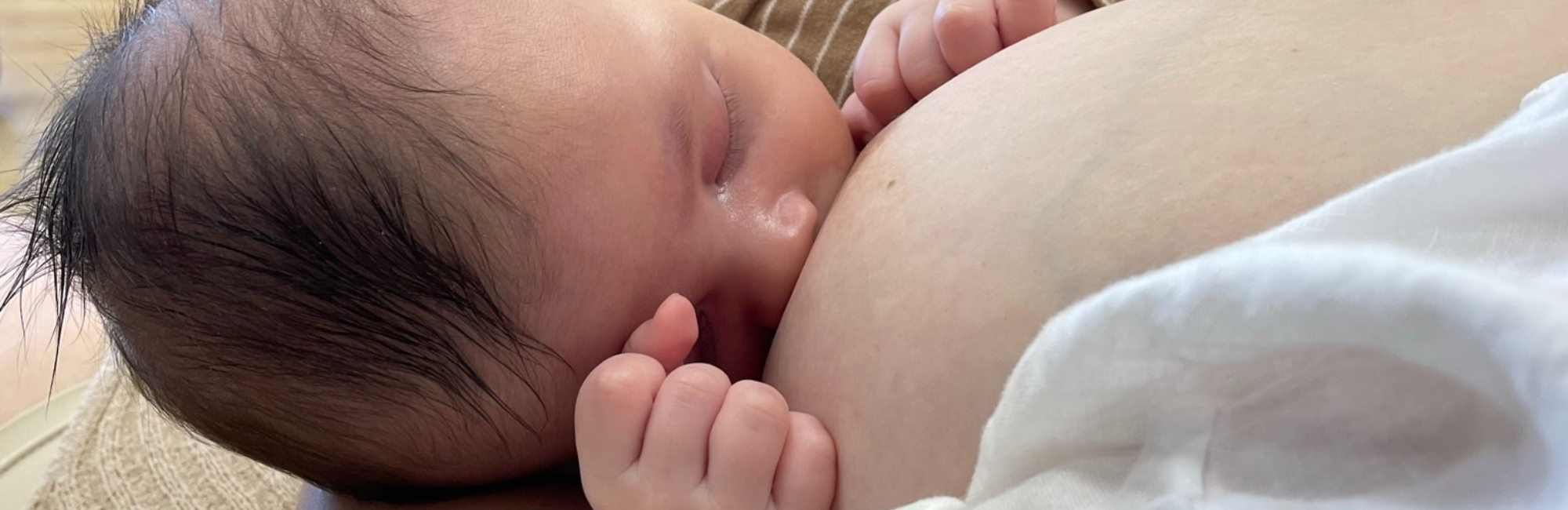
Suckling is driven by a reflex drop of the jaw which creates a vacuum in baby's mouth
The rhythmic drop of your baby's lower jawbone is the engine which drives breastfeeding (not baby's tongue's movement). The tongue doesn't act independently. Your baby's tongue (both the anterior part and the mid-tongue) simply drop down together, following the jaw.
-
Four muscle pairs contract to draw baby's jaw downwards.
-
At the same time, baby's large masseter and also the smaller medial pterygoid muscles relax.
-
Then baby's masseters and medial pterygoids contract to draw the jaw back up.
The lower jawbone does this basic mechanical work like a piston, down and up, down and up around the hinge of the temporomandibular joint, creating a pulsing peak in vacuum when the jaw is as far down as it will go.
This is quite simple, really - but we live in a time when everything about breastfeeding can be made to seem very complicated!
Sealing off an interior space inside your baby's mouth to create a vacuum
The oral cavity needs to be sealed from the external environment or air will seep in and ruin the vacuum. Your baby creates a seal during breastfeeding in two ways.
At the front of the mouth
It's not your baby's lips which create the seal, but the whole lower half of your baby's face symmetrically buried into the breast: chin, lips, and cheeks pressed into against your breast.
Clicking as your baby breastfeeds is a sign that the seal is breaking. (You would apply your micro-movements and paddle hand pressure to try to change this, using the gestalt method.)
For many women and their babies, the click of a breaking seal signals positional instability and as a result, baby has difficulty relaxing down into effective suckling. Some babies successfully breastfeed with a clicking sound, but it's worth experimenting with micromovements anyway to see if you can make the sound go away with a better seal.
At the back of the mouth
The baby's oral cavity is filled by the tongue, and is bordered at the back by the pharynx and pharyngeal wall. The pharynx is bordered by baby's nasal passages at the top.
Baby's soft palate closes up against the nasal passages during a swallow to prevent milk travelling upwards and out the nose. Sometimes if a baby coughs or sneezes you'll see milk coming out the nose, anyway. If milk is often coming out of your baby's nose you do need to ask a doctor to check to be sure there is not a cleft that is interfering with the soft palate's capacity to do its job. But luckily, human milk is full of protective immune factors. Small amounts of breastmilk are often inhaled or blown out through the nostrils, and don't irritate the lining of your baby's respiratory track or harm your baby.
During sucking, the soft palate creates a seal to stop air being drawn into the oral cavity from the nostril passages and pharynx. Ultrasound studies show that this seal starts typically with the mid-tongue closing against the hard palate at junction of the hard and soft palate, although as mentioned previously, in 10% of babies, this seal occurs slightly further back, where the soft palate meets the tongue base. The location of the palate seal will depend on just how much breast tissue is filling up the baby's mouth, and in the gestalt model we propose this seal is placed dynamically in response to how full the baby's mouth is - and perhaps other facts, like the elasticity of the mother's breast tissue, or how good the fit between the mother and baby is.
As the base of the tongue moves to and fro, that is, back and forth during suckling, following the movements of the jaw, the soft palate clings to it, contributing to the seal.
How the vacuum inside your baby's mouth works
-
There is no air inside the mouth when your baby is suckling, just milk and nipple and breast tissue. The vacuum created by the jaw drop acts upon all surfaces within the sealed interior of the baby's mouth, including upon whatever nipple and breast tissue has been drawn in so far.
-
With each drop of the jaw, more nipple and surrounding breast tissue is drawn into the mouth - as long as there is no breast tissue drag getting in the way. The vacuum expands the pliable nipple and breast tissue, and draws milk into and out from the ducts.
-
Up to 30 millilitres a breastfeed can be drawn up from your milk ducts by the vacuum inside your baby's mouth in this way. However, most milk transfer occurs during your milk letdown (or milk ejection).
-
The sides of your baby's tongue rise up to hug around the nipple and breast tissue inside her mouth. The nipple and breast tissue is then stabilized against the moist slippery surface of the hard palate and the inner silky soft surfaces of the cheeks. You can find out about baby's cheeks here.
-
The resulting sensory bath of your nipple not only continues to trigger baby's ongoing jaw drop reflex, but also stimulates your letdown.
-
The more breast tissue which is drawn up into your baby's mouth, the more the mechanical load caused by the vacuum's stretching force is spread out evenly over the surface of the nipple and areola. The milk ducts expand to their maximum, assisted by myoepithelial cell contraction and ductal dilation when you have a milk ejection. You can find out about your letdowns here.
-
There is a slight pressure applied to the mother's breast by the baby's gums during suckling, which does increase when baby's jaw is up. This pressure doesn't extract milk. But this slight pressure could play a small role in transporting milk down the ducts towards the nipple. The gums gently fit against the mother's breast and body as baby's oral reflexes activate. The gums form part of the physical contact of baby's mouth enveloping the nipple and breast, which stabilises the breast. If there's enough breast tissue drag, your baby might use his gums to try to stabilise the area where his mouth meets the breast.
-
Milk only flows when the jaw and tongue are down, due to the vacuum that's created, in tandem with your letdown.
-
Your baby's gums can't bite down on your nipple if that little mouth is wide open and full of nipple and breast tissue. We fill up your baby's mouth with nipple and breast tissue by applying the gestalt method. You can find out about the gestalt method here.
The vacuum is diffuse and applied throughout the whole of the oral cavity
Once the seal is created, the anterior and mid-tongue follow the jaw. As the jaw drops in the presence of a seal, vacuum is created. The tongue simply follows the jaw, anterior and mid-tongue together at the same time, dropping. The vacuum created as the anterior and mid-tongue drop with the jaw is applied evenly around the breast tissue in the baby's mouth, causing expansion of the breast tissue, drawing the breast tissue in deeper.
At the beginning of this process, the mid-tongue moulds up around whatever available breast tissue has arrived to start the process, perhaps just the nipple because baby's typically come on to the breast shallowly. In this case, on ultrasound the mid-tongue will meet the palate more forward from the junction of the hard and soft palate. Once the jaw has been dropping for a while, and we've drawn up lots of breast tissue, the mid-tongue is likely to meet the palate further back.
That is, with sucking, the tip of the nipple is drawn closer to the palate hinge. The nipple and breast tissue in the mouth expand in diameter. The amount of nipple and breast tissue sliding that happens between when the jaw is up and the jaw is down tends to become less, because even when the jaw is up the mouth is quite full. The distance between palate and the surface of the tongue when the jaw drops increases. Milk fills the cavity as the jaw drops.
The vacuum strength does increase throughout the first month of baby's life, as the volume of milk being transferred increases.
Selected references
-
O BO, O'Sullivan EJ, McFadden A, Ota E. Interventions for promoting the initiation of breastfeeding.* Cochrane Database of Systematic Reviews*. 2016;11(CD001688).
-
Lumbiganon P, Martis R, Laopaiboon M, Festin MR, Ho JJ. Antenatal breastfeeding education for increasing breastfeeding duration.* Cochrane Database of Systematic Reviews*. 2016;12(CD006425).
-
Mills N, Lydon A-M, Davies-Payne D, Keesing M, Mirjalili SA, Geddes DT. Imaging the breastfeeding swallow: pilot study utilizing real-time MRI. Laryngoscope Investigative Otolaryngology. 2020;5:572-579.
-
Douglas PS, Geddes DB. Practice-based interpretation of ultrasound studies leads the way to less pharmaceutical and surgical intervention for breastfeeding babies and more effective clinical support. Midwifery. 2018;58:145–155.