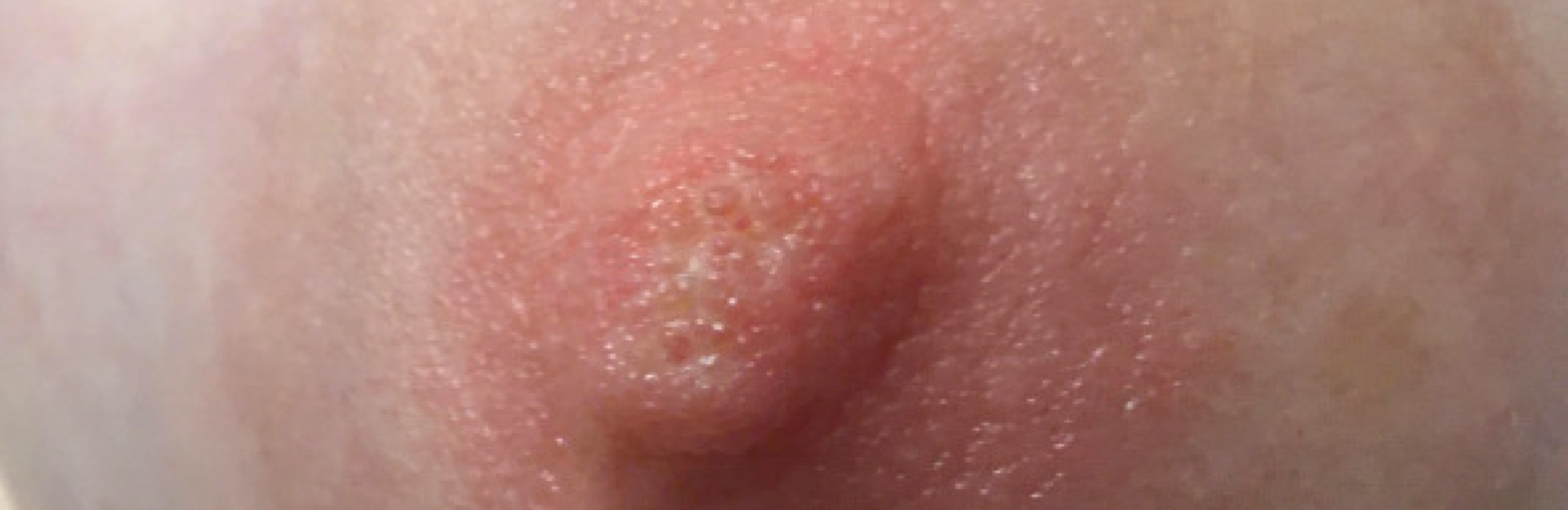
Change things up straight away if you have nipple discomfort, pain, or damage

It's important to seek help if you experience nipple discomfort, pain, or damage
It's normal to feel a deep drawing sensation when your baby suckles, which can seem weird and disconcerting at first. But you might also be told that it’s normal to have pain when baby comes on to the breast, and that this will pass, for instance if you count to twenty.
It’s true that regardless of treatment used, for a majority of women nipple pain fades away a week or ten days after birth. But there are many other women who experience nipple pain in the first days and who go on to experience a cascade of worsening pain and damage. The problem is that there's no way of telling whose nipple pain with breastfeeding will resolve, and whose will get worse.
This is why if you have unpleasant nipple sensations or pain, knowing how to work with fit and hold to eliminate the nipple and breast tissue drag protects you and your baby. The micromovements only work if you and your baby are in a good stable position.
-
You can find out how to use the gestalt method of fit and hold to find this stable position and use the micromovements, starting here.
-
You can search for an NDC Accredited practitioner, who is trained in the gestalt method, here.
When you have nipple pain, you might not see anything. Or you might have visible inflammation, showing up as pinkness or redness and swelling of your nipple. Sometimes the inflammation of your nipple looks a shiny pink, with white flakes. This is just the skin trying to repair itself, over and over. You can find out why this isn't thrush here.
Over half of women with nipple pain have visible damage or breaks in the nipple and areola skin. Visible damage can be unbelievably painful! This includes
-
Cracks
-
Ulcers
-
Blisters, and
-
Bruises.
Even very experienced breastfeeding women can suddenly find themselves dealing with nipple pain
Nipple pain and damage can turn up at any time in your breastfeeding journey. It can turn up even though you are very experienced, having breastfed older children. Although it can be quite disorienting to have breastfed happily and successfully previously, and to now find yourself experiencing awful nipple pain, it's not uncommon. Our breasts change over time, and every baby is different. There are also specific challenges which commonly arise with our older breastfed children. You can find out about these here.
Even though three-quarters of new mothers experience nipple pain, this is not normal!
I expect women are told nipple pain is normal because it’s such a common problem, and more so in some countries than in others.
-
More than three quarters of breastfeeding women experience nipple pain sometime in the first two months of their baby’s life.
-
Even at eight weeks of age, one in five of breastfeeding mothers still have nipple pain.
Nipple pain, with or without visible damage, occurs most often in the first week after the birth. This might be in addition to the pain of a bruised or lacerated perineum, or the pain of an abdominal wound. Add in sleep deprivation and a baby who is screaming, and you might find yourself crashing into a wall of pain and distress. You might find yourself at the very edge of anything you've ever previously experienced or imagined: an overwhelmingly physical experience of crisis.
In the consulting room, women repeatedly tell me that their nipple pain is far worse than the pain of giving birth or having a caesarean section – it’s not only severe, it keeps on going, feed after feed. Research has shown that women who have visible nipple damage rate their pain on average at about a six on the scale of zero to ten, where ten is the worst imaginable pain. Think gunshot wound, kidney stone, migraine – every time a woman goes to feed her baby and often in between feeds, too, day after night after day!
Nipple pain remains one of the most common reasons for introducing formula or ceasing breastfeeding.
What are the possible effects of nipple pain and damage?
Nipple pain and damage usually makes you feel miserable
Nipple pain is a distressing sensory and emotional experience. It interferes with your mood, with how active you feel like being, and even with your sleep, whether you have visible trauma or not. It's serious!
Nipple pain and damage might result in milk production that is less than your baby needs
Unfortunately, even without visible trauma, nipple pain and damage is also linked with low supply. There are two main reasons.
-
It’s normal to want to space out feeds or limit the time your baby is at the breast when you have pain, which unfortunately can decrease your supply. (This is because you need to remove milk to make milk.)
-
Nipple and breast tissue drag, which is the usual cause of the pain, also occludes milk ducts and decreases milk transfer. This might be another reason why there is a link between lessened milk supply and nipple pain.
You might hear it said that nipple pain disrupts the signals which are carried by sensory nerves from the nipple to the hypothalamus in the brain, interfering with oxytocin release and therefore disrupting supply. This is one theory. But there’s no evidence to show that nipple pain is associated with fewer ejection reflexes. An infant's hardwired nervous system reflexes are remarkably resilient.
But spacing out opportunities for milk removal from the breast definitely decreases the number of letdowns you have, which does decrease milk production over time, at least for many women! It's quite a dilemma, because spacing out the feeds protects your hurting nipples. This is when you need good help.
Selected references
Jia X, Dog Y, Shen C. Interventions for breastfeeding-related nipple pain or injury: a meta-analysis. Frontiers in Global Women's Health. 2025;6(1507723.):doi: 10.3389/fgwh.2025.1507723.