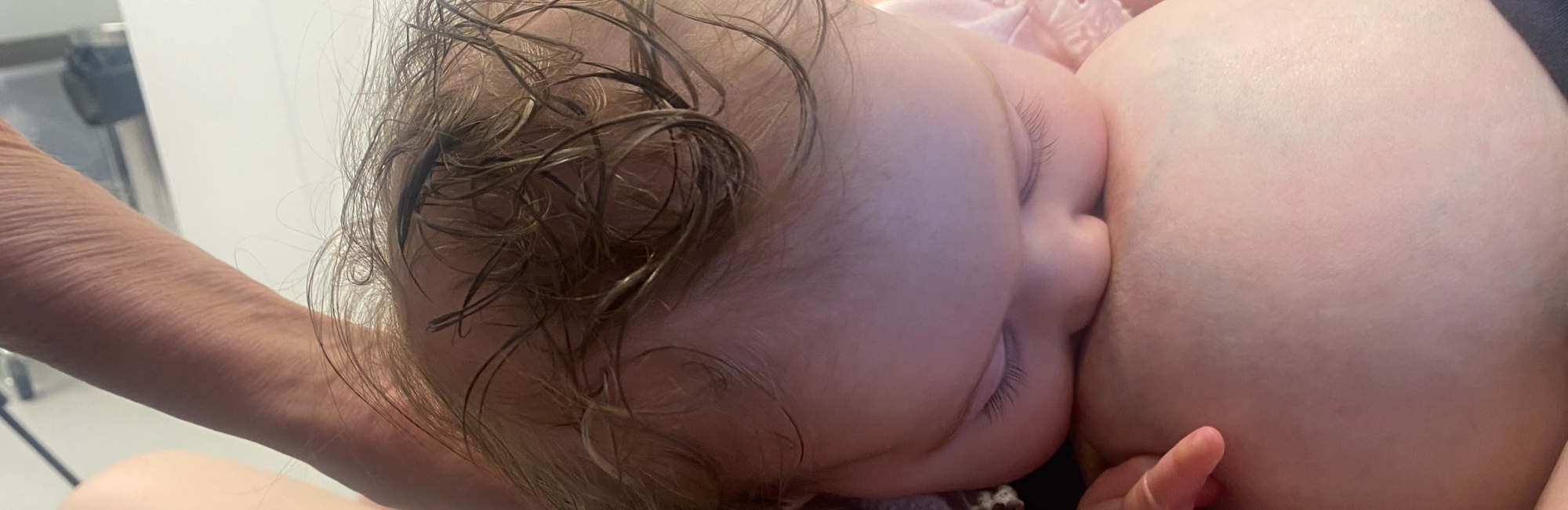
Principle #1. Frequent flexible breastfeeds or milk removal activate the stromal pump to relieve breast inflammation

Why frequent flexible milk removal is the fundamental principle of management of lactation-related breast inflammation
The most fundamental step in either prevention of, or the clinical management of, breast inflammation in lactation across the spectrum of presentations is to help the woman's breast experience repetitive contraction and dilation of the lactiferous ducts. This occurs with milk removal
-
Usually by the infant directly breastfeeding, but
-
May also be by mechanical milk removal if the woman has been pumping and feeding her baby expressed breast milk, prior to the episode of breast inflammation, or
-
Hand expression of milk on occasions in addition to direct breastfeeding, because this also results in contraction of alveoli and dilation of lactiferous ducts. Hand expression shouldn't be necessary though if the baby is happy to take the affected breast frequently and flexibly.
Frequent flexible milk removal activates the stromal pump: hypothesised pathophysiological mechanism
The NDC mechanobiological model of breast inflammation builds on known science. Milk removal triggers milk ejection, which results in irregular alveoli contractions and ductal dilations. The mechanobiological model hypothesises that milk ejections downregulate stromal inflammation in two ways.
- Milk ejections (waves of ductal dilations) create asynchronous and highly irregular waves or vibrations of pressure gradients within the stroma, acting as a stromal pump. This stromal pumping promotes venous and lymphatic drainage of the interstial tissue.1 Ducts dilate by up to 49% of their width again with milk ejection.
By allowing the ducts to open up, this stromal pressure pump
-
Counteracts the compressive effects of high stromal tension upon the milk ducts, which
-
Relieves the backpressure of high milk volumes in the alveoli, which
-
Breaks the worsening cycle of inflammation in the surrounding stroma.
- The vacuum application of milk removal (usually by the infant directly sucking but also mechanically) draws milk from the ducts and alveoli, at the same time as the ducts dilate and the alveoli contract, relieving high milk volumes and pressures within the alveoli.
You can find out about the NDC mechanobiological model of breast inflammation here.
This is why the NDC guidelines state that a woman with lactation-related breast inflammation be advised that milk needs to be removed from her affected breast very frequently and flexibly.
.jpg)
Recommended resources
You can find out about the 11 elements of frequent flexible milk removal here.
You can find out why the NDC concept of frequent and flexible breastfeeds is different to the traditional concept of 'breastfeeding on demand' here.
Selected references
-
Douglas PS. Re-thinking benign inflammation of the lactating breast: a mechanobiological model. Women's Health. 2022;18:https://doi.org/10.1177/17455065221075907.
-
Douglas PS. Re-thinking benign inflammation of the lactating breast: classification, prevention, and management. Women's Health. 2022;18:17455057221091349.
-
Crawford E, Whittingham K, Pallett E, Douglas PS, Creedy DK. An evaluation of Neuroprotective Developmental Care (NDC/Possums Programs) in the first 12 months of life. Maternal and Child Health Journal. 2022;26(1):110-123.
-
Schafer R, Watson Genna C. Physiologic breastfeeding: a contemporary approach to breastfeeding initiation. Journal of Midwifery and Women's Health. 2015;60:546-553.
-
Moore ER, Berman N, Anderson GC, Medley N. Early skin-to-skin contact for mothers and their healthy newborn infants. Cochrane Database of Systematic Reviews. 2016(Issue 11. Art. No.: CD003519):DOI: 10.1002/14651858.CD14003519.pub14651854.
-
Kent JC, Gardner H, Geddes DT. Breastmilk production in the first 4 weeks after birth of term infants. Nutrients. 2016;8(756):doi:10.3390/nu8120756.
-
Kent JC, Mitoulas LR, Cregan MD, Ramsay DT, Doherty DA, Hartmann PE. Volume and frequency of breastfeedings and fat content of breast milk throughout the day. Pediatics. 2006;117(3):e387-e395.