Logo - The Possums baby and toddler sleep program.
parents home
librarybrowse all programsfind answers nowaudioprograms in audiogroup sessionsgroup sessions with dr pam
menu icon NDC Institute
possums for professionals
(the ndc institute)
menu icon eventsguest speakers
menu icon the sciencethe science behind possums/ndcmenu icon who we arewho we aremenu icon evidence basendc research publicationsmenu icon dr pam's booksdr pam's books
menu icon free resourcesfree resourcesmenu icon dr pam's blogdr pam's blog
menu icon consult with dr pamconsult with dr pammenu icon consult with dr pamfind a possums clinicmenu icon find a NDC accredited practitionerfind an ndc accredited practitioner
login-iconlogin

Welcome back!

Forgot password
get access
search

Search programs

PBL Advanced icon

PBL Advanced


  • Key management principle #1. Eliminate repetitive mechanical microtrauma for prevention and management of nipple pain and wounds
  • Key management principle #2. Minimise epidermal overhydration and moisture-associated skin damage for prevention and management of nipple pain and wounds
  • Nipple pain in lactation: management summary
  • Nipple wounds in lactation: management, including exudate, scabs, and nipple rest
  • When are analgesics, antifungal medications and antibiotics indicated in management of nipple pain and wounds?
  • Nipple shields and breastfeeding support in the clinic
  • Treat classic tongue tie when indicated
  • Interventions which don't help lactation-related nipple pain and wounds
  • Case study: Manon has nipple damage from the first week of her baby's life

Next article

Sign up now
  • PBL Advanced
  • S6: Lactation-related nipple pain + wounds
  • CH 4: Management of lactation-related nipple pain and wounds

When are analgesics, antifungal medications and antibiotics indicated in management of nipple pain and wounds?

Dr Pamela Douglas26th of Jun 202423rd of Dec 2025

nipple pain; lactation; breastfeeding; nipple wound;

Anti-inflammatories or analgesics

Ibuprofen may be used for lactation-related nipple pain. However, if the woman is taking more than an occasional dose of anti-infammatories, the NDC guidelines recommend that the clinician discusses with her whether it is time to consider nipple rest, discussed here.

Using pain relief that is effective during breastfeeding may interfere with a woman’s capacity to notice small changes in nipple sensation as she experiments with micromovements. Yet responsiveness to pain signals is very important if she is to eliminate repetitive mechanical microtrauma.

If the pain is so severe that a woman can’t imagine breastfeeding without analgesia, her nipples require complete rest from direct breastfeeding.

Topical or oral antifungals

A standard course of antifungal treatment may occasionally have a role for nipples which have been kept moist, humid, and warm for long periods. You can click here to read a history of the overtreatment of breastfeeding women with antifungals here.

On rare occasions, a one week trial of fluconazole may be indicated, to eliminate the possibility of nipple candidiasis in a woman with persistent nipple pain who has

  • Taken antibiotics recently

  • Preferred to keep her painful breasts in moisture-promoting contexts e.g. constant bra-wearing, not exposing breasts to the air at night

  • High levels of use of lansinoh or hydrogel discs or silverettes or breast shells, which may cause a true candidiasis infection.

In this case, miconazole (Daktarin) oral gel can be painful to apply and worsens overhydration or moisture associated skin damage. The NDC Clinical Guidelines recommend fluconazole 150 mg every second day, for a total of three doses.

There is no reason to treat infant's oral cavity with antifungals, unless clinically obvious candida plaques is observed. This is not usually the case in association with nipple pain.

Prolonged treatment of the lactating woman is never required.7 You can find out about the pathogenic microbiota model of wound healing, and why it is falling out of favour, here.

Antibiotics

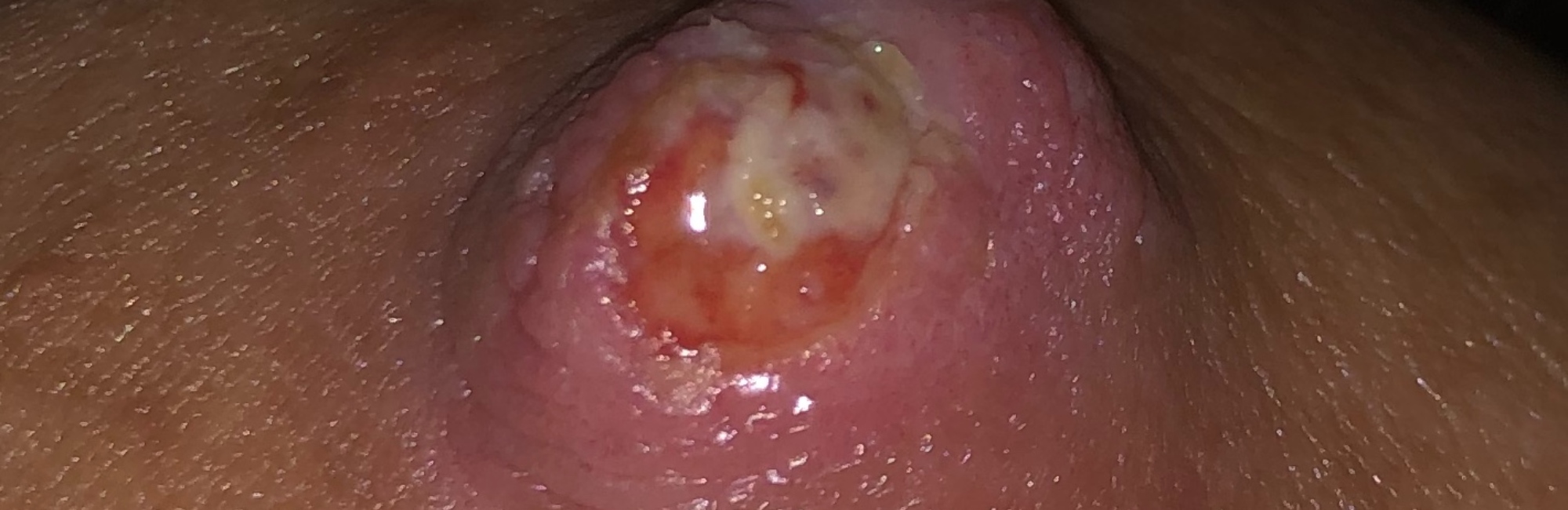
Exudate is commonly somewhat malodorous and may be coloured grey, green, or yellow. Management of an exudate is discussed here.

A clinician may decide that severely purulent exudate which is thick, gray green or yellow and has a strongly unpleasant odour warrants topical antibiotic treatment such as mupiricin, for 5-7 days.

Oral antibiotics are indicated if

  • Cellulitis develops beyond the wound border, presenting as erythematous, spreading peri-wound inflammation and swelling, or

  • For impetiginous changes of the nipple-areolar complex with weeping, yellow crusting blisters which do not respond to topical antibiotics.

Send off a swab for microscopy and culture prior to commencing oral antibiotics. It is likely that Staphylococcus aureus is found in a nipple wound, regardless of clinical presentation. However, taking a swab will alert the clinician to multi-resistant S aureus and need to change antibiotics.

The firstline antibiotic treatment is cefalexin 500 mg qid, unless the patient is allergic to pencillins. Please see the NDC Clinical Guidelines for Nipple Pain and Wounds here for further guidance.

### Recommended resources

Key management principle #1. Eliminate repetitive mechanical microtrauma for prevention and management of nipple pain and wounds

Key management principle #2. Minimise epidermal overhydration and moisture-associated skin damage for prevention and management of nipple pain and wounds

Nipple pain in lactation: management summary

Nipple wounds in lactation: management, including exudate, scabs, and nipple rest

When are analgesics, antifungal medications and antibiotics indicated in management of nipple pain and wounds?

Nipple shields and breastfeeding support in the clinic

Interventions which don't help lactation-related nipple pain and wounds

Case study: Manon has nipple damage from the first week of her baby's life

Selected references

Douglas PS. Overdiagnosis and overtreatment of nipple and breast candidiasis: a review of the relationship between the diagnosis of mammary candidiasis and Candida albicans in breastfeeding women. Women's Health. 2021;17:17455065211031480.

Douglas PS. Re-thinking lactation-related nipple pain and damage. Women's Health. 2022;18:17455057221087865.

Finished

share this article

Next up in Management of lactation-related nipple pain and wounds

Nipple shields and breastfeeding support in the clinic

x

Nipple shields may be useful in management of three clinical presentations

Nipple shields may have a role, at the same time as primary interventions are applied, in the following three presentations:

  1. Severe pain and/or damage

  2. Conditioned sympathetic hyperarousal at the breast in association with nipple pain, commonly due to unidentified positional instability

  3. Very low-height nipple, contributing to difficulties bringing the baby on to the breast despite ongoing intervention to eliminate conflicting intra-oral vectors of force.

Nipple shields are a useful secondary or adjunct intervention for nipple pain and wounds

Although nipple shields are often used as compensation for failure to identify and address underlying problems of positional instability or…

Keep reading
logo‑possums

Possums in your inbox

Evidence-based insights, tips, and tools. Occasional updates.

For parents

parents homebrowse all programsfind answers nowprograms in audiogroup sessions with dr pam

For professionals

possums for professionals
(the ndc institute)
guest speakers

About

the science behind possums/ndcwho we arendc research publicationsdr pam’s books

More resources

free resourcesdr pam’s blog

Clinical consultation

consult with dr pamfind a possums clinicfind an ndc accredited practitioner

Help & support

contact usfaqour social enterpriseprivacy policyterms & conditions

Social

instagramlinked infacebook

Possums acknowledges the traditional owners of the lands upon which The Possums Programs have been created, the Yuggera and Turrbal Peoples. We acknowledge that First Nations have breastfed, slept with, and lovingly raised their children on Australian lands for at least 65,000 years, to become the oldest continuous living culture on Earth. Possums stands with the Uluru Statement from the Heart.