Let's work out what might be going wrong in these photos

The gestalt method of fit and hold is only one part of the Neuroprotective Developmental Care (NDC) or Possums breastfeeding programs (under development as Breastfeeding stripped bare), but an important place to start. This version of the gestalt method of fit and hold for breastfeeding women has been available since 2016. I'm hoping that Breastfeeding stripped bare, the comprehensive NDC approach to breastfeeding and lactation, will be publicly available by the end of 2024. Key elements of the NDC breastfeeding work are also found in The discontented little baby book, and in my research publications, starting here.
I would wish for you an enjoyable breastfeeding relationship that goes on for just as long as you'd like! There are some other useful things to know if challenges come up, so that you can use the breast to make the days (and nights) work just as easily as possible.
Strategies which often create breastfeeding problems
We strongly recommend that you avoid the following because these strategies can result in positional instability and breast tissue drag
-
Leaning forward to offer the breast
-
Holding the breast or sandwiching the breast
-
Pushing the breast towards or into the baby's mouth
-
Dragging breast and nipple over the upper lip to stimulate mouth-opening
-
Holding the baby on the back of the neck or head
-
Checking for baby's lip positions
-
'Banana' pillow in your lap under the baby's body
-
Breast compressions or massage during breastfeeding
-
Use of hakaa pump during breastfeeding.
You might find that the baby has become used to a particular way of getting on, or that you can't seem to make it work in the ways we are suggesting. That's ok - you can start in the way you are used to, and then lie back once the baby is on and start experimenting with other aspects of gestalt breastfeeding.
There are lots of things which might be getting in the way of the breastfeeding reflexes or causing a pulling-off or back-arching reflex. Examples are
-
Pressure on the back of the babies neck or head
-
Tickling of the baby's face or body
-
Forcing the baby to the breast
-
Bra or garment interfering with the landing pad
-
Upper arm interfering with the landing pad.
Photos of things which often cause problems in breastfeeding
If the mother and baby in the lovely photo at the top of this page had any problems at all, I'd suggest that she brought the baby in deeper to her, because her baby's lips are visible, which makes nipple and breast tissue drag more likely.
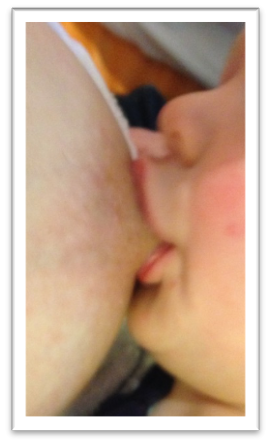
Perhaps you can see now why the mother-baby pairs in the photos below have breastfeeding difficulties. The babies are all too far off the breast, not drawing up enough breast tissue volume and dragging on the nipple, with visible lips.
In the photo below, the baby is turned away from the breast with his arm between his and his mother's body.
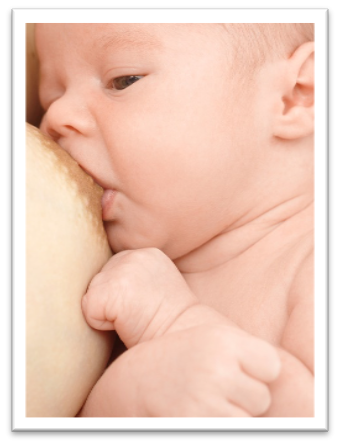
In the photo below, the mother places a hand on the back of the baby's head. which is likely to trigger back-arching and pulling off.

In the photo below, baby doesn't look at all relaxed because he is unable to take in a lovely full mouthful of breast, and is positionally unstable.
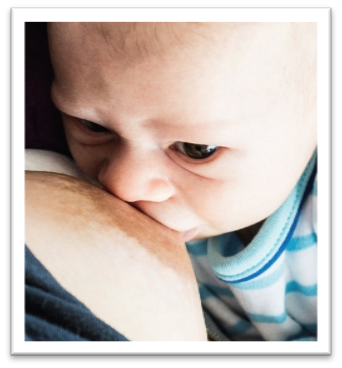
In the photo below, baby has had the lingual frenulum, labial frenulum (upper lip) and 'buccal ties' lasered, but as in all these photos, the underlying problem was fit and hold challenges all along, not oral ties. As soon as gestalt method is applied, the lower half of the face provides a seal (regardless of the shape and insertion of the upper lip frenula), the back of the tongue meets the soft palate to also help with the seal, the jaw drops, the mouth fills with breast tissue, and effective milk transfer is able to occur.
Selected references
Douglas PS, Keogh R. Gestalt breastfeeding: helping mothers and infants optimise positional stability and intra-oral breast tissue volume for effective, pain-free milk transfer. Journal of Human Lactation. 2017;33(3):509–518.
Douglas PS, Geddes DB. Practice-based interpretation of ultrasound studies leads the way to less pharmaceutical and surgical intervention for breastfeeding babies and more effective clinical support. Midwifery. 2018;58:145–155.
Douglas PS, Perrella SL, Geddes DT. A brief gestalt intervention changes ultrasound measures of tongue movement during breastfeeding: case series. BMC Pregnancy and Childbirth. 2022;22(1):94. DOI: 10.1186/s12884-12021-04363-12887.