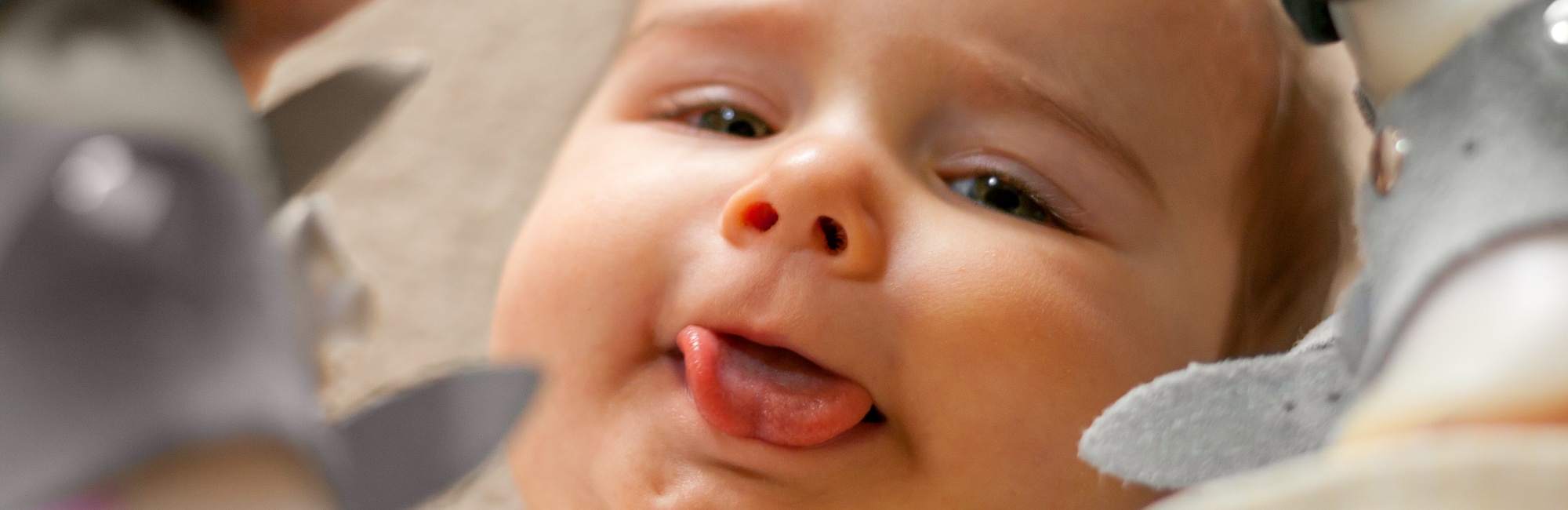
Your baby's tongue doesn't cause friction, pinching, or compression during breastfeeding
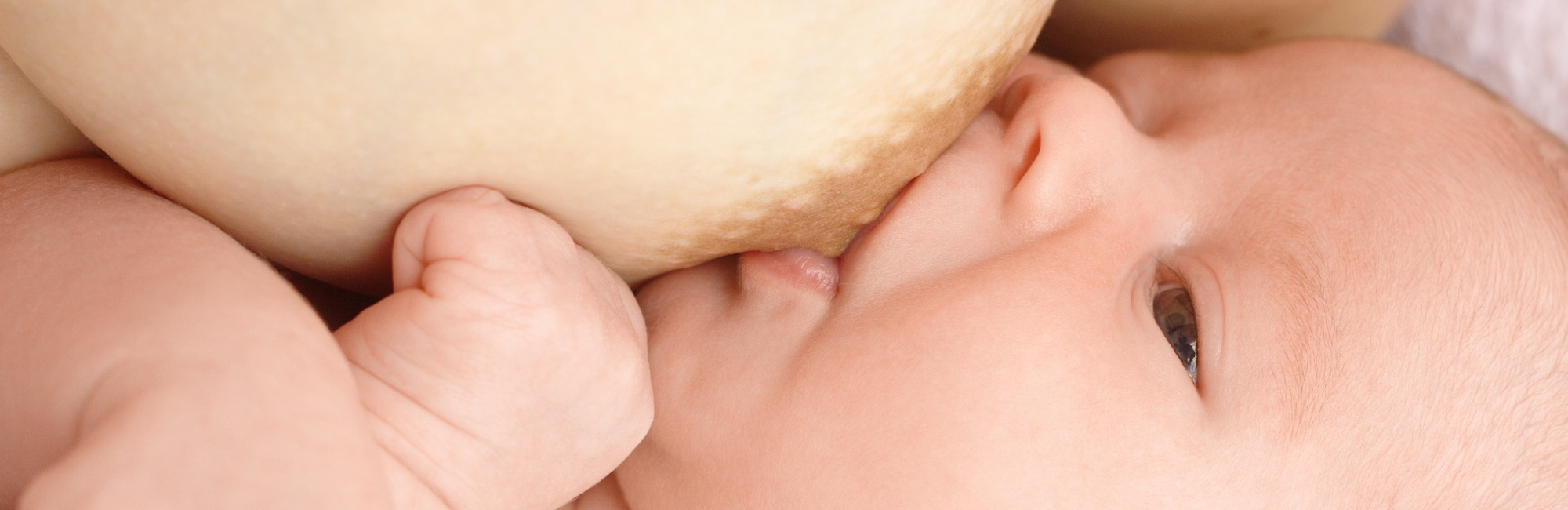
Why baby's tongue isn't doing the damage (despite what you might hear)
It's not the tongue, but high stretching forces from nipple and breast tissue drag which damage the skin (or epidermis) of the nipple.
Your little baby's tongue is an unusual muscle which is able to change shape very easily. This allows the tongue to mould flexibly around the nipple and breast tissue which baby draws up into his mouth. And your baby's tongue is moist, covered with slippery mucous and saliva secretions, which form a highly effective natural lubricant.
You don't need to worry about your baby's tongue's strength and endurance, the way you hear - unless your baby has a medical condition, tongue strength and endurance are not relevant to breastfeeding. All the tongue has to do is drop in tandem with the jaw, nestling around the nipple and breast tissue, then follow the jaw back up.
The functions of the visible part of your baby's tongue during breastfeeding are
-
To participate in the detection of your nipple entering your baby's mouth, which triggers the ongoing reflex of baby's jaw drop
-
To mould around and support the nipple and breast tissue inside baby's mouth
-
To create a warm, moist, soft and slippery cushioning (which I refer to as a sensory bath) around the nipple and breast tissue, which triggers oxytocin release and your milk ejection.
Saliva and mucous in baby's mouth (as well as breast milk) protect against friction burns of baby's mouth and your nipple
It doesn’t make sense to think that nipple damage is caused by rubbing of baby’s tongue, although you'll often hear this said.
Your baby’s mouth is moistened with copious amounts of saliva and mucous from birth, and, after a few days, by your breast milk too. The surface of the tongue slides with minimal friction against the mucosa covering baby's inner cheeks, palate, and gums.
A burn or graze caused by tongue friction would look quite different to the cracks and ulcers that characterise nipple damage. They would be broader, less specific, and would occur on one side of the nipple (depending on the angle your baby is breastfeeding from), but not in the locations where cracks and ulcers form.
Cracks are often at the base of the nipple, as well as on the face. Nipple cracks or fissures are quite different to friction burns!
-
You can find out what's actually causing nipple pain or damage here.
-
You can find out more about the terribly misunderstood baby tongue here.
-
You can find out about tongue-tie here.
-
A more detailed analysis of the research showing that your baby's tongue is not responsible for nipple and areola pain and damage is here.
The picture at the top of this page shows a baby who is positioned in a very unstable way at the breast, with his little lower arm stuck between the mother's body and his body. You can just see that his chest and tummy are turning out away from his mother's body too. As a result, he is on the breast asymmetrically, with lots of his lips visible - unfortunately a recipe for nipple and breast tissue drag (not to mention fussing at the breast), whcih is likely to result in nipple pain and damage.
References
- Kapoor V, Douglas PS, Hill PS, et al. Frenotomy for tongue-tie in Australian children (2006-2016): an increasing problem. MJA 2018:88-89.
- Wei E, Tunkel D, Boss E, et al. Ankyloglossia: update on trends in diagnosis and management in the United States, 2012-2016. Otolaryngology - Head and Neck Surgery 2020:https://doi.org/10.1177%2F0194599820925415.
- Ellehauge E, Schmidt Jensen J, Gronhoj C, et al. Trends of ankyloglossia and lingual frenotomy in hospital settings among children in Denmark. Danish Medical Journal 2020;67(5):A01200051.
- Joseph KS, Kinniburg B, Metcalfe A, et al. Temporal trends in ankyloglossia and frenotomy in British Columbia, Canada, 2004-2013: a population-based study. CMAJ Open 2016;4:e33-e40.
- Dixon B, Gray J, Elliot N, et al. A multifaceted programme to reduce the rate of tongue-tie release surgery in newborn infants: Observational study. international Journal of Pediatric Otorhinolaryngology 2018;113:156-63.
- Schwerla F, Daake B, Moeckel E, et al. Osteopathic treatment of infants in their first year of life: a prospective multicenter observational study (OSTINF study). Complementary Medicine Research 2021;28(5):395-406.
- Mills N, Lydon A-M, Davies-Payne D, et al. Imaging the breastfeeding swallow: pilot study utilizing real-time MRI. Laryngoscope Investigative Otolaryngology 2020;5:572-79.
- Geddes DT, Sakalidis VS. Ultrasound imaging of breastfeeding - a window to the inside: methodology, normal appearances, and application. Journal of Human Lactation 2016;32(2):340-49.
- Mills N, Keough N, Geddes DT, et al. Defining the anatomy of the neonatal lingual frenulum. Clinical Anatomy 2019;32:824-35.
- McClellan HI, Geddes DT, Kent JC, et al. Infants of mothers with persistent nipple pain exert strong sucking vacuums. Acta Paediatrica 2008;97(9):1205-09.
- Geddes DT, Langton DB, Gollow I, et al. Frenulotomy for breastfeeding infants with ankyloglossia: effect on milk removal and sucking mechanism as imaged by ultrasound. Pediatrics 2008;122:e188-e94.
- Douglas PS, Geddes DB. Practice-based interpretation of ultrasound studies leads the way to less pharmaceutical and surgical intervention for breastfeeding babies and more effective clinical support. Midwifery 2018;58:145–55.
- Douglas PS, Perrella SL, Geddes DT. A brief gestalt intervention changes ultrasound measures of tongue movement during breastfeeding: case series. BMC Pregnancy and Childbirth 2022;22(94):https://doi.org/10.1186/s12884-021-04363-7.
- Douglas PS, Keogh R. Gestalt breastfeeding: helping mothers and infants optimise positional stability and intra-oral breast tissue volume for effective, pain-free milk transfer. Journal of Human Lactation 2017;33(3):509–18.
- Zimmerman E, Thompson K. Clarifying nipple confusion. Journal of Perinatology 2015;35(11):895-99.
- McClellan HL, Kent JC, Hepworth AR, et al. Persistent nipple pain in breastfeeding mothers associated with abnormal infant tongue movement. International Journal of Environmental Research and Public Health 2015;12:10833-45.
- Dias JS, Vieira TDO, Vierira GO. Factors associated to nipple trauma in lactation period: a systematic review. Revista Brasileira de Saude Materno Infantil 2017;17(1):27-42.
- Pan L, Zhang X, Gao Q. Effects and mechanisms of histatins as novel skin wound-healing agents. Journal of Tissue Viability 2021;30:190-95.