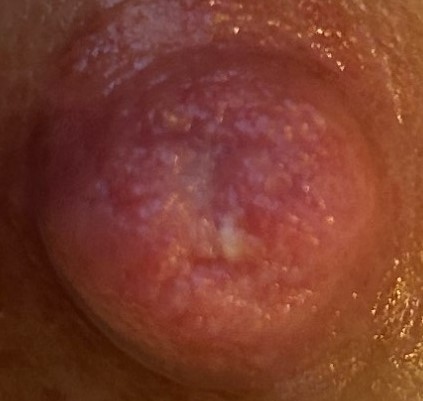
Nipple white spot during breastfeeding #3: milk blister

Three kinds of nipple white spots can develop during lactation
These are three kinds of white spots that might occur on your nipple while your lactating:
-
Milk blister.
I've put them in what I estimate to be the order of frequency, based on my clinical experience, since there's not been any research on the prevalence of white spots that I can find!
Milk blister
A milk blister is an exquisitely painful blister on your nipple, which looks white, especially after breastfeeding. It is small, just a few millimetres wide, and has a clearly defined, circular edge.
This kind of white spot can be terribly painful, but worse, is often associated with a lump, or a wedge-shaped or cordlike area of thickening and pain, which extends into the breast from the nipple. The ‘roof’ or small white area that you can see on the nipple is typically like a tiny sharp-bordered white dot.
Here's how I think it happens.
The stratified squamous epithelium of the nipple skin extends a couple of millimetres into the ducts, after which it changes into the usual thinner columnar squamous epithelium of the ducts. To my mind, a milk blister results when an epithelial roof forms over a duct orifice.
It is possible that this roof over the duct orifice occurs because of microtrauma which causes hyperkeratosis and inflammation of the stratum corneum. Tiny areas of epithelial grazing in the region of the duct orifice may repair and just inside of or over the entrance.
However, it is possible that milk blisters are a random occurrence in the context of nipple use and stretching for some women.
What to do if you have a milk blister
-
It is best to see your doctor as soon as possible to lift the roof of the epithelium with a bevelled needle. Often, then, there is an immediate leakage of milk once the duct has been unroofed.
-
It's best not try unroofing a milk blister yourself, especially if you're having repeated milk blisters. This is because you might accidentally worsen everything, developing damaged, thickened epithelium and hyperkeratosis in response.
-
Also, don't rub a milk blister with a washer or your fingernail, the way you might read on the internet!
-
Try soaking your nipple in warm water before you breastfeed, softening the epithelial roof. This will make it more likely that the roof breaks open when your baby feeds, releasing any build-up of milk.
-
If a milk blister becomes a chronic problem, your doctor might suggest applying a steroid cream, as suggested for hyperkeratosis, to try to suppress the inflammatory response which is causing the epithelial roof to form at the duct entrance. I prefer a cream to an ointment, as the ointment risks overhydration of the nipple epithelium, softening it and making it even more vulnerable to damage. Again, there's no reason to wrap the steroid cream in plastic wrap as is sometimes suggested.
-
As soon as a milk blister's roof is removed, it’s important to feed the baby as frequently as possible from that breast for a time, in an effort to prevent the roof re-sealing over the duct. Short but very frequent episodes of milk flow through the orifice will help prevent the epithelium fusing back over the orifice. This will require that any breast tissue drag is dealt with, however.
The way of categorising white spots which I offer you here is developed from my clinical experience and knowledge of the research literature, and is the NDC or Possums categorisation of white spots, building on the NDC mechanobiological model. It was published in the Women's Health journal in 2022.
Recommended resources
Nipple white spot during breastfeeding #1: hyperkeratosis
Nipple white spot during breastfeeding #2: epidermal inclusion cyst
Nipple white spot during breastfeeding #3: milk blister
White spots: a mother of a three-month-old baby has endured three months of nipple pain
Selected references
Douglas PS. Re-thinking lactation-related nipple pain and damage. Women's Health. 2022;18:17455057221087865.
Douglas PS. Does the Academy of Breastfeeding Medicine Clinical Protocol #36 'The Mastitis Spectrum' promote overtreatment and risk worsened outcomes for breastfeeding families? Commentary. International Breastfeeding Journal. 2023;18:Article no. 51 https://doi.org/10.1186/s13006-13023-00588-13008.
O’Hara M. Bleb histology reveals inflammatory infiltrate that regresses with topic steroids: a case series. Breastfeed Med 2012; 7(Suppl. 1): S2.