Nipple white spot during breastfeeding #2: epidermal inclusion cyst
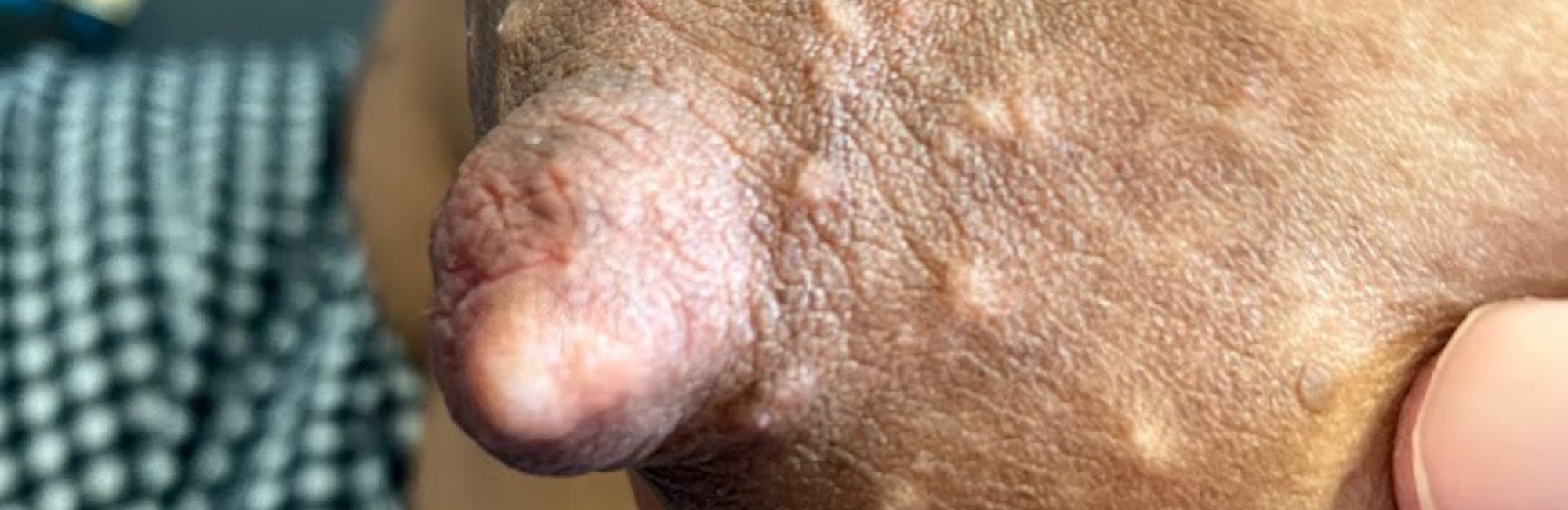
Three kinds of nipple white spots can develop during lactation
These are three kinds of white spots that might occur on your nipple while your lactating:
-
Epidermal inclusion cyst
I've put them in what I estimate to be the order of frequency, based on my clinical experience, since there's not been any research on the prevalence of white spots that I can find!
What are epidermal inclusion cysts on the nipple during lactation?
There are two kinds of epidermal inclusion cysts which might occur on a lactating woman's nipple.
1. A small epidermal inclusion cyst known as a milium
Occasionally, a woman will show me a small white spot on her nipple, perhaps buried in a crevice on the face of her nipple, which doesn’t cause her pain. It may be just a couple of millimetres wide. This is a milium, a small white dermal cyst filled with keratin, lined by a layer of stratified squamous epithelium. It's painless.
Milia like this are also very common on babies’s faces and disappear in time. Milia often arise after mild skin trauma, too.
A little white milium cyst will appear prominent and very white after a breastfeed, due to the way the vacuum of suckling draws it out from the epithelial crevices.
What to do
It's important not to squeeze or try to get rid of a milium, because this might inflame it and make it bigger and painful. A milium is best left completely alone, and usually disappears in time.
2. A larger epidermal inclusion cyst
The photograph at the top of the page is likely to be of an epidermal inclusion cyst, although there is an area of irregularly bordered hyperkeratosis on it's surface and the most prominent area could still be simply hyperkeratosis rather than an inclusion cyst. I only have this photo, without the history associated with it, so it is difficult to know. It is possible that this woman started out with a small epidermal inclusion cyst - or a smaller area of hyperkeratosis - and has tried to lift it with a needle, which has worsened the damage to the skin.
It's not common to have a larger epidermal inclusion cyst develop on your nipple, but it happens sometimes and is often referred to as a white spot, as well. It might be wrongly called a sebacious cyst, but is not actually filled with sebum. It's filled with thick keratin-filled fluid (of broken down cells), much like a milium, but larger.
What to do
It's important not to try to squeeze or drain this cyst. It requires assessment by your doctor, who may organise to have it incised if it is very prominent or very painful. Mostly it's not painful, in which case it's best to ignore it and continue breastfeeding.
Once you've finished breastfeeding, or if you are pregnant and there is time for an incision to heal before you breastfeed, then you might decide to have a breast surgeon excise it for you.
The way of categorising white spots which I offer you here is developed from my clinical experience and knowledge of the research literature, and is the NDC or Possums categorisation of white spots, building on the NDC mechanobiological model. It was published in the Women's Health journal in 2022.
Recommended resources
Nipple white spot during breastfeeding #1: hyperkeratosis
Nipple white spot during breastfeeding #3: milk blister
White spots: a mother of a three-month-old baby has endured three months of nipple pain
Selected references
Douglas PS. Re-thinking lactation-related nipple pain and damage. Women's Health. 2022;18:17455057221087865.
Douglas PS. Does the Academy of Breastfeeding Medicine Clinical Protocol #36 'The Mastitis Spectrum' promote overtreatment and risk worsened outcomes for breastfeeding families? Commentary. International Breastfeeding Journal. 2023;18:Article no. 51 https://doi.org/10.1186/s13006-13023-00588-13008.
O’Hara M. Bleb histology reveals inflammatory infiltrate that regresses with topic steroids: a case series. Breastfeed Med 2012; 7(Suppl. 1): S2.