
How can you tell if your baby is getting enough milk from direct breastfeeding?
Possums Breastfeeding & Lactation is not a substitute for the care of your local doctor or health professional. Please see your own GP, or other suitably qualified health professional, if you have questions or concerns about your baby's weight gains.
Three daily signs that your baby is getting enough milk
What you need to know about weight gain in the first days of your newborn's life, as he regains his birth weight, are found here. Here's what to expect when baby is getting enough milk.
-
Your baby has about five heavy wet nappies in a 24-hour period. Good output of about five heavy wet nappies, containing pale yellow or clear urine which doesn't smell too strongly, is a sign that your baby is adequately hydrated. (You don't need to plot this on an app - estimates are good enough.)
-
If your baby is not receiving enough milk, his urine may be a strong yellow colour, with a strong odour.
-
If your newborn's urine is persistently pink or reddish, this may be due to urate crystals (made of uric acid). Urate crystals are common in the first few days and are usually harmless, especially if baby is well-hydrated. Pink or reddish urine in the nappy needs to be discussed with your health professionals, since it can be a sign of dehydration, especially if it occurs after the first few days of life.
-
-
Your baby has the equivalent of around three palmfuls of stool in his nappy. By a palmful of stool in the nappy, I mean that an area of the nappy about the size of your palm has soaked up or is covered in poo. (Again, you don't need to plot this on an app - estimates are good enough.) Baby stool output, however, can be variable, especially in the first couple of months of life.
-
Some babies don't pass stool every day, and some babies pass copious stool many times a day, yet all are gaining weight well.
-
Whilst it's possible to have excellent weight gain in a baby who isn't passing stool regularly each day, especially with younger babies, decreased output of stool can be a sign baby doesn't have enough milk passing through her gut. Please discuss this with your GP or other health professional if you have concerns.
-
-
Your baby is reasonably dialled down. Babies often dial up if they aren't receiving the milk that they need. You can find out about the dial on your baby's sympathetic nervous system here.
-
Offering frequent flexible feeds, whenever you think this will dial baby down, is the best way forward to ensure good milk supply and baby weight gain. You can find out about frequent flexible breastfeeds here.
-
However, after the first two weeks of life babies dial up inside the house because they aren't receiving enough sensory motor nourishment in the low sensory interior environment of a home, too. You can find out about your baby's need for sensory motor nourishment here.
-
How can you tell your baby is getting enough milk overall?
There are two ways of knowing that your baby is getting enough milk and growing well.
-
You notice your baby's little body filling out, becoming plumper, feeling heavier. You notice that your little one is outgrowing her garments.
-
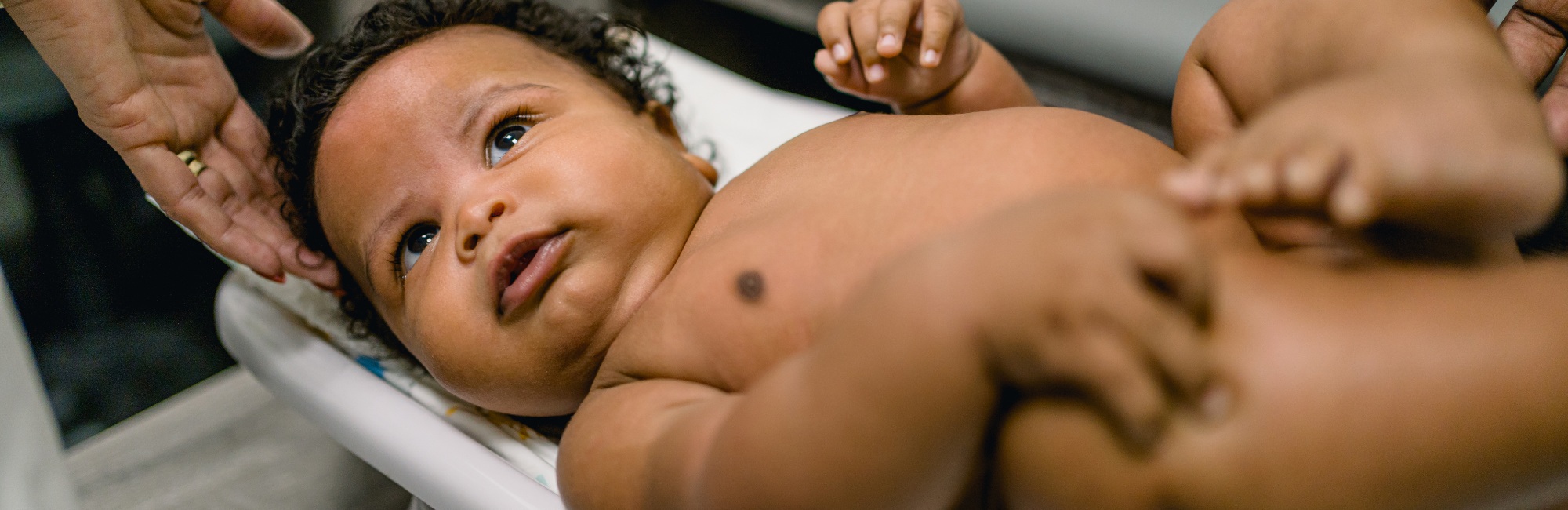
Your health professional weighs your baby on our specially designed scales for infants, then plots your baby's weight on the World Health Organisation (WHO) percentile charts for infant growth. In the first two months of life, big studies have shown that breastfed babies gain on average 200 to 250 gm of weight each week. Girls tend to gain less than boys, within that range. A baby's rate of weight gain eases off and is not quite as rapid after that. This is why when you look at a WHO infant weight gain chart, you'll see a steeper increase at first, then a more gentle curve of weight gain (though still going upwards of course) after the first few months.
Does it matter which percentile line your baby's weight starts on at birth?
When we plot on the WHO charts, we want to see that your baby is tracking along her percentile line from birth.
-
It is quite common for babies to track along a percentile line that is one lower than the percentile line of birth.
-
If your baby has dropped two percentile lines or more relative to birth weight, it's very important that your baby is assessed by your GP or other doctor, as this may not be enough weight gain and can have effects on your baby's develoment down the track.
Some babies are born on the 90th percentile line, or even higher. Unless there is a medical condition explaining this, such as a maternal diagnosis of diabetes, then your baby's genetic material is encoded for height and size at the upper end of the normal range for babies of that age. What matters is that your baby more or less tracks along the same percentile line.
Similarly, some babies are born on the third percentile line, or even lower. Unless there is a medical condition explaining this, such as intrauterine growth restriction, then your baby's genetic material is encoded for height and size at the lower end of the normal range for babies of that age. Again, what matters is that your baby more or less tracks along the same percentile line.
Your health professional will intermittently measure baby's head circumference and length. These measures are taken at birth, then usually with visits for scheduled vaccinations throughout childhood. Here, as I think about breastfeeding and baby taking enough milk, I am only focussing on your baby's weight.
Does it help to use scales at home to track your baby's weight?
I don't recommend using scales to weight baby at home. Firstly, baby scales for use at home can be unreliable. But secondly, and more importantly, it's possible to find yourself unnecessarily concerned about baby's weight gains if you're using scales at home.
This is because, like so much in life with your baby, what really matters is patterns over time.
Your health professionals will watch your newborn's weight closely to make sure that breastfeeding and weight gain are on track, because occasionally there are situations where new parents aren't aware their newborn isn't receiving enough milk and is dehydrating. This can be dangerous. Your health professional will tell you how often you need to come in with your baby for a weigh, but it may be that weighing weekly has a place in the first few weeks of your baby's life.
Once breastfeeding is established, it's common to have a week where baby gains less, and then another week when baby gains more, and this is a normal part of human variability. Once breastfeeding is established, I recommend only weighing baby at visits for the usual vaccination schedule, unless your health professional has said otherwise.
-fotor-20230709154241.jpg)