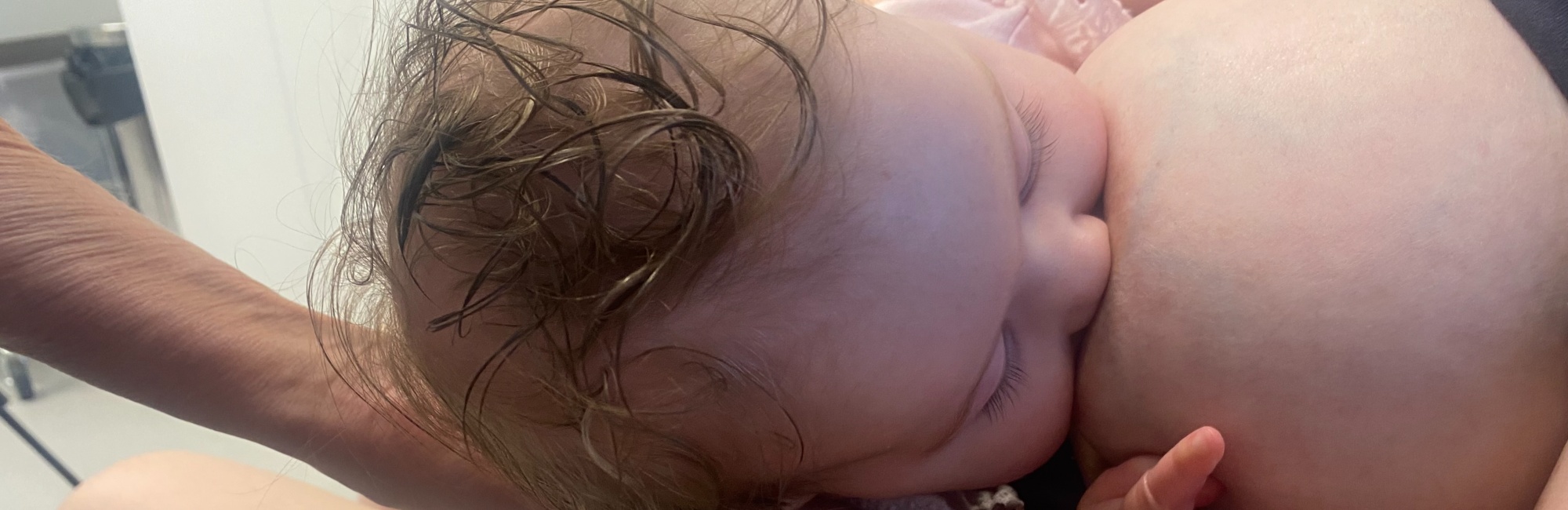
Eleven-week-old Daisy fussed a lot with breastfeeds: how NOT burping made her and her family's days and nights so much happier

Disclaimer: the case below is an amalgam of multiple cases that have presented to me, and is not derived from any specific or identifiable mother-baby pair who have seen me as patients. Needless to say, all names are fictional.
Eleven week old Daisy fretted and back arched and pulled off the breast frequently since birth. Her parents had been told she had gas pain. Everyone recommended her mother take her off the breast regularly to burp her. Even though Daisy often grizzled and cried when they did this, her worried parents thought she was upset because of wind.
Someone else suggested she had air-induced reflux or maybe food intolerance. Last week, their osteopath told them Daisy swallowed a lot of air with feeds because of tongue-tie, and a lactation consultant referred her for laser surgery. The lactation consultant also said that this was why Daisy woke so much at night and resisted going to sleep, and that they needed to burp her in between feeds and at the end of every feed, and to hold her upright for at least 20 minutes and preferably for half an hour after feeds as well.
Daisy's parents came to me for a second opinion. When I checked their little one over, I could see a membrane running some way along the under-surface of her tongue. But normal baby oral anatomy is highly variable, and Daisy had all the function she needed to transfer milk successfully.
When her mother breastfed her, I could see Daisy wasn't in a stable position. This was why Daisy fussed and back arched so much during feeds! We worked together to correct the way her mother's breast dragged off in a direction different to the direction of the vacuum Daisy created inside her little mouth as she suckled. Before we knew it, Daisy was enjoying the most stable and contented breastfeed they'd ever had, according to her parents.
"I know from the research," I explained, "that babies - even when they have feeding problems - are not swallowing large amounts of air at the breast or bottle."
Then I gently explained to these exhausted parents, who had been trying so hard to do the right thing by their little girl, that most human cultures don't burp their babies.
Burping is part of the routinised, sleep-training approach to infant care so popular in the West. Burping after feeds rouses a baby's nervous system, which fits with the (mistaken) idea that you're not supposed to let your baby fall asleep with the breast or bottle so that you avoid 'bad sleep habits'. But it is biologically normal for babies to dial down into a relaxed and sleepy state due to the neurohormonal effects of milk and suckling. Letting babies fall asleep with feeds doesn't set up bad sleep habits, despite what you might hear, but can make the whole sleep thing a lot more difficult than it needs to be!
"Burping Daisy won't help her sleep better, either," I said quietly. "It's normal for babies to wake every couple of hours at night into toddlerhood. What matters is that everyone gets back to sleep quickly." Daisy's parents looked at me skeptically.
"We're so tired we can't think," her father muttered eventually, glancing at Daisy's mother.
"If your little one wakes the minute you put her down during the day, it's not because of gas or wind: it's because a tiny nap took the edge of her rising sleep pressure, which was all she needed, and now she is ready for more daytime sensory adventure. If she wakes every hour or more for whole parts of the night, it's not because of gas or wind: it's because her sleep pattern is disrupted and we need to work with her biological sleep regulators to align her sleep better with yours. If your little one grunts and groans and writhes half the night, so that you can hardly sleep, it's not because of gas or wind: it's because her sleep pressure is no longer high and her circadian clock is disrupted. Again, we need to work with her sleep regulators to make the nights more manageable."
Daisy's parents still didn't look entirely convinced, but they were willing to hear me through to the end.
"Rousing up out of sleep activates the gut, which is why your baby might pass flatulence or puke or burp with all that grunting and groaning in the night. The gut is like a second brain, highly innervated, and when a baby rouses, you'll often notice baby gut events. These can be ignored. We don't need to burp or hold the baby upright - or swaddle or wrap for that matter. And try not to change her nappy unless you absolutely have to! In fact, doing these things in the night can be a recipe for severe sleep deprivation, as you may find yourself awake for an hour or more each time the baby wakes."
When we followed up two weeks later, they told me excitedly how their life with Daisy had completely changed. They were using a range of strategies which we'd discussed from The Possums Sleep Program, as well as the gestalt approach to fit and hold, and couldn't believe the difference. Daisy's mother gazed down, amazed, as her little one snuggled in calmly against her breast and body, feeding as we talked, suck-suck-suck-suck-suck-swallow. Suck-suck-suck-suck-suck-suck-suck-swallow.
"All that burping we did, day and night!" she said, tears slipping over her cheeks. "If only I'd known sooner!"