Continually re-applying a moist or polymeric membrane dressing to a nipple wound so that a scab never forms is not evidence-based practice

The use of polymeric membrane dressings and similar technologies have been demonstrated to improve outcomes for burns and chronic ulcers
There is a race amongst biotech manufacturers to create wound dressings which increasingly mimic the properties of a healthy skin wound healing process. This research targets burns, and chronic wounds such as diabetic ulcers, pressure sores, and venous leg ulcers - conditions characterised by chronic inflammation, infection, and poor tissue regeneration.
Advanced wound care research focuses on
-
Engineered tissue scaffolds, as close to the original extracellular matrix as possible, which aim to provide a porous and localised bioactive environment for the healing of damaged tissues.
-
Composite materials which combine beneficial properties of both natural and synthetic polymers, to provide both structural support (which is weak for natural polymers) and bioactive environments.
-
Developing biological extracellular matrices which incorporate antimicrobial substances, growth factors, cytokines, and even stem cells into smart hydroges which respond to specific stimuli from the wound environment, such as pH and temperature changes, or oxidative stress.
Surgeons in particular have extrapolated this research into wound care in the context of acute wounds in otherwise healthy skin, so that moist wound healing has become an orthodoxy. There are however international voices questioning this extrapolation.
The evolutionary context in which are scientists attempt to create technologies which mimic properties of human biological systems
The process of mimicking the biological in order to create sophisticated tools and technologies which help heal human tissue dysfunction is driven by the phenomenal Homo sapiens power of collective scientific creativity. It is driven by our profound commitment throughout 300,000 years of evolutionary development to the wellbeing of other members of our species.
It's the same power which has driven manufacturers of infant formula to experiment technologically over the past century, in ongoing efforts to mimic human milk. This has occurred in the context of socioculturally determined health system failures to effectively support breastfeeding. (Formula companies can only infiltrate health systems and doctor's offices if the health system itself is coopted by market forces more broadly.) Neither commercial milk formulas nor synthetic wound-healing applications will ever replicate the myriad complex adaptive systems which interact together in healthy biological organisms - but the results of our human efforts to do so through scientific creativity are astonishing, nevertheless.
The stunning scientific intelligence of the 21st century human is driven by both fundamental compassion for our fellow humans and unfettered greed
Our extraordinary human capacity to develop humanised medical technologies results from Homo sapiens evolutionary genius with tools, which has accelerated exponentially through the collective growth of knowledge and technology in my lifetime, and which is sometimes referred to as The Great Acceleration. Our evolutionary drive to imagine and to invent is the human's staggering brilliance. But our unbelievably accelerating collective mind also poses a terrible danger not just to Homo sapiens species, but to the entire planet, urgently requiring our species to develop macrophase wisdom.
The ongoing evolutionary development of the collective intelligence of the human draws on what is now, after 300,000 years, an incomprehensibly sophisticated cultural hereditary of knowledge which wraps around the Earth. Debates about clinical approaches to breastfeeding and lactation challenges are tiny nodes in a planetary nervous system of digital connection. The ongoing improvement of both commercial milk formulas and wound healing technologies are two small examples of 21st century Homo sapiens tools for the betterment of humankind. What matters is how we manage these tools. The tools themselves aren't bad; in fact, they're amazing.
Our scientific evolutionary drive is coopted by another powerful evolutionary drive which lies behind the planetary dominance of Homo sapiens - the power of trade, the power of the markets, also a brilliant human gift for connection and mutual benefit between groups, now also an unfettered, monstrous, human-harming, species-eating greed, horrifying in its capacity for destruction of the whole planet.
We urgently require cultural awareness of how the power of biotech markets impacts our ordinary lives and our belief systems as doctors and health professionals. The multinational corporations which increasingly dominate medical biotech undoubtedly have genuine desire to improve the human condition, but are also powerfully motivated by profit to broaden the application of their technologies into new markets. We see this in the extension of wound healing technologies into my field of lactation. Although there is no (convincing) evidence or good biological rationale to support the use of moist wound healing preparations, there is a worldwide trend to use these technologies for nipple wounds, which are very common in breastfeeding women.
Extrapolation of moist wound healing into the care of breastfeeding women is driven by biotech-dominated paradigms of health care, and lacks both an evidence-base and plausible biological rationale
The breastfeeding women who are advised to use these technologies are given the impression that moist wound healing preparations are the latest, most scientific, most effective and evidence-based way to help their nipple wounds heal. A voice like mine that challenges this trend is viewed - on a kind of gut level, which is unfortunately how groupthink works - as unbelievably dated, stuck in the past, and scientifically unsophisticated! In the grip of groupthink, there is little curiosity for understanding and debating what an uncomfortably different voice might have to say.
Protecting an injured nipple from sticking or rubbing on garments is necessary; framing this as superior way to heal a wound, rather than a pragmatic cultural adaptation while we support the innate biological wound-healing process, misleads women, and is financially lucrative for companies which promote breastfeeding-adapted polymeric membranes and other high-tech wound membranes. The use of these wound technologies also fits the mechanistic biomedical model, which remains dominant in medical systems, especially in the US: the latest polymeric membranes seem naturally cutting edge, well-controlled, and far superior to the messiness of the (300 million-year-old) biological wound healing process!
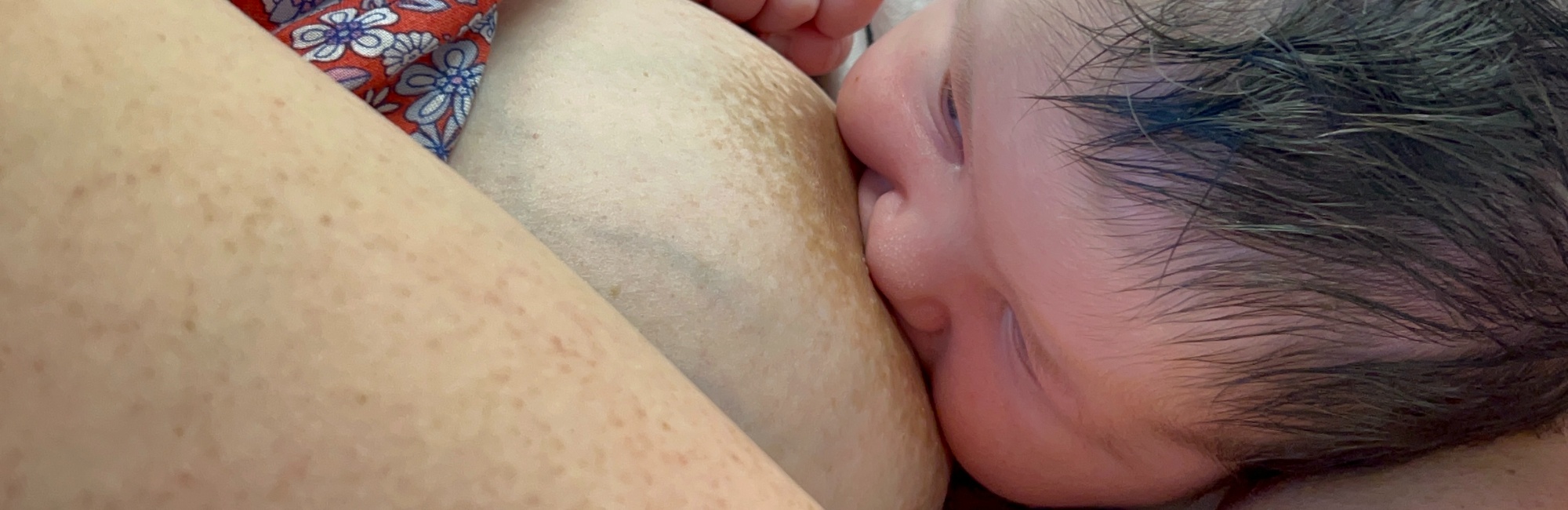
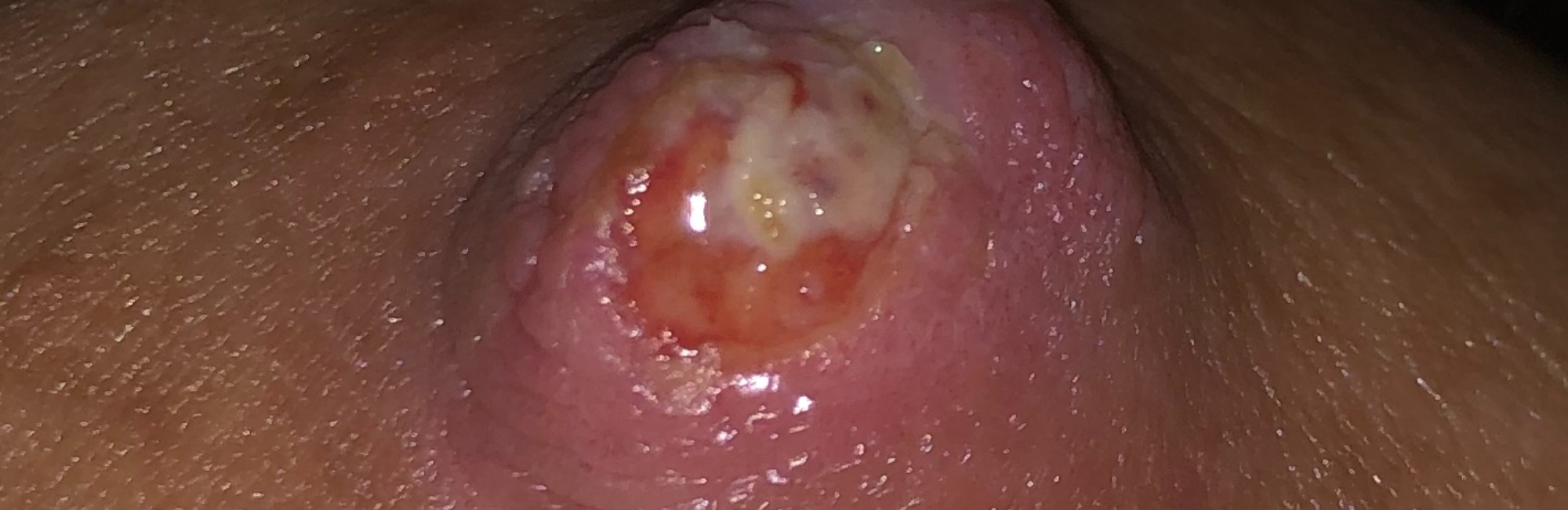
Below, you see an image of a nasty nipple wound which had persisted for many weeks in a courageous breastfeeding woman who continued offering her baby the breast. She had been told to use moist wound healing. This is the photo from when she first came to see me. The image at the top of the page shows an image of how her nipple looked after just a couple of weeks of using NDC principles.
Recommended resources
Interventions which don't help lactation-related nipple pain and wounds