Lactational phlegmon
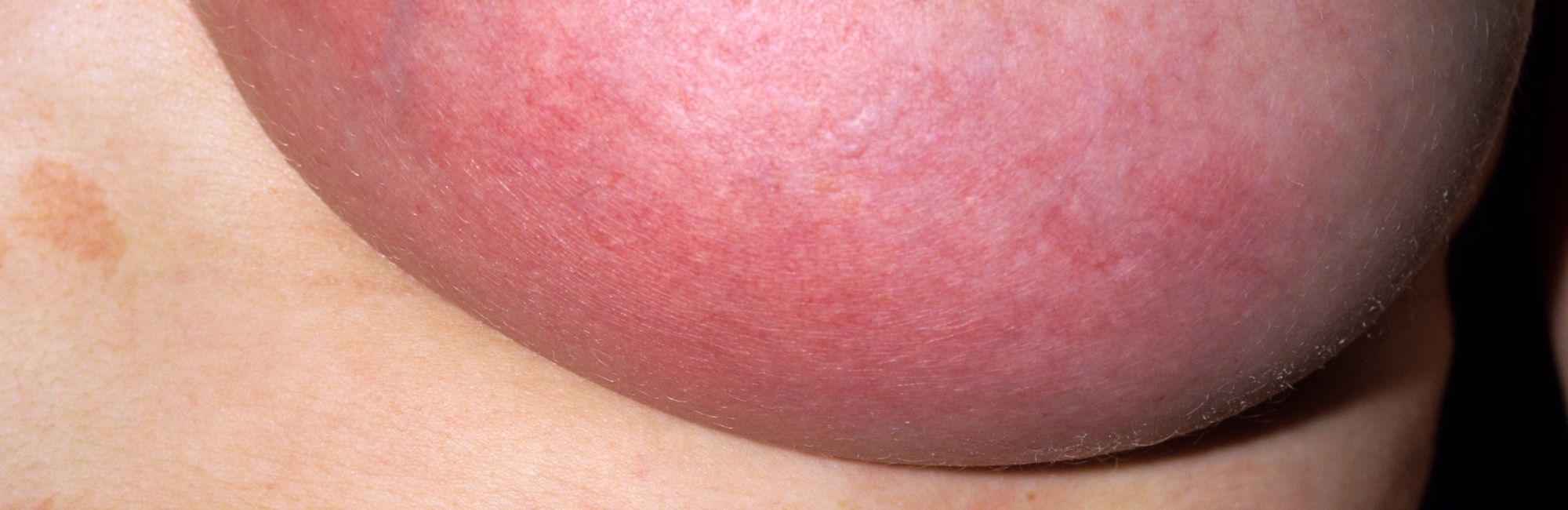
Prevalence of phlegmon
There is no prevalence data.
There are no presenting signs and symptoms on the spectrum of breast inflammation which distinguish a phlegmon from mastitis
A phlegmon has been described as a poorly defined indurated lump in the breast of a lactating woman, but this term lacks clear definition and cannot be distinguished clinically from mastitis. The presenting signs and symptoms are found below, and are the same as the spectrum of signs and symptoms which characterise the acute breast inflammation commonly referred to as mastitis.1,2
Here are the signs and symptoms of lactation-related breast inflammation when abscess is suspected, recorded using the NDC Classification of Benign Lactation-related Breast Inflammation.2 You can find out more about the NDC classification system here.
| Location of inflammation | Dimensions (millimetres) | Erythema | Pain | Systemtic signs + symptoms |
|---|---|---|---|---|
| Generalised - bilateral | None | None | Feels well | |
| Generalised - unilateral | Mild | Mild when touched only | Fever | |
| Localised WITHOUT lump | Moderate | Mild constant | Myalgia | |
| Localised WITH lump | Severe | Moderate when touched only | Rigor | |
| Moderate constant | ||||
| Severe |
Phlegmon is a diagnosis made by imaging investigation, when ultrasound to exclude abscess is indicated. You can find out about ultrasound investigation and breast inflammation here and here. Because mastitis means 'breast inflammation', and encompasses the spectrum of breast inflammation, a phlegmon found on imaging is simply a form of mastitis that
-
Contains some fluid collections which are visible on imaging, and
-
Is not (yet) an abscess.
The pathophysiology of a phlegmon in lactation: acute inflammation (unilateral and localised)
On ultrasound imaging of a lactating breast with a presenting lump, an irregular and heterogenous inflammatory mass which contains visible fluid in the stroma may be labelled a phlegmon. The term 'phlegmon' is extrapolated to the lactating breast from the surgical literature, where inflammatory masses referred to as phlegmons surround a hollow organ, for example, in appendicitis and diverticulitis.
Phlegmon is an investigative diagnosis, made in the context of the clinical diagnosis of mastitis, or acute breast inflammation.1,2 Mastitis is characterised by a spectrum of accumulating interstial fluid in response to an inflammatory cascade, which may or may not yet be visible on imaging.1 There is no meaningful cut-off between small amounts and large amounts of interstial fluid collections.
Once collections of fluid are visible, the interstial tension has become more pronounced, increasing the chance of focussed alveoli involution and tissue necrosis, and therefore of abscess. You can find out about the NDC mechanobiological model of breast inflammation here.
You can find out about lactational abscess here.
The management of a phegmon is the same as management of mastitis, because it is on the mastitis spectrum
The management of phlegmon identified on ultrasound is the same as the management of mastitis. There is no indication for repeat ultrasound that is particular to the identification of phlegmon. The need for a repeat ultrasound is based upon clinical indicators, using the same criteria used for mastitis when there is a high index of suspicion for abscess.1,2
You can find the management of mastitis (and therefore phlegmon) here.
Critique of the Academy of Breastfeeding Medicine's Clinical Protocol #36 use of phlegmon as a clinical diagnosis
The Academy of Breastfeeding Medicine Clinical Protocol #36 states: “Phlegmon should be suspected with a history of mastitis that worsens into a firm, mass-like area without fluctuance. ... Acute bacterial mastitis … can progress to phlegmon. Lactational phlegmon may require extended antibiotics for complete resolution [italics mine].”3
Phlegmon is identified when the clinician investigates a breast lump with imaging to exclude abscess. Phlegmon is not diagnosed by history and physical examination, but by imaging. However, the decision to follow up with further imaging should be made on clinical assessment of the inflammatory lump post-imaging, only.1,2
-
No imaging follow up is necessary if signs and symptoms are resolving.
-
A diagnosis of phlegmon found on imaging does not impact upon interventions offered, since abscess has been excluded.
-
The diagnosis made on imaging reflects the subjective judgement of the radiologist that there is enough fluid collection to warrant the term, since there are no shared or meaningful definitions.
-
The finding of phlegmon on imaging occurs towards the more severe end of the inflammatory spectrum of interstitial fluid secretion
-
The finding of phlegmon does not indicate significant bacterial overgrowth requiring antibiotics.
There is no role for antibiotic use in the management of mastitis that has been labelled as phlegmon on ultrasound
Antibiotic use remains a clinical decision based on worsening signs and symptoms of mastitis, or the finding of an abscess.2 Clinical Protocol #36’s use of the diagnosis of phlegmon in the lactating breast risks both
-
Unnecessary follow up imaging and
-
Unnecessary antibiotic use.4
Selected references
-
Douglas P. Re-thinking benign inflammation of the lactating breast: a mechanobiological model. Women's Health. 2022;18:17455065221075907.
-
Douglas PS. Re-thinking benign inflammation of the lactating breast: classification, prevention, and management. Women's Health. 2022;18:17455057221091349.
-
Mitchell KB, Johnson HM, Rodriguez JM, Eglash A, Scherzinger C, Cash KW, et al. Academy of Breastfeeding Medicine Clinical Protocol #36: The Mastitis Spectrum, Revised 2022. Breastfeeding Medicine. 2022;17(5):360-375.
-
Douglas PS. Does the Academy of Breastfeeding Medicine Clinical Protocol #36 'The Mastitis Spectrum' promote overtreatment and risk worsened outcomes for breastfeeding families? Commentary. International Breastfeeding Journal. 2023;18:Article no. 51 https://doi.org/10.1186/s13006-13023-00588-13008.