Mastitis: prevalence, presentation, pathophysiology

Presenting signs and symptoms on the spectrum of breast inflammation in lactation commonly referred to as 'mastitis'
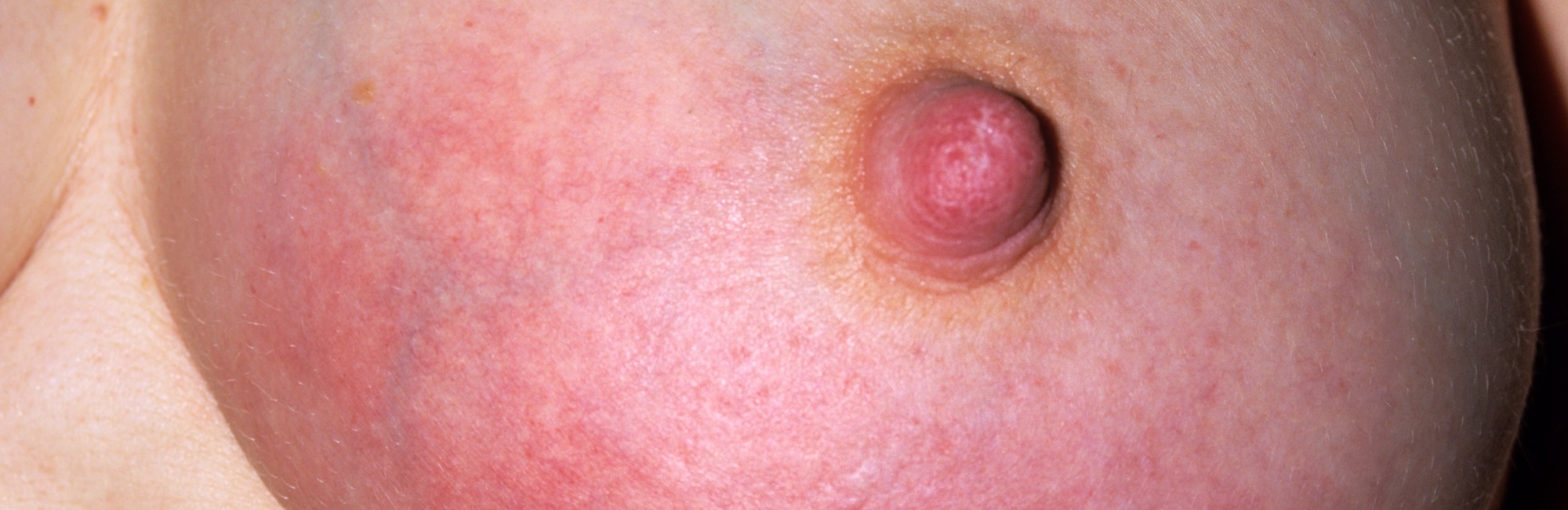
Mastitis means ‘inflammation of the breast’, but the definition of 'mastitis' still lacks international consensus. Similarly, management of mastitis lacks varies markedly between countries.1 Despite diagnostic uncertainty, the presentation of breast inflammation which is most commonly meant when the word 'mastitis' is used remains a serious lactation-related problem.2 Used popularly, the diagnosis mastitis describes an erythematous painful lump in the breast, usually towards the outer part of the breast, with or without systemic symptoms of fever, myalgia, rigors, and fatigue.
The cluster of signs and symptoms commonly used to diagnose a mastitis emerge variably on a continuum of breast inflammation from mild to severe. The NDC guidelines propose that breast inflammation, which encompasses mastitis, is more accurately described by clinical presentation (signs and symptoms) rather than by terms which lack clear definition.3 Clinically, a presentation of breast inflammation is most usefully described by selecting the relevant presenting signs and symptoms described in the table below.
Because of the highly subjective nature of fatigue, this symptom is not used in the NDC classification system.
| Location of inflammation | Dimensions (millimetres) | Erythema | Pain | Systemtic signs + symptoms |
|---|---|---|---|---|
| Generalised - bilateral | None | None | Feels well | |
| Generalised - unilateral | Mild | Mild when touched only | Fever | |
| Localised WITHOUT lump | Moderate | Mild constant | Myalgia | |
| Localised WITH lump | Severe | Moderate when touched only | Rigor | |
| Moderate constant | ||||
| Severe |
Prevalence of mastitis
Breast pain is one of the most common reasons women give for premature weaning.4-6 Prevalence data for mastitis is based upon variable definitions, in the absence of agreement about underlying mechanisms.
-
Wilson et al’s 2020 systematic review of incidence and risk factors for lactational mastitis, which included 26 articles, concluded that lactational mastitis affects about one in four women during the first 6 months postpartum. However, the authors note that the quality of studies is poor.7
-
Mastitis appears to be the most common reason given for weaning in the first three weeks postbirth.8,9
-
70% of mastitis cases occur in the first 4 to 8 weeks.10,11
-
Although an episode of mastitis mostly occurs in just one breast, it may occur more than once, and on either side, and some women experience mastitis multiple times with the same child.
-
Women who experienced mastitis with previous children are 2 to 4 times more likely to experience mastitis in subsequent lactations.12
-
Because the incidence varies widely across locations, Wilson et al propose that mastitis, regardless of variable definitions, may be mostly preventable.7
-
When evaluating Australia data alone, the rate is at the higher end of the spectrum, at approximately 18%.13
The pathophysiology of mastitis in lactation: acute inflammation (unilateral and localised)
The NDC mechanobiological model of breast inflammation
You can find out about the mechanobiological model of breast inflammation here, which is, I have argued, the aetiological model which has the most robust evidence-base.14
The link between nipple damage and mastitis is associative, not causative
There is an association between nipple damage and mastitis.
-
Foxman et al’s 2002 prospective cohort study of 946 breastfeeding women found that the presence of nipple cracks and damage was linked with a three- to six-fold increase in the risk of mastitis.12
-
In 2007 Kvist et al investigated 210 cases of lactation-related breast inflammation, finding that 36% of the women also had nipple damage. Although nipple damage was linked with slower resolution of inflammation, it was not linked with increased need for antibiotics.15
-
In 2015 Cullinane et al showed that in 70 breastfeeding women who developed mastitis in the first 8 weeks post-birth, those who reported nipple damage had twice the incidence of mastitis.13
-
In 2020 Wilson et al conducted a systematic review which investigated the incidence of and risk factors for mastitis, and found that cracked nipples were significantly associated with lactational mastitis in all 8 studies analysed.7
Engorgement, difficulties attaching the baby to the breast, and blocked ducts have also been associated with increased risk of mastitis.7,16 Kvist et al found that women with breast inflammation who were using nipple shields had less favourable outcomes.15
Associations between breastfeeding problems and mastitis have been explained using the pathogenic model of breast inflammation, in which it is hypothesised that pathogenic bacteria, for example, Staphylococcus and Corynebacterium, enter the milk from nipple cracks to cause breast inflammation.7,13
However, new evidence about the composition of the human milk microbiome, detailed here, demonstrates why it is unlikely that mastitis is caused by retrograde spread of ‘pathogenic’ bacteria from visible nipple damage.
-
Bacteria and fungi identified on the nipple-areolar-complex in the presence of nipple pain and damage are also regularly identified in healthy human milk microbiomes.12,14,17
-
Most women with mastitis (64% in Cullinane et al) don’t have nipple damage.11
-
Only a small proportion of nipple cracks and ulcers show signs of infection, and nipple damage is often not adjacent to the duct openings, but at the junction of the nipple and areola.
From the perspective of the gestalt biomechanical model of breastfeeding, nipple damage, breast inflammation, and difficulties bringing the infant on to the breast have a shared aetiology, which is nipple and breast tissue drag, or conflicting intra-oral vectors of force. Applying the gestalt model, nipple shield use is often an indicator of underlying and unresolved breast tissue drag and positional stability problems.

Recommended resources
Is the concept of human milk dysbiosis helpful?
Clinical inflammation of the stroma of the lactating breast: NDC mechanobiological model
References
-
Amir LH, Coca KP, Da Silva Alves MdR. Management of mastitis in the hospital setting: an international audit study. Journal of Human Lactation. 2025;4(3):401-411.
-
Crepinsek MA, Taylor EA, Michener K, Stewart F. Interventions for preventing mastitis after childbirth (Review). Cochrane Database of Systematic Reviews. 2020(9):Doi:10.1002/14651858.CD14007239.pub14651854.
-
Douglas PS. Re-thinking benign inflammation of the lactating breast: classification, prevention, and management. Women's Health. 2022;18:17455057221091349.
-
Odom E, Scanlon K, Perrine C, Grummer-Strawn L. Reasons for earlier than desired cessation of breastfeeding. Pediatics. 2013;131:e726-732.
-
Patil DS, Pundir P, Dhyani VS. A mixed-methods systematic review on barriers to exclusive breastfeeding. Nutrition and Health. 2020;26(4):232-346.
-
Reynolds R, Kingsland M, Daly J. Breastfeeding practices and associations with pregnancy, maternal and infant characteristics in Australia: a cross-sectional study. International Breastfeeding Journal. 2023;18(8):https://doi.org/10.1186/s13006-13023-00545-13005.
-
Wilson E, Woodd SL, Benova L. Incidence of and risk factors for lactational mastitis: a systematic review. Journal of Human Lactation. 2020;36(4):673-686.
-
Boakes E, Woods A, Johnson N, Kadoglou N. Breast infections: a review of diagnosis and management practices. European Journal of Breast Health. 2018;14:136-143.
-
Michie C, Lockie F, Lynn W. The challenge of mastitis. Archives of Disease in Childhood. 2003;88(9):818-821.
-
Amir LH, Forster DA, Lumley J, McLachlan H. A descriptive study of mastitis in Australian breastfeeding women: incidence and determinants. BMC Public Health. 2007;7(62):http://www.biomedcentral.cm/1471-2458/1477/1462.
-
Cullinane M, Amir LH, Donath SM, Garland SM, Tabrizi SN, Payne MS, et al. Determinants of mastitis in women in the CASTLE study: a cohort study. BMC Family Practice. 2015;16:181.
-
Foxman B, D'Arcy H, Gillespie B, Bobo JK, Schwartz K. Lactation mastitis: occurrence and medical management among 946 breastfeeding women in the United States. American Journal of Epidemiology. 2002;155:103-114.
-
Cullinane M, Amir LH, Donath SM, Garland SM, Tabrizi SN, Payne MS, et al. Determinants of mastitis in women in the CASTLE study: a cohort study. BMC Family Practice. 2015;16:181.
-
Douglas P. Re-thinking benign inflammation of the lactating breast: a mechanobiological model. Women's Health. 2022;18:17455065221075907.
-
Kvist LJ, Halll-Lord ML, Larsson BW. A descriptive study of Swedish women with symptoms of breast inflammation during lactation and their perceptions of the quality of care given at a breastfeeding clinic. International Breastfeeding Journal. 2007;2(2):doi:10.1186/1746-4358-1182-1182.
-
Tang L, Lee AH, Qui L, Binns CW. Mastitis in Chinese breastfeeding mothers: a prospective cohort study. Breastfeeding Medicine. 2014;9(1):35-38.
-
Douglas PS. Overdiagnosis and overtreatment of nipple and breast candidiasis: a review of the relationship between the diagnosis of mammary candidiasis and Candida albicans in breastfeeding women. Women's Health. 2021;17:17455065211031480.