Why I sometimes think of Possums Breastfeeding & Lactation as a secular Book of Hours

I've sometimes thought of Possums Breastfeeding & Lactation as a contemporary Book of Hours
This article draws on one specific kind of cultural history, that of medieval Western Europe with its distinctly Judeo-Christian worldview. In fact, other kinds of cultural histories and mythologies speak far more powerfully and directly of breastfeeding women. This includes Australian First Peoples. But the Judeo-Christian cosmology is the heritage into which I, personally, was born, and I speak of it here, since it has shaped me.
Here's why I have sometimes thought of Possums Breastfeeding & Lactation as a contemporary and secular Book of Hours for women who are breastfeeding their children, writing in this pivotal decade when the future of our planet (the climate, the land, the skies, the seas) - or perhaps more accurately, the future of us humans on this planet - hangs on a thread. In medieval societies of Western Europe, a Book of Hours contained ideas and artwork, prayers, lessons and psalms, and was seen as a companion for women through life’s difficulties.
-
If prayer is a quality of attention directed towards something that matters a great deal, then Possums Breastfeeding & Lactation has been my prayer for you, the breastfeeding woman.
-
If lessons arise from the wrestling of wisdom out of dreams and failures, then Possums Breastfeeding & Lactation offers you my life’s lessons as I’ve walked alongside breastfeeding women, dreaming, failing, and gathering up my courage to dream some more.
-
If a psalm is a celebration of the great life-force rising up within all of us, a song of renewal and hope in a world that also brings so much darkness and violence, then there is no more powerful psalm than celebration of the birth of a precious new human life and of a woman’s capacity to nourish that new life from her own body. Possums Breastfeeding & Lactation aims to be a voice in this celebration.
Those are the reasons why I have sometimes liked to imagine Possums Breastfeeding & Lactation as a companion which supports a breasted kind of embodiment, hour by hour, day by day - in the same way a Book of Hours accompanied my medieval female forebears, hour by difficult hour, day by day.
A note about Books of Hours for history nerds
Do you find details about how women lived or survived their lives in other eras and cultures fascinating, the way I do? Then this historical note is for you! It's a peek into Western European medieval history, a very specific and very narrow window. I acknowledge the kaleidoscope of other incredibly rich and diverse cultural and spiritual traditions upon which women have drawn to make sense of our world and our lives, from the dawn of human time.
For a while, from the 12th century, the European Christian Church was willing (just!) to tolerate popular expressions of far more ancient images of the female divine, in the severely constrained, not very wild, but definitely much-loved figure of the Virgin Mary, Mother of God. Also from the 12th century, and for the first time in the Western tradition, lay people were able to incorporate elements of monastic devotion into their lives using written text.
A Book of Hours is an ornate prayer book that was very popular with women in medieval Christian Europe between the 12th and the late 15th centuries. In addition to psalms, prayers, and 'Stations of the Cross', it contained readings known as the Hours of the Virgin, which celebrated the life of the Mother of God. These were recited at eight set ‘hours’ throughout the day. In those centuries, in the cultures of patriarchal Europe, women endured very limited life choices, long wars, and the catastrophy of the Black Death. A third or a half of their children died in infancy. Their life expectancy was perhaps 43 years. In this context, many women drew solace from a cherished Book of Hours.
These were initially commissioned from monasteries and painstakingly inscribed on vellum, that is, on animal skin. Depending on the means of the owner, the quality varied from simple illumination of capital letters at the start of psalms, to highly ornate full-page illustrations at the start of each section, with precious metals including gold and silver lavishly applied to the decorated borders of each page. The wealthiest even enjoyed Books of Hours with jeweled covers, heraldic emblems, and portraits of the owner.
By the late 14th century, laymen were taking over illumination, particularly in Flemish cities, and the growing business classes could afford to commission Books of Hours. Books of Hours surviving from this time have handwritten notes on the flyleaves and in margins, where women jotted household accounting, autographs of important visitors, and records of births and deaths.
A Book of Hours was often the only book in the house, from which the children learnt to read. By the end of the 15th century, with the advent of the printing press, Books of Hours with woodcut illustrations were circulated en masse. Even female domestic servants owned them, bound as girdle books for easy access throughout the day.
But the printing press heralded a time of great social upheaval. The Reformation took hold, and Non-conformists, including my forebears, took part in a just revolt against the exploitative powers of the Church. They expressed their anger by mutilation of iconography. They destroyed the faces of statues and paintings of the Virgin Mary. They stripped pretentious and oppressive images of Church-sanctioned belief from their places of worship. The popularity of Books of Hours quickly declined.
This is how the last very widely enjoyed, even if constrained, representations of a birthing and breastfeeding divinity were lost to the Western cultural imaginary. The loss of a female cultural imaginary of birth and breastfeeding in the Western tradition has impacted profoundly on how we experience our transition into motherhood, even still today.
From the 18th century, the new profession of doctors – male – began stepping into this big cultural gap in the way we, as a Western society, imagined pregnancy, birth and breastfeeding. As my own profession gained more and more control over the care of women's bodies and their rite of passage into motherhood, our cultural imaginary reflected this. The stories women began to hear and tell each other about their breastfeeding experiences were increasingly medicalised.
The unnecessary medicalisation and overtreatment of breastfeeding women and their babies has continued throughout the 35 years since I had my babies. I like to imagine Possums Breastfeeding & Lactation as a 21st century companion for the breastfeeding woman in the tradition of a Book of Hours, gratefully benefiting from and also vigorously challenging the reductionist discourse of medical science, so that together we create a de-medicalised imaginary which empowers us to celebrate our glorious, transfigurative, milk-making bodies.
Acknowledgement
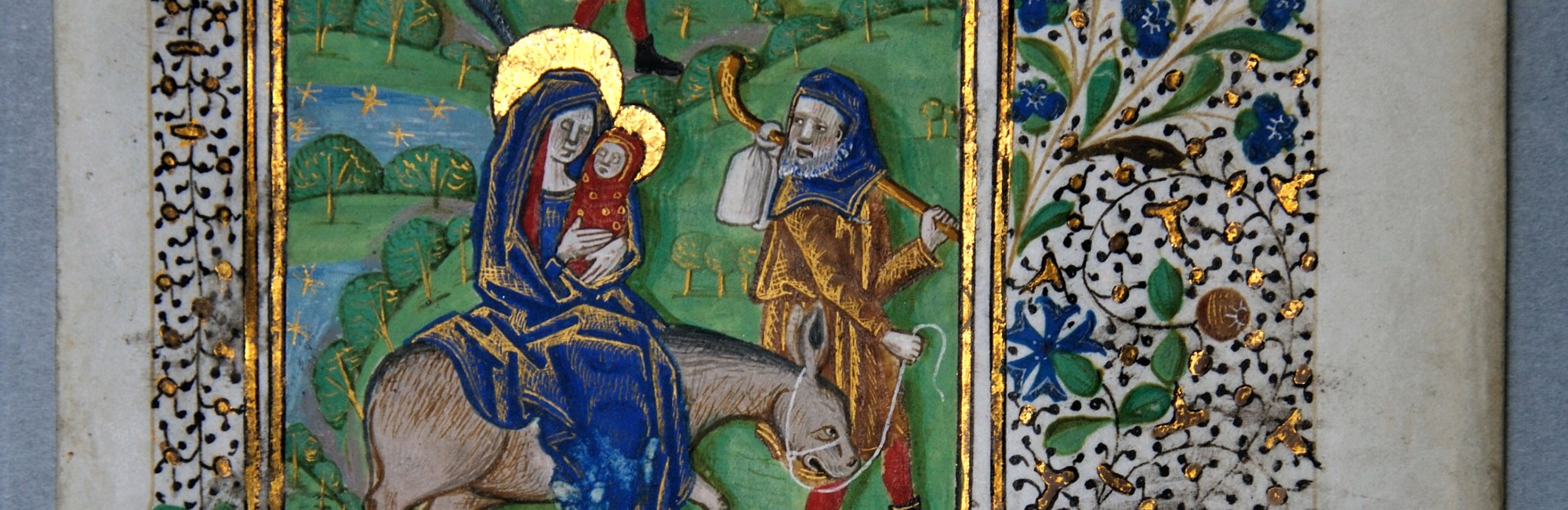
The page above is from a 15th century Book of Hours, written in France on vellum, showing Joseph and Mary taking Jesus to Egypt. (Fragment 19 from the Reed Rare Books Collection in Dunedin, New Zealand.)
At the top of the page you'll see a photograph of The Milky Way, a stunning image of effervescent cosmic life rising and falling in the endless creativity of our galactic home. In some Australian First Nations' stories, the Milky Way is a river in the sky by the side of which the ancestors camp, living on fish and water lily bulbs. In Greek mythology, the Milky Way is the Goddess Hera's spurting breast milk.