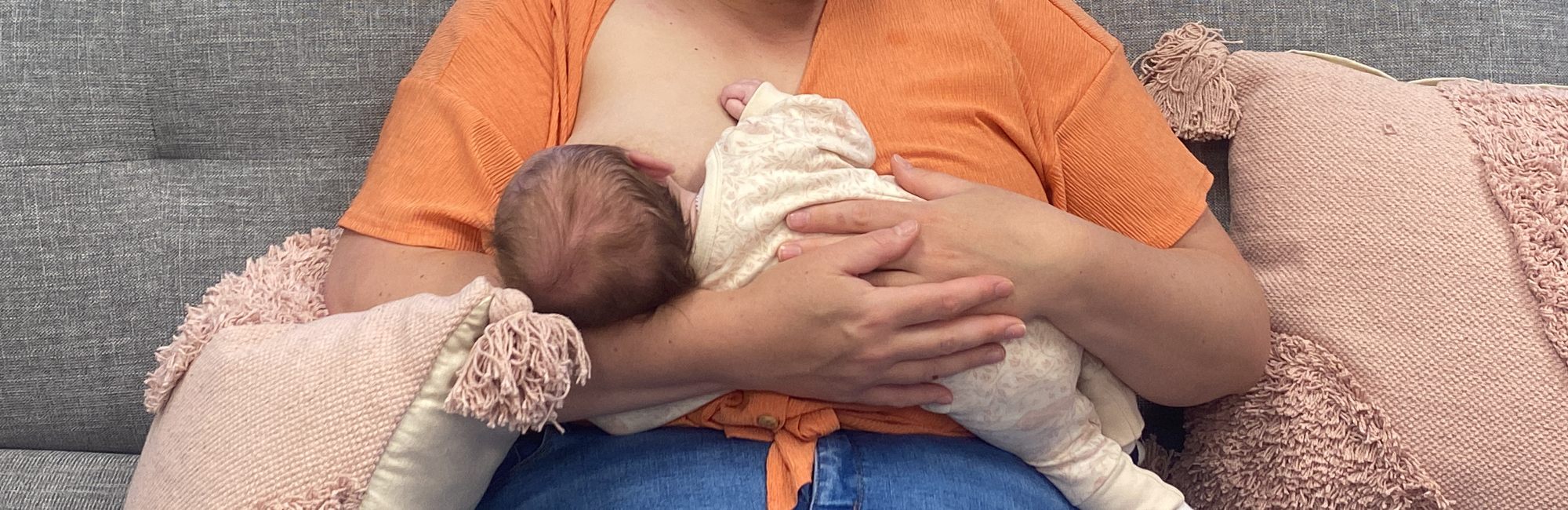
Micromovements in breastfeeding: horizontal, vertical, and angle-control
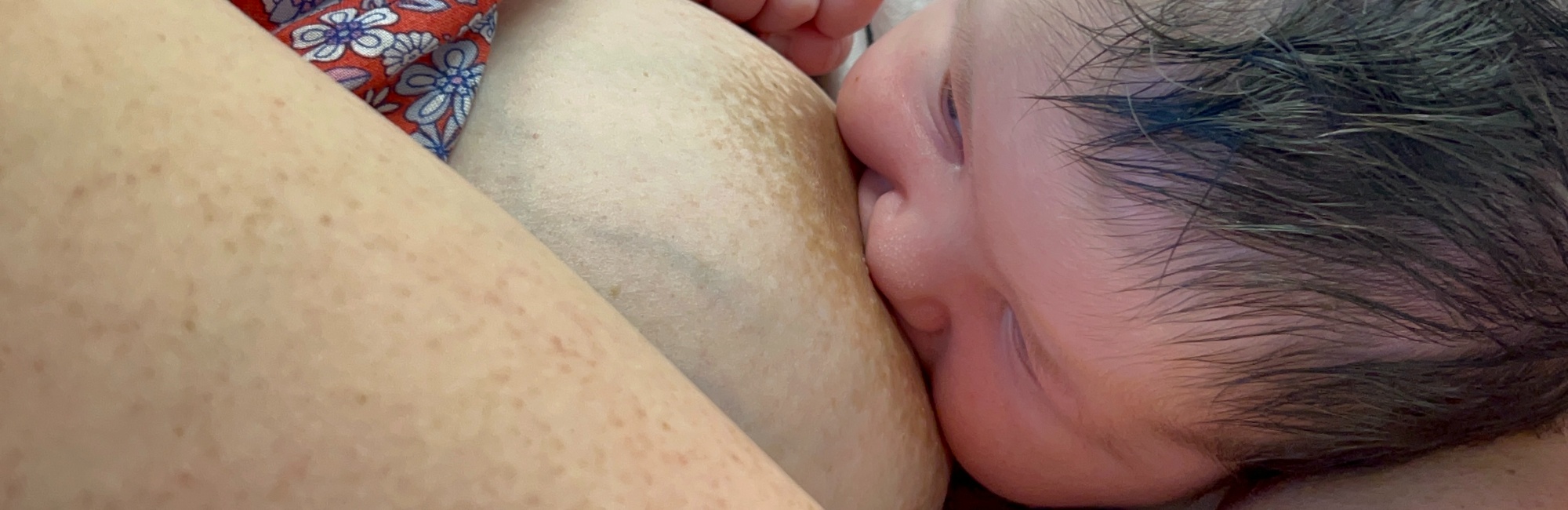
Baby's head is tilted back with her nostrils touching the breast but allowing easy air flow
Your baby is most comfortable drinking with her head and neck either neutral or tilted back slightly. But you don't have to think about this. You only need to be experimenting with micromovements.
You'll notice that wrapping a newborn's bottom and legs tightly up under the opposite breast, with slight micromovements towards her feet, and lovely firm pressure using your 'paddle-hand' between her shoulder-blades, releases her nostrils just that little bit as they rest against your breast, so that baby is breathing comfortably. That's all you need to be experimenting with!
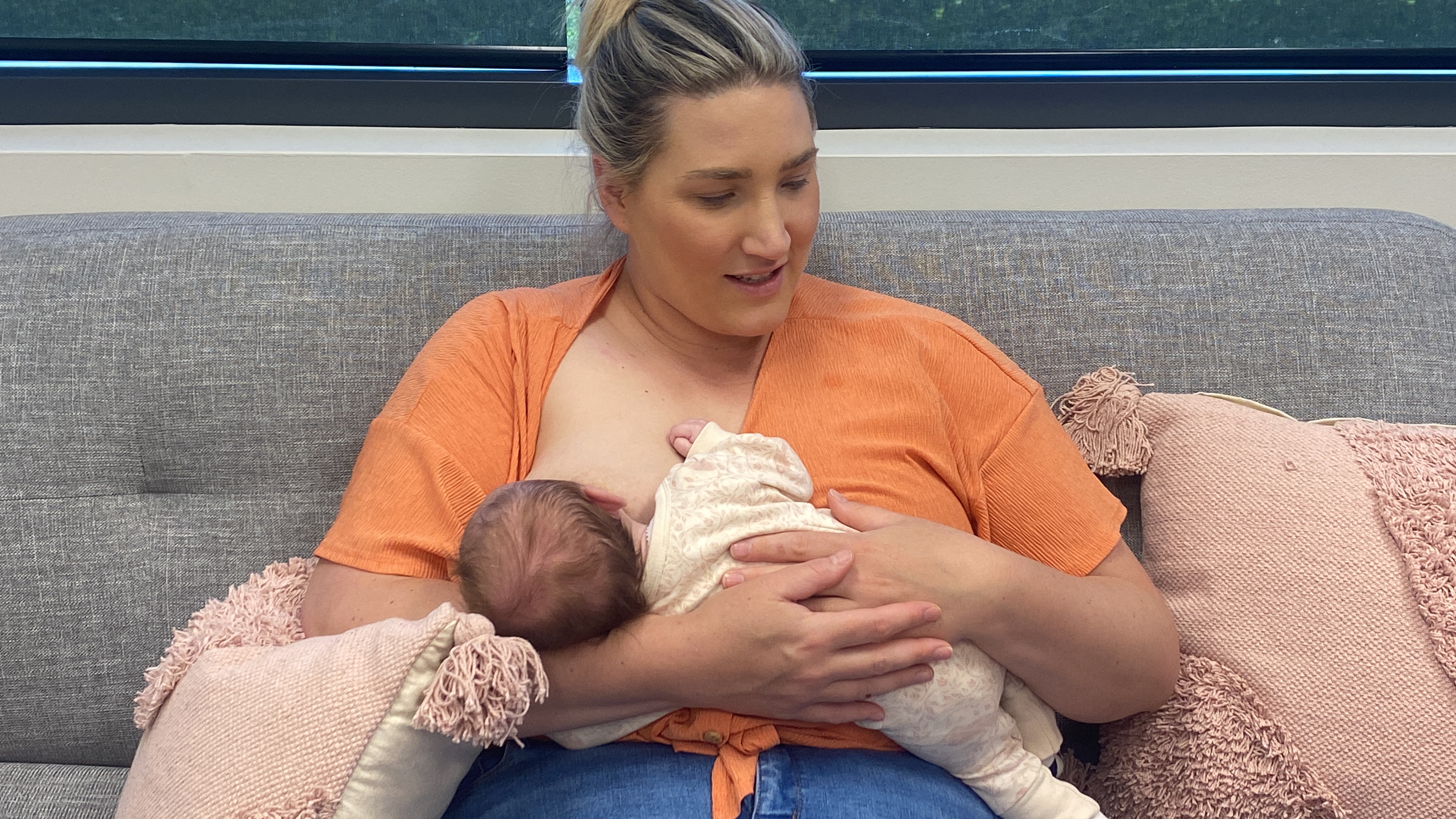
Vertical micromovements of baby's body
The first way you can eliminate breast tissue drag is by experimenting with tiny vertical adjustments of the baby's head, higher or lower.
A micromovement worth checking out regularly throughout the feed is the 'down and in' (just by millimetres!). This is because it's common to hold baby too high relative to where the breast wants to fall, placing an upward drag on the nipple. Experimenting with dropping baby lower, millimetre by millimetre, can be very helpful.
Other women (often with more delicate breasts) find that baby is dragging the breast tissue down too low, and they are much more comfortable when baby is held higher.
Horizontal micromovements of baby's body
With horizontal micromovements, the baby remains deeply pressed in against your body. The aim is to move the baby relative to your breast, rather than having your breast move with the baby. These micromovements are directed mostly from your hand placed like a paddle with fingers together between his shoulder blades, or also from your forearm which is supporting his head.
We often need to pull baby back from an overshoot when coming on to the breast, just by a tiny amount. We often tend to bring baby on a little too far towards the upper arm on that side. We can start pulling back slightly towards the baby's feet - always only by millimetres, experimentally, to see what it feels like, and what the baby does.
You will notice that if your baby seems to have drowsed off, a micromovement or two often reminds your baby that she's at the breast, and she begins to suck again. There's no need to tickle baby's feet or back to wake her up at the breast, as this can be an aversive or unpleasant sensation for babies. Of course, your baby might simply be done, and you might just take her off.
Pay deep attention to even slightly different sensations in your nipple as you use micromovements. Experiment!
Early on when you're both getting the hang of it, or if you have nipple pain, it's best to keep trying to find the place that feels just right, without discomfort or pain, in which baby is most dialled down, right throughout the feed.
Angle control with your forearm
Although you will never be able to see from side on, and are doing this by feel, getting that deep, symmetrical face-breast bury with the little cheeks symmetrically buried in against your breast requires what I call 'angle control'. This is experimentation with the angle at which baby buries the lower half of his little face into your breast.
In angle control, you use your forearm to create a slight rolling action, to achieve that lovely symmetrical face-breast bury.
If your forearm is hugging the baby up too close to her neck, her little head and face will tend to fall back over your forearm and her lips become visible. Experiment with having your forearm further towards the back of your baby's head, so that you can do micromovements adjusting the plane of contact between baby's face and the breast so that there is no breast tissue drag.
Recommended resources
Paying attention to micromovements is the best way to heal up nipple pain and damage
The power of micromovements
Selected references
Douglas PS, Keogh R. Gestalt breastfeeding: helping mothers and infants optimise positional stability and intra-oral breast tissue volume for effective, pain-free milk transfer. Journal of Human Lactation. 2017;33(3):509–518.
Douglas PS, Geddes DB. Practice-based interpretation of ultrasound studies leads the way to less pharmaceutical and surgical intervention for breastfeeding babies and more effective clinical support. Midwifery. 2018;58:145–155.
Douglas PS, Perrella SL, Geddes DT. A brief gestalt intervention changes ultrasound measures of tongue movement during breastfeeding: case series. BMC Pregnancy and Childbirth. 2022;22(1):94. DOI: 10.1186/s12884-12021-04363-12887.