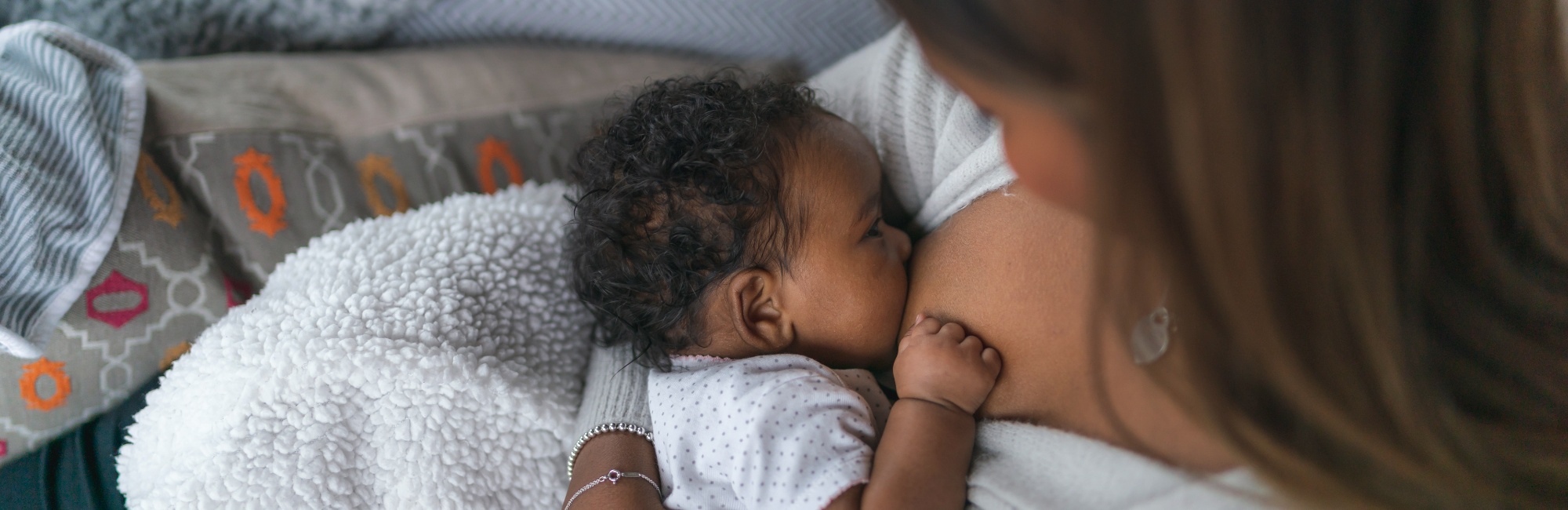
Part 1. Muhammad is nine weeks old when Angelika asks me for help with the wounds on her nipples: hearing what has happened so far, including about baby's frenotomy and bodywork therapy, and checking out Angelika's nipple shields

Disclaimer: the case below is an amalgam of multiple cases that have presented to me, and is not derived from any specific or identifiable mother-baby pair who have seen me as patients. Needless to say, all names are fictional.
Angelika has nipple pain from the very first time she breastfeeds baby Muhammad
“From the very first breastfeed, the pain was awful!” Angelika tells me. Muhammad is now nine weeks old, dressed in a white tee-shirt and little cotton romper with sailing boats on a blue background, gazing at me from his mother’s arms.
“The midwives said to count to twenty, that it was normal to have some pain when I put him on at first.”
“Ok.” I nod, cautiously. Although most women experience pain in the first days of breastfeeding in our society, that doesn’t mean that nipple pain should be expected and tolerated. In my view, women have the right to receive help as soon as there is any sign of pain.
“By day three, the nipple shield was full of blood after I’d fed him. Both my nipples had huge ulcers with yellow scabs, which would come off each time I breastfed. Actually, a huge chunk fell out of my left nipple, I had this hole...”
I shake my head a little, draw in my breath, and wince slightly, letting her know that I get how terrible this experience has been. Angelika tells me that by the second week of Muhammad’s life, he was bottle-fed, sometimes expressed breast milk, sometimes formula. She pumped when she could but was also trying to let her breasts heal.
Muhammad is diagnosed with tongue-tie and treated with frenotomy and bodywork but the pain continues
“Then at three weeks a lactation consultant diagnosed a tongue-tie. The paediatrician and the GP had both said not to worry about it, but we could see that it came along way up the undersurface of the tongue, and I was desperate. The paediatrician snipped it for us in the end, about three weeks ago.”
“Did that help, do you think?” I ask.
“Yes, it did,” Angelika replies. But nevertheless, for the past two weeks she’s only been able to breastfeed a few times each day, using nipple shields. The pain remains severe. Otherwise, Muhammad takes expressed breast milk. Because he’s been gaining weight well, Angelika and her partner haven’t used formula for weeks. I check the weight gains and agree: he’s been gaining on average over 200 gm each week.
Two International Board Certified Lactation Consultants (IBCLCs) have again recently reassured Angelika that her fit and hold is fine. Attachment and positioning, they would have said. One of them recommended a repeat frenotomy, with laser this time, which that lactation consultant thought would be more thorough and effective than the scissors treatment he'd already had. She referred the family to a dentist.
This same lactation consultant also said the baby's upper lip frenulum was too tight, but that they could wait and watch with that. Both IBCLCs strongly recommended orofacial myology, or bodywork, for Muhammad, which the family has been doing. Angelika’s husband Gil has been doing some research, and that’s how she ended up making an appointment to see me - they want another opinion.
“Gil really wanted to come, but he couldn’t get out of work. He’s worried about me.” Angelika pauses and looks steadily at me for a moment. “I’m not sure how much longer I can keep going. I’ve really wanted to breastfeed. I always thought I would breastfeed, but I’m at the end of the road now. It’s just been so stressful. I dread breastfeeding.”
I nod a little. “It’s completely normal for women to dread breastfeeding when they have pain – and the pain can be shockingly severe even when there isn’t visible damage.” I finish taking the history. Soon, I’m checking out Angelika's breasts. She unclasps her bra, gingerly removes the breast pads, slowly peels off the hydrogel discs, wincing.
Angelika has severe ulceration of both nipples
The damage to each of Angelika’s nipples is severe, and much worse on the left. I shake my head, concerned.
“Have you seen nipples this bad before?” she asks, still astonished at what’s happened to her body.
“I’ve seen some dreadfully damaged nipples over the years. But this is definitely at the severe end,” I reply.
She has ulceration on the face of her nipple, with granulomatous tissue visible and yellowish sloughing over a quarter of the face of the right nipple, and three-quarters of the face of the left.
I notice where her breasts want to fall naturally, in response to gravity. In Angelika’s case, the bra is not affecting her breast fall much. The nipple on the left looks more to the side than the nipple on the right. There is plenty of room under the breast and over her abdomen for the baby to achieve a face-breast bury, without being forced to angulate the little face relative to the breast and drag on the breast tissue.
You can read what to notice about your working breasts here.
“But I should tell you, I have also seen worse. One woman emailed me recently ten months after I last saw her, to tell me how much she’s loved breastfeeding. When I first saw her, her nipples were even worse than yours, if you can believe it. After we finished working together she went on to breastfeed frequently and happily, and is only now thinking of weaning.”
Angelika pulls a face, and carefully restores the hydrogel and bra, trying to imagine damage worse than she is enduring. But also, perhaps, hearing that there is hope.
There's no abnormality to find when I examine baby Muhammad
With Angelika's help, I examine the baby, including his little face and mouth. The frenulum under his tongue looks normal. It is a little ragged due to the scissors frenotomy, and still projects perhaps 25% percent along the under surface of his tongue. He has, however, perfectly adequate tongue mobility, since even during the examination the tip of his tongue extends out on to his lower lip. It really only needs to reach his lower gum. There's a small divet visible on the tip of his tongue but the tongue moves normally from side to side, tracking my forefinger as I run it along his lower gum.
We can’t extrapolate from findings about tongue shape and movement from an oral examination, to make judgements about how well he can breastfeed - I'll need to watch a feed for that. Tongue movement and shape during an examination is highly dynamic and often defensive (babies don’t like it) and doesn't functionally equate to breastfeeding.
But everything is looking normal.
I check out the nipple shields that Angelika has been using
I check the size of the nipple shields Angelika uses, holding them close to her breast. They are, as is commonly the case, too small. Her nipple and breast tissue will swell when the shield is applied and the baby feeds.
It’s often estimated that there needs to be a two millimetre gap between the base of the nipple and the shield, that’s a four millimetre increased diameter. But this is just a guess, because the amount a nipple expands with a breastfeed varies significantly, the same way women’s anatomies vary, and experimentation is required. I often suggest that women have two sizes at home, and try between the two, to see which is more comfortable, and which size the baby seems to manage best.
I explain this, and take a new, larger shield from the cupboard. "Would you like to try with a bigger shield?" I ask.
"Sure. ... But anyway, do shields decrease milk flow?” she asks.
“When I was a young doctor doing this in the mid-nineties, studies showed that the shields did seem to reduce the flow. But there's no effect of the very thin modern nipple shields on milk flow, or if it exists at all the baby easily compensates for it, as long as we use the shield correctly. We don’t want the shield compressing the nipple and breast tissue because it’s too small, which will compress the ducts and decrease milk flow. We also don’t want the tip of the shield pinching in inside the baby’s mouth, or the sides collapsing in, which will block the flow. But once we get the fit and hold right usually a shield effectively protects the nipple while it is healing.”
Little Muhammad is dialing up.
“He wants to feed,” Angelika says. I look at her doubtfully.
"This is very severe ulceration of your nipples. The pain must be awful. Are you truly sure you want to go ahead?" I ask.
You can find Part 2 of Angelika and baby Muhammad's story here.