
The hypothesis that white spots are caused by milk dysbiosis or ductal biofilm lacks biological plausibility and promotes antibiotic overuse
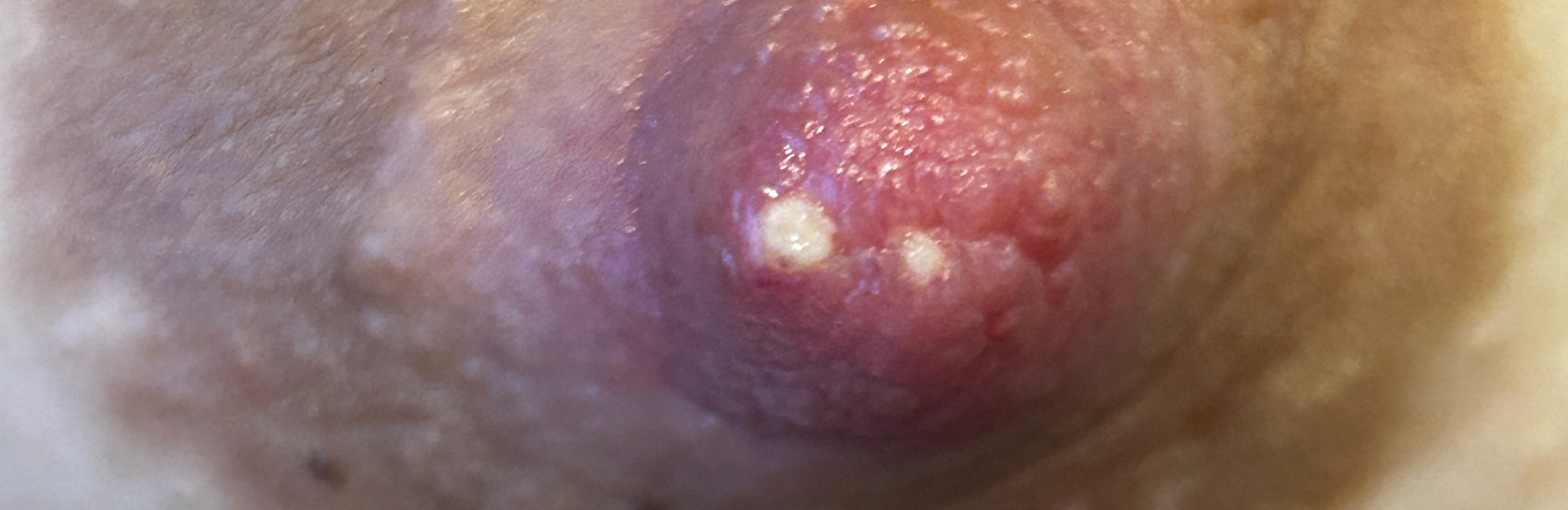
The hypothesis that white spots are caused by mammary dysbiosis is not supported by evidence and lacks a convincing pathophysiological rationale
Mitchell et al. hypothesize that white spots result from subacute mastitis and mammary dysbiosis, in which ductal biofilm formation extends to the nipple epithelium.1, 2 Their hypothesis builds on the 2017 Rodriguez and Fernandez hypothesis that breast inflammation results from biofilm blockages within lactiferous ducts.3
But the diagnoses of mammary dysbiosis and subacute or subclinical mastitis are not supported by the evidence, and the hypothesis that breast inflammation is caused by intra-ductal biofilm is unconvincing. Pathogenic biofilm formation may be an occasional late-stage development in a cascade of severe breast inflammation, not causative. Similarly, there is no convincing evidence-based rationale to suggest that white spots are an extension of intra ductal biofilm to the face of the nipple.
These pathogenic bacterial models result in widespread prescription of short or prolonged courses of antibiotics for lactating women, with little evidence of benefit relative to the passage of time, and contribute to the global problem of antimicrobial resistance.4-6
Analysis of Mitchell et al 2020
In 2020, Mitchell et al published a single case study of a 35-year-old lactating woman in the US. In this analysis, the authors hypothesised that milk blebs are a surface extension of intra-ductal mammary dysbiosis and plugging caused by biofilm formation.1 This hypothesis was then used to inform the Academy of Breastfeeding Medicine Clinical Protocol #36 guidelines for the management of white spots,9 which is further critiqued here.10
Mitchell et al propose that dysbiosis extends superficially to dissect the duct at the nipple orifice, resulting in growth of epidermal tissue over the orifice. The patient had successfully breastfed two older children but her third infant received expressed breast milk exclusively from birth, due to persistent inability to latch, attributed to extremely large nipple size relative to the baby’s mouth. By the time this mother presented 6 months postpartum to a breast surgery clinic, she had received antibiotics for three previous episodes of mastitis, with the last episode occurring two weeks prior. She presented with persistent left breast pain, scattered areas of ‘plugging’ of her left breast and extensive left nipple blebs believed to be occluding multiple nipple orifices, with no erythema. Her milk grew multi-drug resistant Staphylococcus aureus.
The patient was treated with intravenous antibiotic therapy (daptomycin and dalbavancin). Two weeks later, her symptoms had improved but not resolved, and she received further intravenous dalbavacin. Eight weeks later both bleb and pain were completely resolved.1
It is not known if the woman had been
-
Self-treating her blocked ducts and mastitis with massage prior to presentation, which is commonly advised and likely to worsen breast inflammation;
-
Applying breast compressions during mechanical milk removal, which is commonly advised but may predispose to breast inflammation; or
-
Attempting to ‘unroof’ or rub away the white spots, which is commonly advised but likely to worsen pain and hyperkeratosis.
Because this woman had successfully breastfed two infants prior, one for 10 and one for 16 months, it is unlikely that an abnormally large nipple relative to the infant’s mouth explains why she had been unable to latch this third infant over the previous 6 months. Unidentified and unmanaged problems of fit and hold are a more likely explanation. The report of early latch difficulty and brief nipple shield use for the second infant indicate previous emergence of fit and hold challenges. Applying a mechanobiological model, epithelial trauma from excessively high mechanical loads is the most likely cause of both breast inflammations and hyperkeratotic white spots on the nipple in this case. The authors assume that the white spots occluded nipple orifices but the case is more consistent with hyperkeratotic white spots rather than milk blisters.
Analysis of Mitchell and Johnson 2020: antibiotics for subacute mastitis
In 2020 Mitchell and Johnson found nipple ‘blebs’ represented 17% of all referrals to a US breastfeeding medicine practice.2 Thirty-four women were treated for blebs, at the same time as the clinicians addressed milk supply that was in excess of the infant’s needs, as deemed relevant.
Patients were advised to apply mid-potency topic steroid cream ‘to thin the inflamed, fibrinous tissue obstructing the nipple orifice and to reduce pain with latch’ several times a day after breastfeeding, and prescribed 5-10 grams organic powdered sunflower lecithin orally each day. Forty-four percent were prescribed antibiotics for concurrent acute or subacute mastitis.
Two blebs causing acute obstruction were unroofed with a sterile needle. One patient presented with an uncomplicated bleb at five months postpartum, was not compliant with lecithin or topical triamcinolone therapy, repeatedly unroofed her bleb at home, then re-presented months later with a hypertrophic, painful bleb. Triamcinolone injection was unsuccessful. Excision and pathology showed squamous hyperplasia, consistent with hyperkeratosis.
Unfortunately, this methodologically weak retrospective audit does not corroborate mammary dysbiosis as an explanatory model for white spots of the nipple, nor demonstrate treatment efficacy.2 Nevertheless, the mammary dysbiosis model of white spots and antibiotic is incorporated into The Academy of Breastfeeding Medicine Clinical Protocol #36 The Mastitis Spectrum. I published a critique of this scientifically weak clinical protocol here, concerned that we have seen inappropriate antibiotic use with white spots and also a rise in overtreatment of breast inflammation generally as a result.
References
- Mitchell K, Eglash A, Bamberger E. Mammary dysbiosis and nipple blebs treated with intravenous daptomycin and dalbavancin. Journal of Human Lactation. 2020;36(2):365-368.
- Mitchell K, Johnson HM. Breast pathology that contributes to dysfunction of human lactation: a spotlight on nipple blebs. Journal of Mammary Gland Biology and Neoplasia. 2020:http://doi.org/10.1007/s10911-10020-09450-10917.
- Rodriguez JM, Fernandez L. Infectious mastitis during lactation: a mammary dysbiosis model. In: McGuire M, Bode L, editors. Prebiotics and probiotics in human milk: Academic Press; 2017. p. 401-428.
- Douglas P. Re-thinking benign inflammation of the lactating breast: a mechanobiological model. Women's Health. 2022;18:17455065221075907.
- Douglas PS. Re-thinking benign inflammation of the lactating breast: classification, prevention, and management. Women's Health. 2022;18:17455057221091349.
- Douglas PS. Re-thinking lactation-related nipple pain and damage. Women's Health. 2022;18:17455057221087865.
- O'Hara M. Bleb histology reveals inflammatory infiltrate that regresses with topic steroids: a case series. Breastfeeding Medicine. 2012;7 (Suppl 1):S2.
- Witkowska-Zimny M, Kaminska-El-Hassan E. Cells of human milk. Cellular and Molecular Biology Letters. 2017;22(11):doi:101186/s111658-101017-100042-101184.
- Mitchell KB, Johnson HM, Rodriguez JM, Eglash A, Scherzinger C, Cash KW, et al. Academy of Breastfeeding Medicine Clinical Protocol #36: The Mastitis Spectrum, Revised 2022. Breastfeeding Medicine. 2022;17(5):360-375.
- Douglas PS. Does the Academy of Breastfeeding Medicine Clinical Protocol #36 'The Mastitis Spectrum' promote overtreatment and risk worsened outcomes for breastfeeding families? Commentary. International Breastfeeding Journal. 2023;18:Article no. 51 https://doi.org/10.1186/s13006-13023-00588-13008.