
Complexity science is foundational to Neuroprotective Developmental Care or the Possums programs

What is complexity science?
Here are the basic tenets of complexity science, which I've adapted to develop the NDC or Possums programs for breastfeeding problems, unsettled infant behaviour and family well-being in early life. The woman and her baby, the carer and their baby, are conceptualised as a complex adaptive system (CAS).
-
A CAS is comprised of myriad different factors which interact and co-evolve together
-
A CAS is nested within bigger CASs (such as family and society), and comprised of many smaller CASs (such as the enteromammary immune system, or the stress response system, or orofacial and breast anatomies)
-
CASs are inherently resilient, with myriad feedback loops operating to keep the system stable
-
Small perturbations early on can have unpredictable and amplified effects within the CAS down the track ('the butterfly effect')
-
Problems in health and well-being emerge when the CAS can no longer downregulate an imbalance
-
Specific elements of the system may amplify and change the complex interacting functions within the system (known as 'attractors')
-
Simple, or simplistic, interventions into a CAS commonly result in unexpected, unintended outcomes (that is, reductionist interventions may cause more problems than they solve in the end, not least because the real causes have not been addressed)
-
Experimentation with multiple strategies (offered from a coherent holistic approach) are typically required when a problem emerges from a CAS, to downregulate and stabilise the system.
It was a great relief for me to watch complexity science emerge as a lens adapted for general practice and health in the 2010s, including through the pioneering work of GP-academics Professor Joachim Sturmberg in Australia and Professor Trisha Greenhalgh in the UK. Finally, attempts to improve clinical outcomes (in my case, in the field of mothers and babies) had a theoretical framework which broke free of the outdated, reductionist, biomedical theoretical models!
Leaning into complexity science to develop the holistic, multi-domain NDC approaches to infant care and breastfeeding challenges
I and colleagues wrote an article back in 2011 showing why complexity science was the most appropriate way to think about unsettled infant behaviour, which you can read here. (It actually became the cover article for that issue of the Archives of Disease in Childhood.) This early complexity science paper began to lay the evidence-base for the Possums 5-domain approach to unsettled infant behaviour, itself built upon the innovative Neurobiological Model of Infant Crying Behaviour, published here, in 2012.
It was extremely difficult getting this sort of thing through editors and reviewers into the broader medical research literature back then, and often I had to abandon key elements for the sake of getting something novel published (even if it was, in my mind, incomplete). This was the case with my article on crying babies in the BMJ that same year (another cover article, as it turned out).
This BMJ article was the first time that breastfeeding problems were integrated into a clinical guidelines for crying babies internationally, as far as I'm aware, including the possibilty that not enough calories and feed spacing resulted in excessive crying behaviours in breastfed babies.
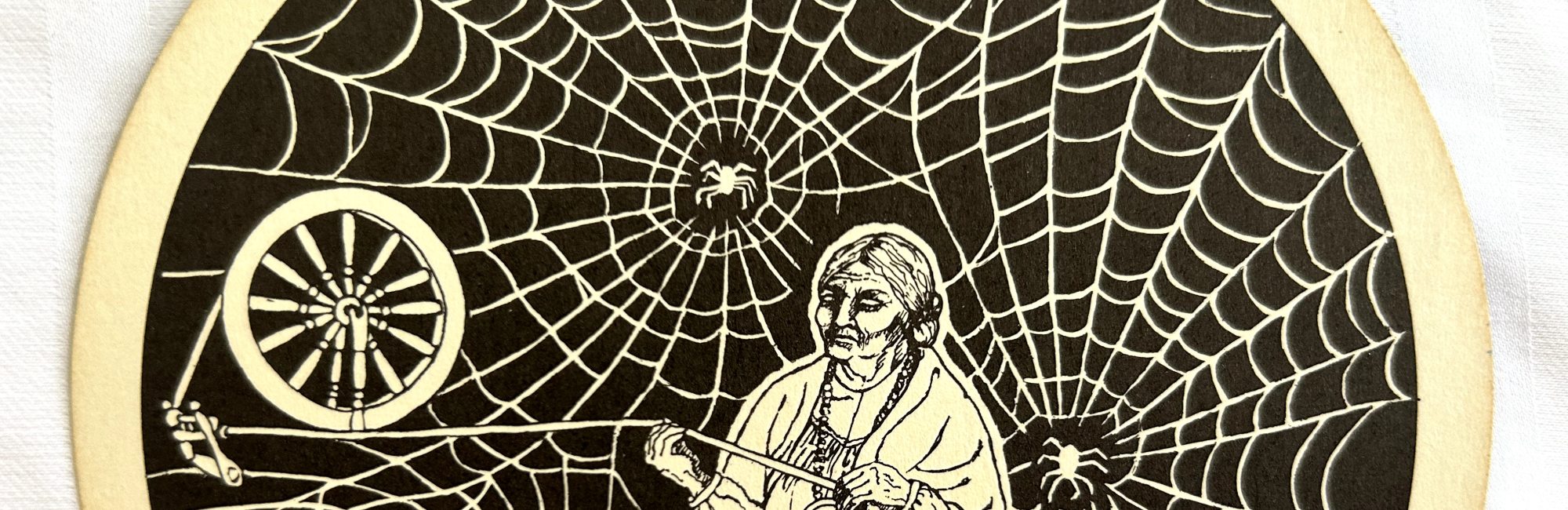
In the year 2000, when I first presented the Possums programs in early form to a national conference of the Australian Lactation Consultants Association in Melbourne, Australia, I used a celluloid photographic slide (that was the powerpoint equivalent back then) showing a five-stranded web to illustrate the interaction between the five relevant domains, with the words 'physiological equilibrium' placed at the centre of the web. Although dynamic systems theory was around at that time, it hadn't yet been translated into complexity science for health systems. I was trying to use an image which communicated complexity, the way multiple factors are interconnected when we are dealing with complex clinical problems (such as a crying baby), and how this demandedthe a holistic, multilateral clinical approach.
I boldly began my presentation with an image of an old American First Nations woman spinning a web. The web has been used as an ancient symbol for the connectedness of things across many First Peoples cultures, and older women have held this knowledge for their communities for millenia.
Needless to say, the image didn't go down well! I think it might be better understood by an audience of (what was then, and probably still would be, mostly) women today. My work didn't go down well, either, with lactation consultants. But I had the view, even in 2000, that perhaps the most important way we could improve breastfeeding rates was to better respond to unsettled infant behaviour, examining how breastfeeding problems often remained either unidentified, or misidentified using a reductionist or medicalised lens as reflux, allergy, or lactose intolerance. I believed a holistic biological system framework was required, and I was experimenting how best to communicate this.
Now, in 2024, people are much more accustomed to thinking about complex systems and whole-of-system approaches, whether ecologically or sociologically or in health. It's whole-of-system approaches which will save the planet, if we're to pull that off, and which will drive health system costs down. I've developed Neuroprotective Developmental Care or the Possums programs from these same whole-of-system principles over the past few decades.
February 2024
Selected references
Braithwaite J, Churruca K, Long JC. When complexity science meets implementation science: a theoretical and empirical analysis of systems change. BMC Medicine. 2018;16:63.
Douglas PS, Hill PS, Brodribb W. The unsettled baby: how complexity science helps. Arch Dis Child. 2011;96:793-797.
Greenhalgh T. Complexity theory and family medicine: a new symbiosis. Prim Care. 2010;10(2):19.
Greenhalgh T, Papoutsi C. Studying complexity in health services research: desperately seeking an overdue paradigm shift. BMC Medicine. 2018;16:95.
Heath I, Rubinstein A, Stange KC, Van Driel ML. Quality in primary health care: a multidimensional approach to complexity. Br Med J. 2009;338:911-913.
Sturmberg JP. Systems and complexity thinking in general practice. Aust Fam Physician. 2007;38(3):170-173.
Sturmberg JP. The Foundations of Primary Care: Daring to be Different. Oxford: Radcliffe; 2007.
Sturmberg JP. EBM: a narrow and obsessive methodology that fails to meet the knowledge needs of a complex adaptive clinical world: a commentary on Djulbegovic, B., Guyatt, G. H. & Ashcroft, R. E. (2009) Cancer Control, 16, 158-168. J Eval Clin Pract. 2009;15:917-923.
Sturmberg JP, O'Halloran DM, Martin CM. People at the centre of complex adaptive health systems reform. Med J Aust. 2010;193(8):474-478.
Wolpert M, Rutter H. Using flawed, uncertain, proximate and sparse (FUPS) data in the context of complexity: learning from the case of child mental health. BMC Medicine. 2018;16:82.
