A biological systems approach to classification of acute and end-stage breast inflammation in the lactating breast

Breast inflammation is a spectrum condition in lactation
The interaction between networks of inflammatory signals within the lactating mammary gland immune system, triggered by high intraluminal pressures, determines the severity of breast inflammation, its duration, and resolution.
The common diagnoses used on the spectrum of breast inflammation are poorly defined and have overlapping presentations. For this reason, NDC proposes a complex systems approach to the spectrum of breast inflammation presentation, which results in a classification system using two main categories
-
Acute breast inflamation
-
Endstage breast inflammation.
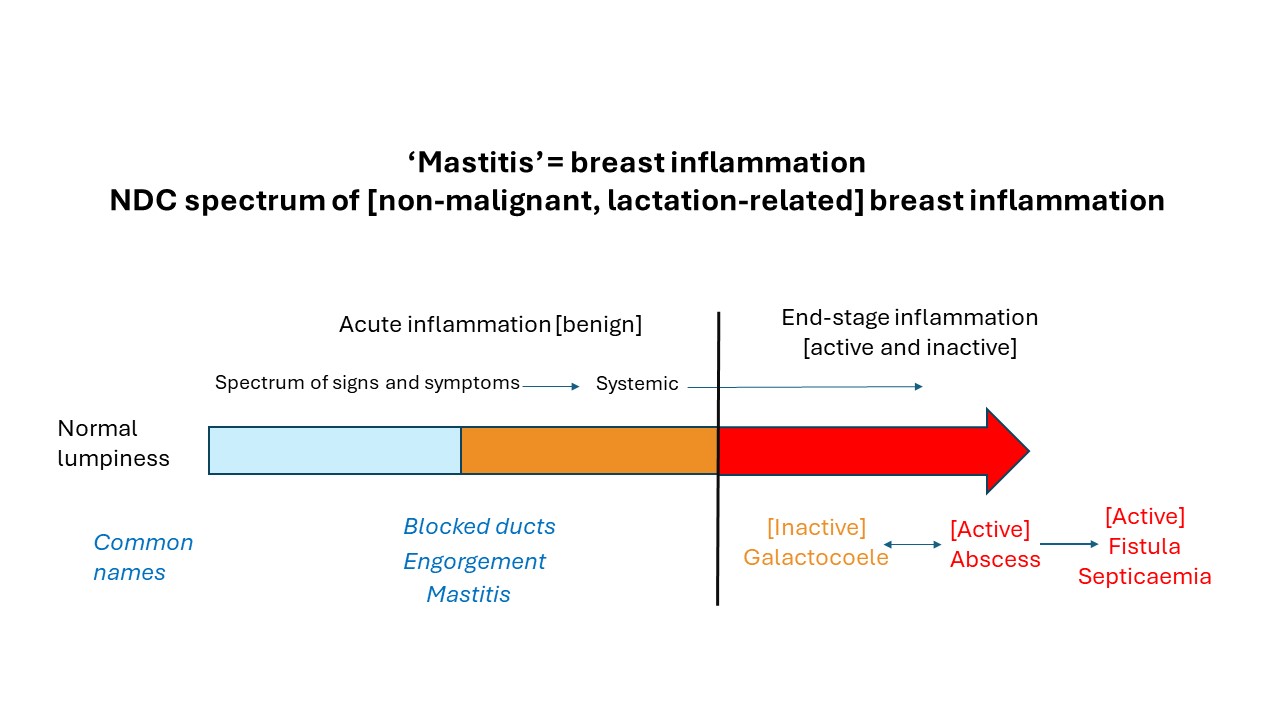
Acute lactation-related breast inflammation
The first, benign lactation-related breast inflammation, is described clinically by relevant presenting signs and symptoms, selected from signs and symptoms on the spectrum of breast inflammation detailed in the table below.
Engorgement, a diagnosis with clearer and agreed definition, is conceptualised as a bilateral and generalised presentation of breast inflammation. From a complexity science perspective, breast inflammation emerges out of multiple interacting systems, and is located along a spectrum of severity, spread, and systemic involvement.
When acute breast inflammation becomes more severe, whether localised or generalised, systemic responses of fever, myalgia, and rigor are triggered.
End-stage lactation-related breast inflammation
The second category is end-stage (non-malignant) inflammation of the lactating breast, with sub-categories of active or inactive. Three well-defined diagnoses fall within the category of active, end-stage (non-malignant) inflammation of the lactating breast: abscess, fistula and septicaemia. Though non-malignant, these conditions are also not benign.
An abscess is described by the relevant presenting signs and symptoms of lactation-related breast inflammation selected from the table below.
The diagnosis of galactocoele, also well-defined, sits within the category of inactive, end-stage (non-malignant or benign) inflammation of the lactating breast. A galactocoele is also described by the relevant presentation of signs and symptoms detailed below.
Clinical signs and symptoms used to classify acute and end-stage breast inflammation
This table is designed to be placed in medical records so that the relevant sign or symptom highlighted.
| Location of inflammation | Dimensions (millimetres) | Erythema | Pain | Systemtic signs + symptoms |
|---|---|---|---|---|
| Generalised - bilateral | None | None | Feels well | |
| Generalised - unilateral R or L | Mild | Mild when touched only | Fever | |
| Localised WITHOUT lump | Moderate | Mild constant | Myalgia | |
| Localised WITH lump | Severe | Moderate when touched only | Rigor | |
| Moderate constant | ||||
| Severe |
Selected references
Ingman WV, Glynn DJ, Hutchinson MR. Inflammatory mediators in mastitis and lactation insufficiency. Journal of Mammary Gland Biology and Neoplasia. 2014;19:161-167.
Douglas PS. Re-thinking benign inflammation of the lactating breast: classification, prevention, and management. Women's Health. 2022;18:17455057221091349.
Guillen-Morales DdJ, Cruz-Cortes I, Sosa-Velazco TA, Aquino-Dominguez AS. The mother-infant symbiosis: a novel perspective on the newborn's role in protecting maternal breast health. Hygiene. 2025;5(46):https://doi.org/10.3390/hygiene5040046.