Human milk oligosaccharides
-fotor-20250322152734.jpg)
What are human milk oligosaccharides (HMOs)?
Human milk oligosaccharides (HMOs) are a structurally diverse family of carbohydrates in breast milk that play key non-nutritive roles in early life.
-
HMOs are the third most abundant solid component after lactose and lipids, with typical concentrations around 5–20 g/L in mature milk, approximately 20–25 g/L in colostrum, and more than 200 distinct structures
-
HMOs are not digested by the infant and reach the colon, where they act as selective substrates for the developing gut microbiota, functioning as intestinal prebiotics
-
HMOs also influence pathogen interactions, including inhibition of certain pathogens like group B Streptococcus, and modulate immune responses and gut barrier properties in experimental systems
-
HMO profile varies from patient to patient.
Breast milk is an essential source of infant nutrition. It is also a vital determinant of the structure and function of the infant intestinal microbial community, and it connects the mother and infant intestinal microbiota.
Human milk oligosaccharides (HMOs) are a critical component in breast milk. HMOs can reach the baby’s colon entirely from milk and become a fermentable substrate for some intestinal microorganisms. HMOs can enhance intestinal mucosal barrier function and affect the intestinal function of the host through immune function, which has a therapeutic effect on specific infant intestinal diseases, such as necrotizing enterocolitis.
In addition, changes in infant intestinal microbiota can reflect the maternal intestinal microbiota. HMOs are a link between the maternal intestinal microbiota and infant intestinal microbiota. HMOs affect the intestinal microbiota of infants and are related to the maternal milk microbiota.
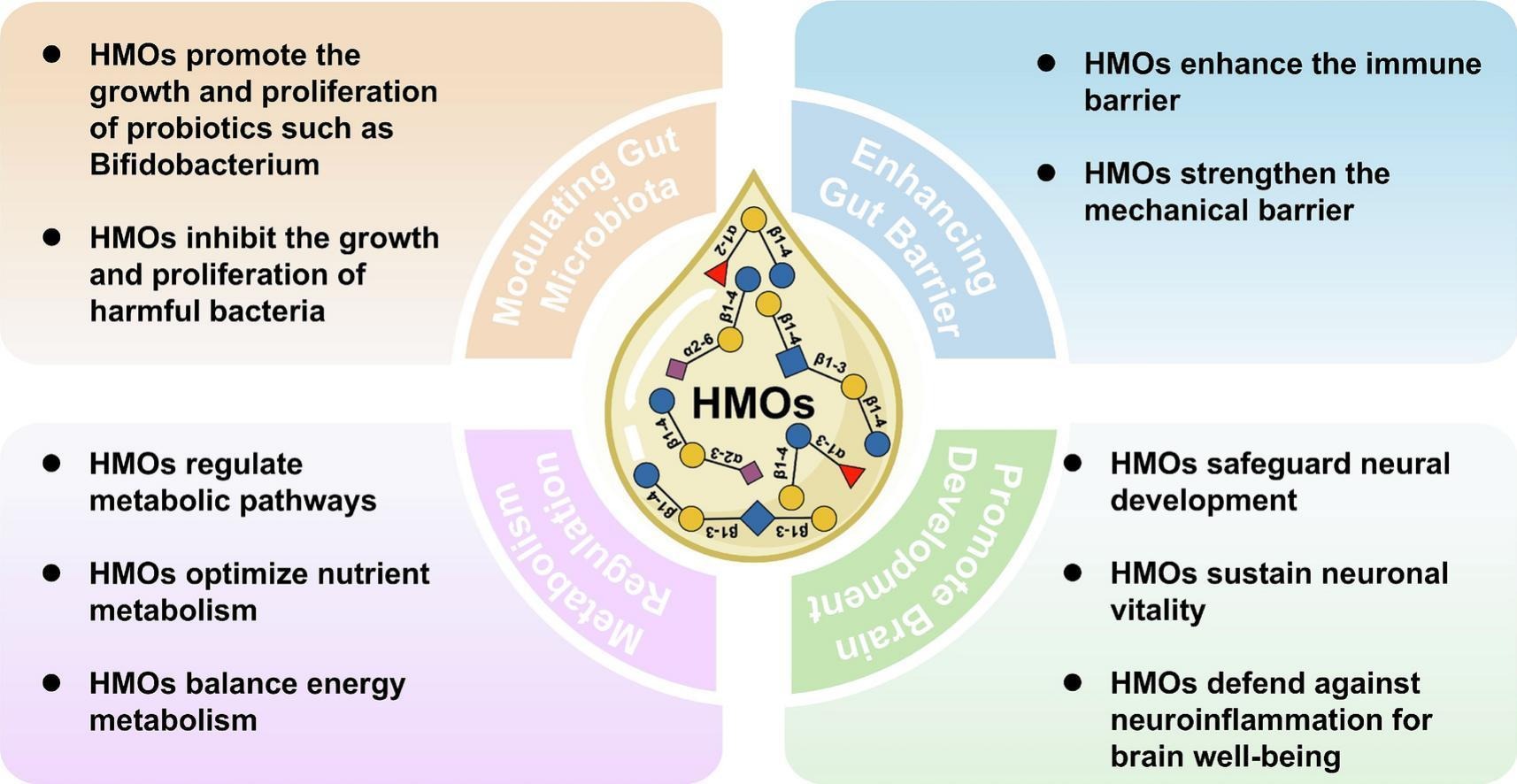
The diagram above is from Xu et al 2025.
Microbiota and prebiotic actions of HMOs
HMOs promote the growth of beneficial bacteria, especially bifidobacteria such as Bifidobacterium longum and Bifidobacterium infantis. These bacteria metabolize HMOs, creating cross-feeding networks that shape the early microbial ecosystem and support a bifidobacteria-dominated microbiota in infancy.
Genetic variation and individuality
HMO profiles are influenced by the FUT2 gene, which encodes an enzyme affecting the fucosylation of milk sugars. 20 to 40% of mothers have a “non-secretor” polymorphism that inactivates the FUT2 gene, resulting in variable HMO proportions in milk. This genetic variation helps explain interindividual differences in microbiota assembly.
But secretor and non-secretor mothers equally promote infant growth and respiratory health through breastfeeding.
Xu et al 2025
This article provides a comprehensive review of human milk oligosaccharides (HMOs), their structural diversity, factors influencing compositional variations, and their role in infant neurodevelopment through the gut-brain axis.
Key points:
-
HMOs are the third most abundant solid component in human milk, classified into neutral fucosylated, neutral non-fucosylated, and acidic sialylated types.
-
Genetic factors, delivery timing, environmental conditions, and maternal health status influence HMO composition in human milk.
-
HMOs modulate gut microbiota, enhance intestinal barrier, and regulate immune responses.
-
They also influence neurotransmitter pathways and neurotrophic factors to promote neuronal development.
-
HMOs have shown promise for inclusion in infant formula to bridge nutritional gaps.
Selected references
Manus C, et al. Front Nutr. 2023 Oct 30;10:1203552. doi: 10.3389/fnut.2023.1203552.
Sun, W., Tao, L., Qian, C., Xue, P., Du, S., & Tao, Y. (2025). Human milk oligosaccharides: bridging the gap in intestinal microbiota between mothers and infants. Frontiers in Cellular and Infection Microbiology, 14. https://doi.org/10.3389/fcimb.2024.1386421
Xu J, Song J, Xu H. Structural diversity, composition variation and neurodevelopmental promoting effects of human milk oligosaccharides: a systematic review. Carbohydrate polymers. 2025;368(124229):https://doi.org/10.1016/j.carbpol.2025.124229.