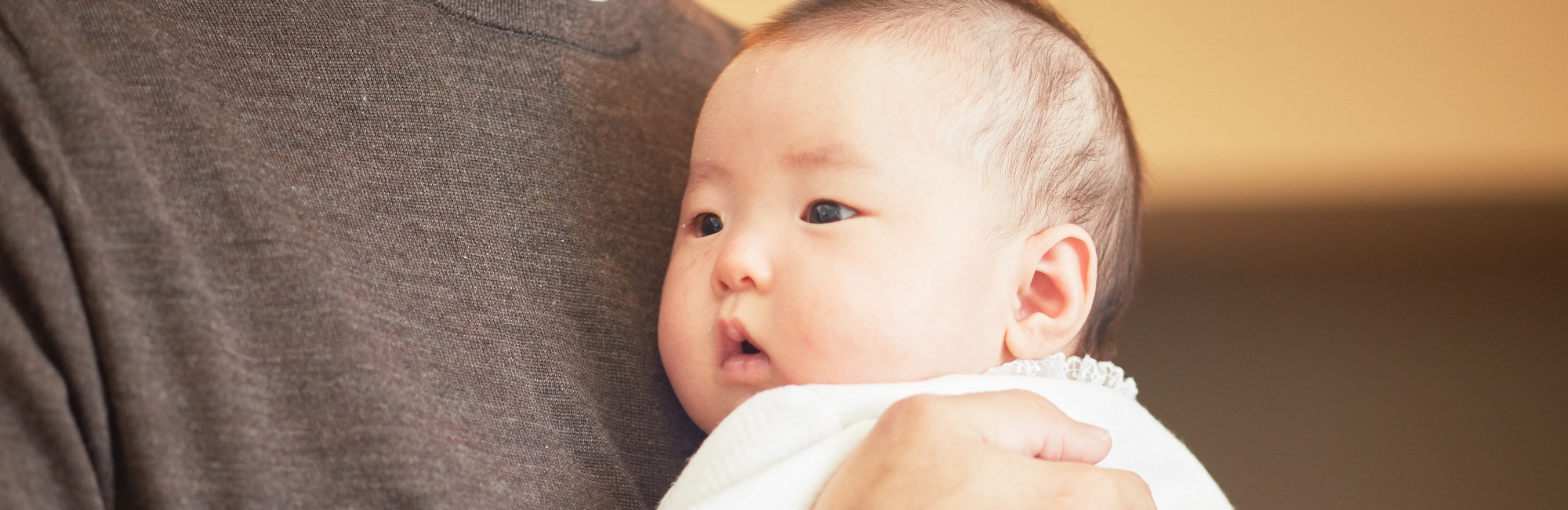
Days 4-25. Verity comes in for a consultation because Riku still won't come on to the breast much

Disclaimer: the case below is an amalgam of multiple cases that have presented to me, and is not derived from any specific or identifiable mother-baby pair who have seen me as patients. Needless to say, all names are fictional.
By day 25 Riku is still fussing a lot at the breast and mostly unable to come on
You can find out about the challenges Verity and her newborn faced in the first four days of Riku's life here.
The family come in to see me for the first time when Riku is twenty-five days old, accompanied by Hiromi's petite grey-haired mother, who tells me warmly when I greet them in the waiting room that Riku means 'wise sky' in Japanese.
Verity maneuvers the pram in, and Hiromi follows with Riku asleep in his arms. We ease the pram in front of the consulting room door once it's shut. I make Verity and Hiromi as comfortable as I can on my two-seater lounge with its open arms, offering pillows to support Verity's back and a low footstool under her feet. I draw up another chair for the grandmother.
"How can I be helpful today?" I ask when we are seated.
"Riku still won't latch," Verity explains. "Sometimes he'll get on and suck for a minute or two, but mostly he cries every time I bring him near, or as soon as I try." She looks at Hiromi, who is paying careful attention.
"He gets so upset, it's awful!" Verity explains. "I'm pumping eight times a day and he has mostly expressed breast milk and one formula bottle of about 60 mls in the evening. I usually try with a nipple shield because that seems to work best."
"How amazing," I observe, "that this baby is receiving mostly expressed breast milk despite everything that you've been through in the past few weeks!"
"The upsetting thing for Verity," Hiromi ventures, "is that Riku gets so upset when she offers the breast, but then happily chugs down the expressed milk from the bottle. It's pretty demoralizing."
"Sometimes I don't even try to offer the breast anymore now," Verity says. "The child health nurse thought perhaps I should take a break from trying to breastfeed, just feed him expressed breast milk in the bottle for a while." I notice Hiromi nodding a little again, in support.
"Honestly, I've tried everything. I've been up to the outpatients clinic to lactation consultants twice. But I've got very flat nipples. Also, a private lactation consultant who visited me at home earlier this week said that Riku has a tongue and upper lip-tie, and that we should think about getting frenotomies done. She said that he is why he has such a weak suck and can't stay on. She advised me to see an oral myofacial therapist urgently, and recommended the one who is in her practice. I took Riku in yesterday. And the oral myofascial therapist, who was kind and spent a lot of time with us, said that he not only has the ties, but has a retrognathia and high palate. She said he has a lot of tightness of the muscles around his temporomandibular joints, which would lead to the shallow suck too. She said he has a torticollis as well, that this relates to the tight fascia. She did quite a lot of work on his very weak suck."
"Which apparently can all go together when there is tongue-tie?" Hiromi adds, uncertainly. "Do you agree with that?"
"There's so much conflicting advice, you just don't know what to believe," Verity says.
"Well, can I suggest I gather up all the information I need, check Riku over, and then let you know my thoughts?"
I take a careful history. Thankfully, Verity has never had nipple pain. Riku regained his birthweight two days ago. He is passing 5 heavy wet nappies and 2-4 palmfuls of stools in a 24 hour period, which indicates good throughput. He had only very slight jaundice, which has resolved, and is mostly quite settled other than when Verity tries to breastfeed.
I check Riku over
I weigh Riku, and check him over. He is a healthy little thing. Though the scales are different, he appears to have gained about 60 gram in the past 48 hours. He has a mild right-sided head-turning preference, with no flattening of the skull.
I perform an oromotor assessment. He has a normal variant of a labial frenulum, which inserts down on the margin of the gum and is rather fleshy. I demonstrate though how flexible his upper lip remains, bringing the lip up high to almost cover his nostrils.
"Don't worry that it blanches," I say, as Hiromi and Verity lean in to watch. "That is normal when we lift the lips like this in babies."
I see normal buccal mucosa, and a palate that could be higher and narrower than some, but which is completely normal. He has a 30 or 40% anterior membrane and excellent tongue-mobility. I show them that when I lay my finger against his gum and lower lip, or lateralise with my finger, his tongue follows, or follows out onto the lower lip. The baby is poking his tongue towards the pad of my finger which I've gently moved over his lower lip and onto his lower gum. There is a small dimple on the tip of his tongue, but this too is insignificant.
"He only needs to be able to bring his tongue to the lower gum ridge in order to breastfeed," I explain. "And look! He is moving is tongue beautifully! No tongue tie there! That little membrane you can see is just a normal variant, it's not tying the tongue at all."
Verity and Hiromi look at each other, relieved. "That's good news," says Hiromi.
"His palate could be on the high side," I say, "but goodness, that is also completely normal. Our task is to simply fill it up with as much breast tissue as possible, and there are strategies to do that."
"He does have a rather delicate chin," I add. "But that is normal in babies, too. It changes over time." I notice his father, too, has a smaller chin, but don't mention this.
"And it's true that he has a head-turning preference to the right. There are strategies we need to put in place for this - but this is also unrelated to his breastfeeding problems. You'll see that he can turn his head from side to side completely normally."
I watch Verity try a breastfeed and also find that the nipple shield she's been using is too small
Riku has dialed up a little after the examination, and we agree that Verity will offer the breast in her usual way. Hiromi's mother excuses herself and goes back into the waiting room.
When Verity removes her outer garments and bra, I have opportunity to observe where Verity's breasts naturally want to fall (her 'breastfall'). Sometimes I check this out with the bra on, too, especially if the woman is doing a lot of her breastfeeding with the bra. I notice that Verity's breasts fall low, so that there is little exposure of the 'landing pad' beneath her nipples.
The attempt to breastfeed doesn't go well. She lifts the breast and manages to hold the nipple shield in place, though I see that the shield is too small. Verity holds the baby with her left hand and fingers on the back of his neck and in his armpit. The baby begins to cry as soon as he approaches the breast, back-arching, curling his hands into fists, drawing up his knees. After ten or twenty seconds of the baby's distress, we stop.
Riku quickly settles down in Hiromi's arms, and Hiromi continues to engage him in quiet little interactions.
"The child health nurse said he was picking up on my anxiety," Verity comments tearfully. Hiromi breaks in quickly.
"I wasn't happy about that," he tells me. "Verity has been amazing. She is always so calm with him!"
"It's very distressing for women when the baby won't take the breast," I say, and Verity's tears well up again, this time spilling over and streaming down her cheeks. She locates a tissue in her hand-bag. "But I don't agree that babies have trouble latching because women are anxious."
"You've been parents for nearly four weeks," I continue, "and you know how much conflicting advice is out there!"
"You can say that again," mutters Hiromi, darkly. Verity nods vigorously. "It's just ridiculous. It's unbelievable," she says, with distress, and wipes tears from her eyes and cheeks.
"So I know that I am going to say things that seem very different to what you've heard. I might argue that what we are offering with the gestalt breastfeeding has been developed from the latest evidence, and that in ten or twenty years everyone will be doing something similar. But that doesn't help parents! All parents can do is take what they think might be useful from the people helping them, and experiment with it. Experimentation is your resilience as parents. It's the way you work out what is right for your unique baby and family. I know you'll simply experiment with the ideas I offer you, and see what works."
Verity and Hiromi are listening carefully.
"So to my mind, we have three problems here," I explain, carefully, "which have come together in a perfect storm. Firstly, I can see that Riku has breast tissue drag and positional instability when he breastfeeds. This causes him to fuss and back-arch and pull off. Secondly, I think he has developed some conditioned dialing up at the breast, given that the situation has been so difficult. And thirdly, I think the nipple shield is too small, which means that it will be more difficult for him to transfer milk through the shield, anyway."
I don't say this to the family, of course, but I view these and a majority of the situations families come to see me with as completely preventable. Women try so incredibly hard, health professionals try so incredibly hard, but the strategies both are taught to use often simply don't work.
"You can see," I continue, "that I'm not worried about his oral connective tissues. He has excellent tongue mobility and upper lip mobility, so his tongue and upper lip are not tied. We don't need to worry that he has 'tight connective tissues'. He has a mild right side head-turning preference, which we need to discuss, but this will not impact upon breastfeeding, despite what you've been told. We can help him turn his head in whatever direction we want, and you'll be able to do that when breastfeeding too. He has a normal delicate baby's chin and a normal palate. There is no reason to think he can't suck perfectly well, but first we will need to get rid of the breast tissue drag and repair the conditioned dialing up at the breast. I can never make promises, and we won't be able to change everything immediately, but it does seem to me that we should be able to turn things around fairly quickly."
And together, Verity and I begin our work.
You can find out what we do here.