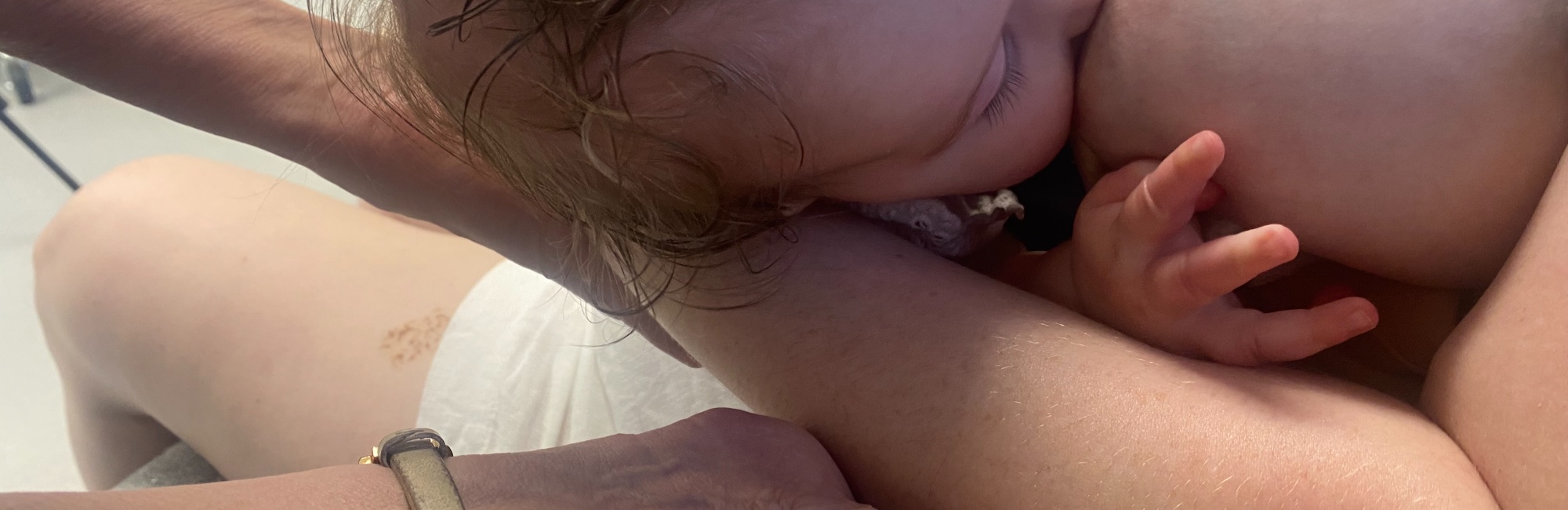
It usually works best to have baby's chest and tummy flat against your body during breastfeeding, with good spinal alignment

Bringing baby's chest and tummy flat against your body turns on his breastfeeding reflexes
Bringing the baby to your body, so that his chest and tummy are flat against your chest and tummy, switches on the breastfeeding reflexes.
Being in the deck-chair position helps this, making it easier to hold the baby against you without fighting against gravity, that is, without you having to carry any weight, and without the baby wanting to fall off you or fall away from the breast.
Hold your newborn horizontal in a ribcage wrap or an older baby slightly diagonal across your body
If you and your baby are having any difficulties, including if the baby is fussing even a little at the breast, and your baby is in the first weeks and months of life, I suggest starting with baby horizontal or close to horizontal across your body.
If baby is still a newborn (depending on baby's length), being tucked up under your other breast is usually best for biomechanics. In a ribcage wrap, your newborn is held snug with his hips tucked up under your other breast, tummy, hips and legs wrapped around the side of you opposite from where he's feeding.
Women often lift the other breast and wrap baby underneath, then allow that breast to rest on baby's body. This can transform breastfeeding. It allows his head to tilt back and helps with the biomechanics - and also protects caesarean section wounds.
Soon though, as baby grows, she'll push off the back of the couch in a ribcage wrap, or a ribcage wrap begins to feel too awkward.
A somewhat diagonal position works as baby grows, still with her chest and tummy pressed up against you, her hip resting on your upper thigh, and her legs out to the side draped onto the couch. Often our older babies have their bottom and legs much further off to one side than you would ever expect, if you are to avoid dragging the breast tissue towards the other side.
Babies will pull off if their nose buries in so that they can't breathe. However, sliding a baby a millimetre or two across towards the baby's feet, or securing that horizontal ribcage wrap if she is still very little, will tilt the head and lift the nose.

Keep baby's spine well aligned
For stable breastfeeding, your baby's spine needs to be aligned through the midline from top to bottom. Breastfeeding goes best when your baby's head, neck, spine and pelvis are in a straight line, aligned right down his little body.
If his little spine or neck is rotated, it becomes difficult to drink comfortably for long, and the baby will pull off. It is much the same as us trying to drink from a glass of water turning our head to one side - it's difficult to sustain!
It's best to keep his pelvis and hips tucked up in nice alignment, without twisting off to one side, too.
Spinal alignment is something you can check out for yourself by feel and by what you can see of your baby while you're breastfeeding. If you thought it might help, you could ask your support person to check out spinal alignment, by standing in front of you and looking at you and baby.
If you have a newborn, spinal alignment in a tight ribcage wrap usually works best. Soon though babies are too long for a ribcage wrap, and need to breastfeed somewhat diagonally across your torso, still with the little spine carefully aligned.
-fotor-20230709184421.jpg)
Your hand supports the baby's upper back (the 'paddle' hand)
It works best to support baby's head with your forearm as she comes onto the breast in what's often referred to as cradle hold.
Support between her shoulder blades with a firm (but never forceful) hand pressure helps stabilise your baby at the breast once she is on. I suggest holding your hand as if it is a paddle, flat, with fingers together. This also tilts baby's head back and lifts her nose a little for comfortable breathing, even as her nostrils rest lightly on the breast.
Remember it's not how you get the baby on, but what you do next once the baby is on, with your micromovements, that really matters. Babies usually come onto the nipple shallowly, but you will quickly change this as baby sucks and you experiment with micromovements. You can find out about micromovements here.

In this demonstration video, above, I (accidentally) have the doll's head touching my upper arm. If we tuck our baby's head into the crook of our arm, with his forehead touching or pressed into our upper arm, our capacity to use our forearm as a lever is compromised. The landing pad might also be compromised because the upper arm is coming up too close to the breast. This means that we may have trouble getting rid of nipple and breast tissue drag. It's important to have a gap between your upper arm and baby's head.
Selected references
Colson SD, Meek JH, Hawdon JM. Optimal positions for the release of primitive neonatal reflexes stimulating breastfeeding. Early Hum Dev. 2008;84:441-449.
Douglas PS, Keogh R. Gestalt breastfeeding: helping mothers and infants optimise positional stability and intra-oral breast tissue volume for effective, pain-free milk transfer. Journal of Human Lactation. 2017;33(3):509–518.
Douglas PS, Geddes DB. Practice-based interpretation of ultrasound studies leads the way to less pharmaceutical and surgical intervention for breastfeeding babies and more effective clinical support. Midwifery. 2018;58:145–155.
Douglas PS, Perrella SL, Geddes DT. A brief gestalt intervention changes ultrasound measures of tongue movement during breastfeeding: case series. BMC Pregnancy and Childbirth. 2022;22(1):94. DOI: 10.1186/s12884-12021-04363-12887.
Moore ER, Berman N, Anderson GC, Medley N. Early skin-to-skin contact for mothers and their healthy newborn infants. Cochrane Database of Systematic Reviews. 2016(Issue 11. Art. No.: CD003519):DOI: 10.1002/14651858.CD14003519.pub14651854.
Schafer R, Watson Genna C. Physiologic breastfeeding: a contemporary approach to breastfeeding initiation. Journal of Midwifery and Women's Health. 2015;60:546-553.
Smillie CM. How infants learn to feed: a neurobehavioral model. In: Watson CG, editor. Supporting sucking skills in breastfeeding infants. New York: Jones and Bartlett Learning; 2016. p. 89-111.