Why your letdowns help prevent or heal inflammation when you're lactating

Your lactating breasts are part of a sensitive and constantly adapting ecosystem (which includes your baby)
Your working breasts are their own magnificently complex yet highly ordered biological system. Your baby's little body is part of that ecosystem, too. The myriad different elements of your mammary immune system, for instance, interact together to protect both you and your baby. The mammary immune system does this in large part by using inflammatory processes.
-
You can find out why you and your baby are a single biological system here.
-
You can find out about your breasts and inflammation here.
There is nothing machine-like about breastfeeding, which is why feeding routines often don't work. Your breast doesn’t work like a machine when it's making milk.
Your breasts' stroma or connective tissue is always trying to squash the milk ducts shut
Your breast tissue or stroma always exerts pressure upon your milk ducts (and also your lymph vessels and capillaries). Sometimes the pressure in your stroma is higher than at others, depending on blood flow to the area and also on how much fluid is dispersed throughout your breast tissue or stroma at any one time.
Your milk ducts will be completely closed sometimes, because they are fine and delicate and easily compressed when empty. We also know that half of your lymph vessels are completely closed at any one time when you're lactating.
Some women have higher breast stroma tension or pressure than others, regardless of blood flow or interstitial fluid. To some extent, the amount of pressure that the breast stroma exerts on the ducts is genetic, affected by the density of your own unique connective tissue.
Your letdowns change the pressures inside your breast, acting like a gentle healing internal massage
Letdowns aren’t piston-like. Instead, ripples of pressure changes sweep throughout your breasts with your letdowns, irregularly and variably over time. This is more like a gentle and irregular internal squeezing and massage of your breast's stroma or tissue.
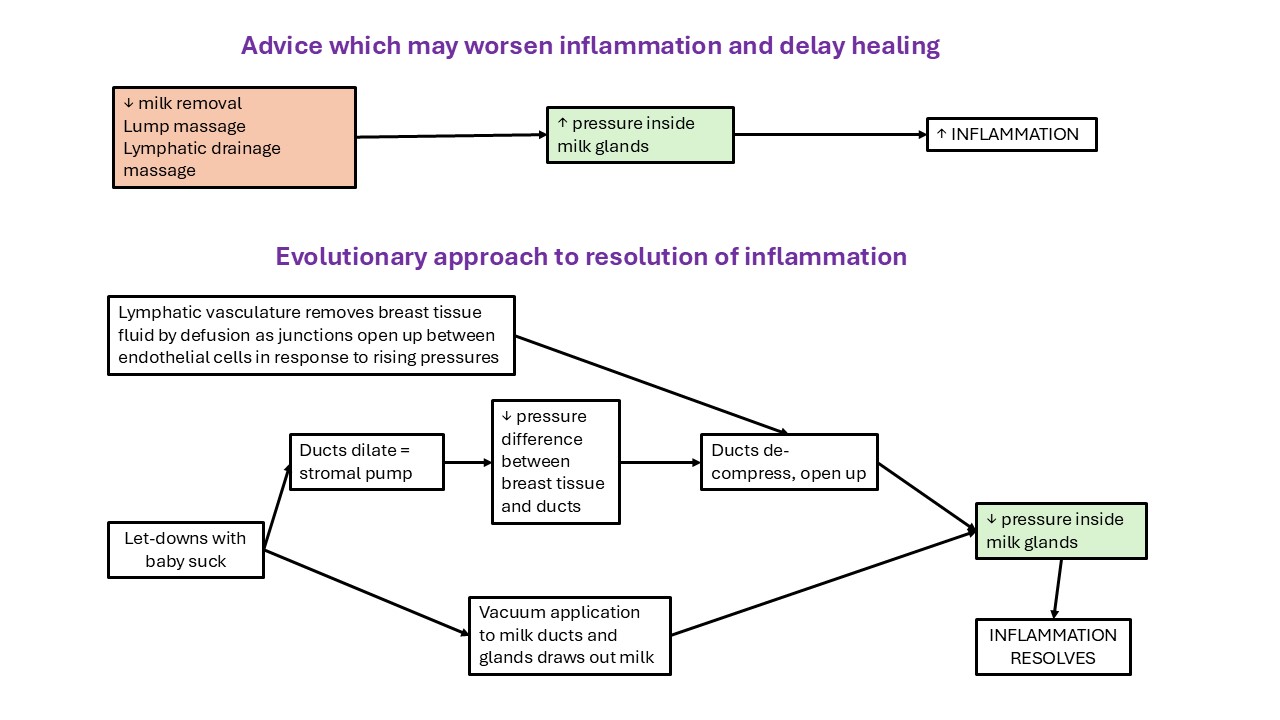
Letdowns are a gentle kind of inbuilt tissue pump, which open up the ducts, and stimulate the lymph vessels to drink in lymph.
When you have a letdown (and mostly you won’t even know you are having one) your milk ducts dilate. The dilation of the milk ducts pushes pressure back on to the breast stroma, changing the pressure gradient.
This doesn’t happen all at once, like a piston. The amount by which your ducts dilate is irregular, and the amount of milk in your glands and ducts is irregularly distributed throughout the breast at any one time. But with a letdown, your breasts are being swept through by changing pressures for a period of time.
The more often your ducts open up and dilate with letdowns, the less likely you are to have high backpressures in your glands. High milk backpressures cause inflammatory cascades, which then result in high stromal tensions due to increased capillary flow and interstitial fluid.
It's true that some women are genetically programmed to produce more milk than their baby needs, which increases their risk of breast inflammation. Even then, though there are important steps you need to take if your production is higher than your baby needs, spacing out feeds is not the solution. Others produce more milk than their baby needs because of pumping.
You can find out about letdowns here.
Putting baby to the breast (even for a short time) switches on your stromal pump, which is cleansing
All you need to do to activate this cleansing tissue pump is to put your baby to the breast.
(It's easy for me to write those words. I acknowledge that for some women putting baby to the breast is difficult or distressing. You can find out about nipple pain here, conditioned dialling up here, and how to use the gestalt method of fit and and hold here.)
These deep pressure gradients changes with letdown ramp up the flow of interstitial fluid into the lymph vessels. This is because the flow of interstital fluid into lymph vessels depends on pressure changes, as well as defusion.
It’s a mistake to think that we can make our lymph flow more or drain fluid away by massaging the breast, no matter how firmly or lightly. But the ducts will be sensitive to any pressure you apply, and it is possible that even light massage could increase backpressures in the milk glands.
You can find out why Therapeutic Breast Massage of Lactation doesn't help inflammation here.
Frequent flexible breastfeeds are the best way to keep your breast healthy and your milk supply matched with your baby's needs
But for most of us, frequent flexible breastfeeds regularly sweep the breast with ductal dilations and ripples of pressure gradient changes, protecting against breast inflammation, or helping a breast inflammation resolve quickly before it becomes too bad.
Frequent flexible breastfeeds keep the tissues of your working breasts as active and as healthy as possible.
You can find out about frequent flexible breastfeeds here.