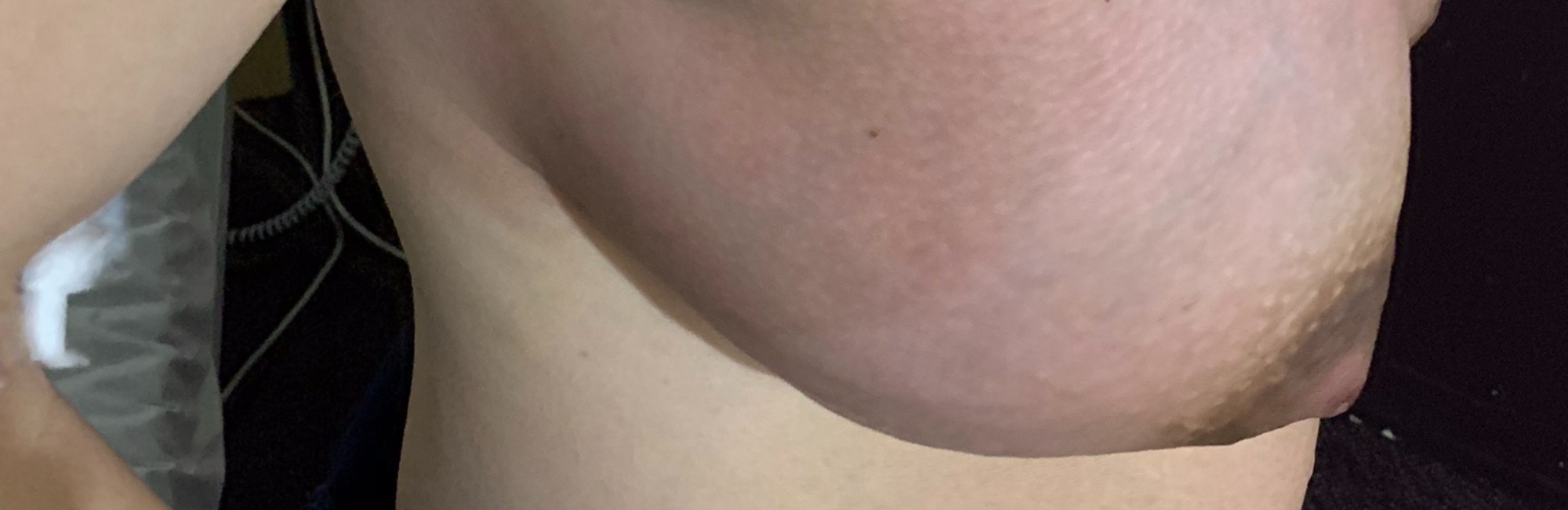
Non-surgical principles of abscess management including antibiotics

Continue with the four main principles of breast inflammation management
Importantly, there's no reason to cease breastfeeding when an abscess is diagnosed. Women can be reassured that any milk which occasionally leaks from a fine needle aspiration site helps rather than hinders healing, due to its immunoprotective properties.
The same principles of mastitis management (detailed as management of breast inflammation principles #1-4 here and here) continue to apply to the lactating woman who is diagnosed with an abscess.1 Abscess is at the end-stage inflammation end of the spectrum of lactation-related breast inflammation, discussed here.
Antibiotics are indicated
Antibiotics are always indicated for the treatment of puerperal abscess. However, the woman can be reassured, if she has not been taking antibiotics prior to the diagnosis, that use of antibiotics would not have prevented the abscess forming.2-4
-
First line treatment is dicloxacillin or flucloxacillin 500mg four times daily orally for 10-14 days. If the patient has a penicillin allergy, prescribe erythromycin.
-
Methicillin-resistant Staphylococcus aureus may require clindamycin 300 mg orally four times daily for 10-14 days.
Antibiotics are commenced whilst awaiting culture. The most common organisms identified by the laboratory in an sample of abscess contents for culture and sensitivities are S aureus (including multi-drug resistant S aureus), S epidermidis, and streptococci. Dr Ofri and Dr Douglas acknowledge that these organisms are also typically found from human milk outside the setting of pathology, but continue to recommend antibiotics once abscess is diagnosed.
A 2015 Cochrane review by Irusen et al found that antibiotic treatment did not improve outcomes in lactating women with breast abscess who were also treated with incision and drainage, though all studies were poorly conducted. Although antibiotics are overused in treatment of mastitis or breast inflammation generally, the authors of this module propose that antibiotics are always indicated in treatment of lactational abscess.2
However, the NDC mechanobiological model proposes that premature antibiotic may predispose to abscess formation in some cases. Antibiotics kill many bacterial species in the milk and breast tissue microbiomes, which disrupts the immunoregulatory properties of these microbiomes, potentially predisposing to abscess by increasing the incidence of multi-drug resistant staphylococcus aureus. You can find out about this hypothesis here and here.
Anti-inflammatories may be indicated
If the patient is experiencing pain, anti-inflammatories may be required, titrated according to the woman's pain experience. In particular, anti-inflammatories and pain relief (ibuprofen, paracetamol) may be important at night for patient comfort and sleep.
Drainage is usually necessary
In the human body, undrained purulent fluid is usually not successfully treated by antibiotics alone. Drainage of a symptomatic fluid collection is indicated, to promote rapid resolution and to minimise the risks of fistula formation or septicemia.
Our aim is to detect and manage lactational abscess as early as possible, to protect skin integrity and prevent spread of the abscess and associated infection.
The nature of the drainage intervention is guided by the overlying skin. If the patient has
-
Healthy skin overlying the abscess, then fine needle aspiration is indicated, here
-
Thinned and necrotic skin overlying the abscess, then incision and drainage is indicated, here.
What doesn't help
There is no benefit in
-
Taking an expressed milk sample of culture and sensitivity, given the highly variable nature of the human milk microbiome. Staphylococcus aureus are likely to be present in high numbers, but this doesn't guide treatment. You can find out about this here.
-
Blood tests. C-reactive protein and ESR are elevated in an inflammatory condition, and do not assist with either diagnosis or management of breast inflammation or abscess.
-
Cold compresses. You can find out more about the lack of evidence to support the use of cold applications here.
References
-
Douglas PS. Re-thinking benign inflammation of the lactating breast: classification, prevention, and management. Women's Health. 2022;18:17455057221091349.
-
Irusen H, Rohwer AC, Steyn DW, Young T. Treatments for breast abscesses in breastfeeding women (review). Cochrane Database of Systematic Reviews. 2015(8):Doi:10.1002/14651858.CD14014090.pub14651852.
-
Kvist LJ. Toward a clarfication of the concept of mastitis as used in empirical studies of breast inflammation during lactation. Journal of Human Lactation. 2010;26(1):doi:10.1177/0890334409349806.
-
Kvist L, Larsson BW, Hall-Lord ML, Steen A, Schalen C. The role of bacteria in lactational mastitis and some considerations of the use of antibiotic treatment. International Breastfeeding Journal. 2008;3:6.