
What the research tells us about food protein induced immune reactions in infants: diagnostic categories and management

Diagnosis of food protein immune reactions in infants: latest studies
Alshehhi et al 2026 review: food protein induced enterocolitis syndrome
-
Very unwell infants who present with recurrent vomiting 1-4 hours after ingestion of trigger
-
Predominantly formula fed infants; rare in breastfed infants
-
Symptoms occur within first few weeks of introducing cow's milk or soy proteins
-
Rare presentation neonatally within hours or days post-birth after initiation of formula
-
Emerges 4-7 months of age if triggered by solid foods
-
No diagnostic tests (blood IgE and skin prick tests don't help)
-
Management is avoidance of trigger protein
-
Oral food challenge may have a role depending on individual case but is a high risk procedure conducted in emergency support setting.
Mahoney et al 2025 review: food protein induced allergic proctocolitis (FPIAP)
-
Affects both breastfed and formula-fed infants
-
Spontaneous resolution, often within first year of life, even without specific dietary intervention; over 75% of children with FPIAP develop tolerance to previous food triggers by 24 months.
-
Diagnosis made on clinical criteria
-
Cow's milk most commonly cited trigger, with reported rates of up to 100%; followed by egg (7-37%), soy (6-15%), beef (6-11%), wheat (4-14%). Most have a single dietary trigger.
-
However, Mahoney et al 2025 note that levels of milk, egg, wheat, and peanut proteins noted to be substantially below the 1% eliciting dose for IgE-FA in most breast milk samples, with an estimated probability of reaction of ≤1 in 1000 infants
-
Gut microbiota 'dysbiosis' linked with FPIAP; links noted with atopic predisposition
-
May correlate with elevated risk of IgE-mediated food allergies in later life (but from NDC perspective this link could also be explained by the use of cow's milk protein elimination diets)
Caffarelli et al 2025 review: cow's milk protein allergy (CMPA)
There are still many uncertainties about cow's milk allergy in breastfed babies. It's accepted that cow's milk is among the most common cause of food allergy in infants, though overdiagnosed. Overall, data on allergenic food protein levels in breast milk following maternal ingestion lead to the estimate that more than 99% of infants with CMA may tolerate breastmilk from a mother who consumes dairy products.
This review does not use the term 'intolerance' due to confusions it causes in diagnosis.
This review considers clinical signs which are associated with cow's milk related immune responses in breastfeeding infants, classified into
-
Immediate IgE mediated immune responses - rare in exclusively breastfed infants. Signs are
-
Cutaneous (erythematous rashes, urticaria, angioedema of eyelids, face, lips)
-
Respiratory (rhinorrhea, coughing, sneezing, stridor, wheezing, shortness of breath)
-
Gastrointestinal (vomiting, crampy abdominal pain, diarrhoea)
-
Anaphylaxis (rapid onset, potentially life-threatening, rare, often presents with vomiting and hives)
-
-
Delayed or non-IgE mediated (or cell mediated) immune responses - guidelines are inconsistent, symptoms are nonspecific.
-
Food protein-induced proctocolitis
-
Food protein-induced enterocolitis syndrome
-
Other non-IgE-mediated conditions
-
-
Mixed IgE/non-IgE-mediated responses
- Atopic dermatitis (eczema)
Standard IgE tests are often of no benefit in non-IgE cases, and diagnosis typically requires dietary elimination and cow’s milk challenge.
Management of food protein immune reactions in infants: latest research
Caffarelli et al 2025
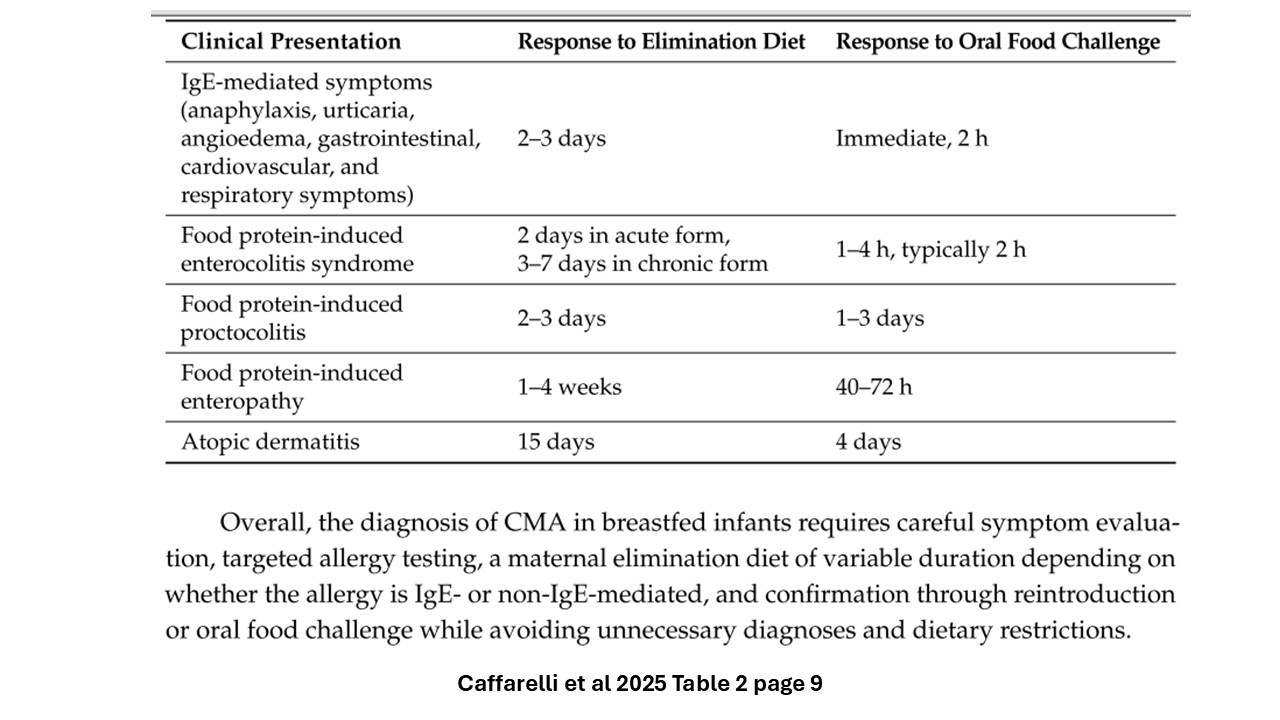
Abrams et al 2023 review (extracts)
Oral challenge-proven food allergy rates are often much lower than self-reported rates, and these rates vary considerably with geographical differences internationally.
Data supports the dual allergen exposure hypothesis, which states that early exposure in infancy through ingestion is tolerising, whereas avoidance combined with cutaneous exposure (especially in infants with early-onset, persistent eczema) can be sensitising.
Maternal dietary supplementation with vitamin D, omega-3, or prebiotics or probiotics is not currently recommended as a means of infant food allergy prevention.
Recommendations:
-
Maternal allergen avoidance during pregnancy and lactation is not recommended.
-
Although exclusive breastfeeding is the recommended infant nutritional source, whether it has any role in food allergy prevention is unclear.
-
Irregular exposure to cow’s milk formula in early infancy might increase the risk of cow’s milk allergy.
-
Maternal peanut ingestion during breastfeeding, in combination with early infant ingestion of peanut, might have a role in peanut allergy prevention, although further studies are required.
Fleischer et al 2020 review
Recommendations
-
Introduce both peanut and egg at around 6 months of age (not before 4 months) to prevent peanut and/or egg allergy
-
No reason to screen solids before introduction
-
Offer infants a diverse diet because this may help foster prevention of allergy
-
No protective benefit from use of hydrolyzed formula in first year of life against food allergy or sensitisation
-
No reason to exclude allergens during pregnancy or lactation as this doesn't prevent food allergy.
Recommended resources
Infant haematochezia + allergy NDC guidelines (0-12 months) 29_6_26.pdf
Infant allergy, unsettled behaviour, and the gut: PLAIN LANGUAGE SUMMARY for health professionals
Infant haematochezia (blood in the stool): PLAIN LANGUAGE SUMMARY for health professionals
It's normal for babies to have green stools and mucous in the stool
Is your baby unsettled or having trouble sleeping because of allergy?
Selected references
Abrams EM, Shaker MS, Chan ES. Prevention of food allergy in infancy: the role of maternal interventions and exposures during pregnancy and lactation. The Lancet Child and Adolescent Health. 2023;7:358-366.
Allen HI, Wing O, Milkova D. Prevalence and risk factors for milk allergy overdiagnosis in the BEEP trial cohort. Food Allergy and Gastrointestinal Disease. 2024;80:148-160. DOI: 110.1111/all.16203.
Bhasin M, Cooper M, Macchiaverni P. Colostrum as a protective factor against peanut allergy: evidence from a birth cohort. Allergy. 2025:1–11. https://doi.org/10.1111/all.70043.
Buccini G, Larrison C, Neupane S, et al. Complex intertwined association between breastfeeding practices and household food insecurity: Systematic review and meta-analysis. Matern Child Nutr. 2024;20(4):e13696. doi:10.1111/mcn.13696
Caffarelli C, Giannetti A, Buono EV. Cow's milk allergy in breastfed infants: what we need to know about mechanisms, management, and maternal role. Nutrients. 2025;17(1787):https://doi.org/10.3390/nu17111787.
Ding Y, Zhu C, Li S, et al. Breastfeeding and risk of food allergy and allergic rhinitis in offspring: a systematic review and meta-analysis of cohort studies. Eur J Pediatr. 2024;183(8):3433-3443. doi:10.1007/s00431-024-05580-w
Fleischer DM, Chan ES, Venter C. A consensus approach to the primary prevention of food allergy through nutrition: guidance from the American Academy of Allergy, Asthma, and Immunology; American College of Allergy, Asthma, and Immunology; and the Canadian Society of Allergy and Clinical Immunology. American Academy of Allergy, Asthma & Immunology. 2020:https://doi.org/10.1016/j.jaip.2020.1011.1002.
Hage G, Sacre Y, Haddad J. Food hypersensitivity: distinguishing allergy from intolerance, main characteristics, and symptoms - a narrative review. Nutrients. 2025;17:1359. https://doi.org/1310.3390/nu17081359.
Mahoney LB, Syverson EP, Elverson W, Venkatesh R. Food protein induced allergic proctocolitis: what do we know and where are we going? Current Treatment Options in Pediatrics. 2025;11(30):https://doi.org/10.1007/s40746-40025-00346-40744.
Munblit D, Perkin MR, Palmer D, Allen K, Boyle RJ. Assessment of evidence about common infant symptoms and cow's milk allergy. JAMA Pediatrics. 2020;174:599-608.