
Infant haematochezia (blood in the stool): PLAIN LANGUAGE SUMMARY for health professionals
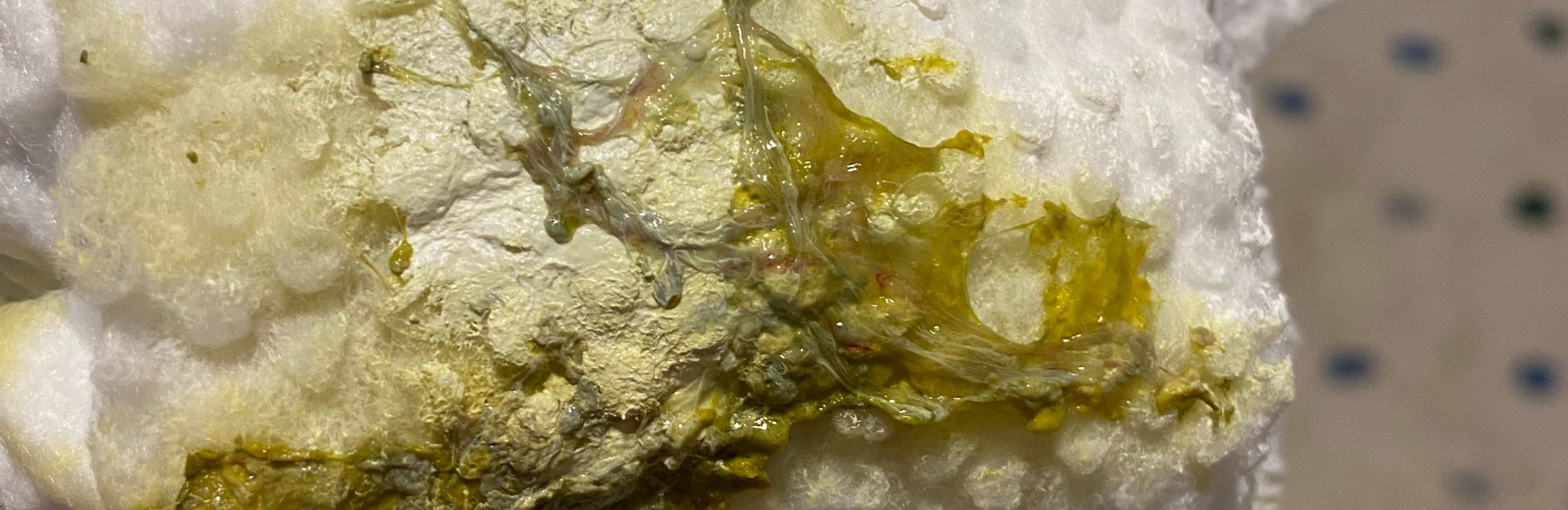
Although the image above shows mucous and green stools, the latter are normal variation for both breastfed and formula-fed infants. What matters in this image are the small streaks of blood in the centre and to the right of centre.
Blood in the infant’s stool
Blood in an infant’s stool is a finding that concerns parents.(1) Streaks or drops of blood in the nappy are common in the first months of life, are usually harmless, and typically resolve within a couple of months. The latest evidence indicates there is no basis for assuming this slight bleeding is allergic in origin. There are, however, important clinical considerations, and these infants require medical review.
Blood in the stool in breastfed infants under six months of age
Small streaks of blood occur quite commonly in the stool of otherwise healthy breastfed infants. This presentation is most likely to be seen in the first eight weeks of life, or at some other point in the first six months. Green stools and mucous in the stool are normal for infants and do not in themselves require investigation.(2,3)
Research investigations(4) conducted in infants with small amounts of blood in the stool often(5) identify a temporary patch of mild inflammatory change in the lining of the colon (though not elsewhere in the gut). The reasons for these changes remain unclear.
In formula-fed infants who develop a persistent pattern of blood-streaked stools, a change to extensively hydrolysed formula may be warranted, as formula-fed infants have a higher likelihood of food-protein-induced allergic proctocolitis. This should be assessed and managed by the treating clinician.
Non-allergic benign infantile proctocolitis
Non-allergic benign infantile proctocolitis(6) is the term given to the mild and temporary inflammation in the colon or rectum of an otherwise well infant, which results in streaks of blood in the stool. Frequent and flexible breastfeeding is by far the most beneficial intervention available. There is no basis for assuming these changes are allergic or related to food proteins in the breast milk.
A useful clinical analogy is eczema, a common inflammation of infant skin. A small, mild patch of eczema causes no discomfort or distress, and does not require treatment. Mild or even moderate eczema is not caused by allergy.(7) Similarly, an infant with streaks or drops of blood in the stool is likely to have a small patch of inflammation in the large gut that causes no discomfort or distress and is not related to allergy.
The diagnosis of non-allergic benign infantile proctocolitis is appropriate when the infant:
-
Is under six months of age
-
Has small amounts of blood — just streaks or drops — in or on the stool
-
The bleeding has not persisted for more than two months
-
The bleeding is not worsening.
Where this clinical picture is present, a period of observation and watchful waiting of up to two months is the recommended approach, subject to clinical judgement in the context of the individual infant’s presentation.
When allergy is the likely cause of blood in the stool
The following clinical features suggest that allergy(8) is the likely cause of blood in the infant’s stool and warrant medical assessment:
-
The infant is older than six months of age, or
-
The stool is pink or red,(9) or
-
There are large amounts of blood in the stool (more than a streak or drop), or
-
The amount of blood is increasing over time, or
-
The bleeding has continued for two months without resolving.
Food-protein-induced allergic proctocolitis (FPIAP)
Where one or more of the above clinical features is present, a cow’s milk protein elimination diet is the recommended diagnostic and therapeutic approach, with a diagnosis of food-protein-induced allergic proctocolitis (FPIAP) being considered. The following points are relevant to management:
-
Resolution of bleeding following elimination of cow’s milk protein — usually within days, and up to a fortnight — is diagnostic of cow’s milk FPIAP.
-
Following resolution, cow’s milk protein is reintroduced. Recurrence of bleeding further confirms the diagnosis.
-
If bleeding persists despite cow’s milk protein elimination, soy and chicken egg may be removed from the diet, with reintroduction after bleeding ceases to confirm the diagnosis.
-
Reintroduction of the allergenic protein is generally offered at the latest around three months after commencement of the elimination diet. In very severe cases, reintroduction may need to occur later, and further investigations may be considered.
Partial or exclusive breastfeeding is protective against true FPIAP. Infants generally outgrow(10) the allergy by one to three years of age. Research has identified a localised patch of inflammation(11) in the large gut as the histological correlate of the bleeding in FPIAP. There is no evidence that eliminating goat’s and sheep’s milk proteins provides additional benefit, although some clinicians may consider this given the high cross-allergenicity of cow’s, goat’s and sheep’s milk. Soy, egg, and grain protein allergies may occur in infants and toddlers, but are uncommon(12) and similarly often overdiagnosed. Soy has a low cross-reactivity with cow’s milk protein. Where other concerning health signs arise, or bleeding persists beyond one year of age, further investigations are indicated.
For formula-fed infants(13) diagnosed with true cow’s milk allergy, a specialised formula(14) may be required.
Signs that are not indicative of allergy or FPIAP in infants with blood in the stool
The following features are sometimes cited as supporting a diagnosis of allergy or FPIAP in infants with blood in the stool; however, this is not consistent with the current evidence base:
-
Green stool and mucous in the stool are normal findings in infants and do not indicate allergy.
-
Unsettled behaviour is not a sign of allergy. Blood in the stool may co-occur with unsettled behaviour, but the unsettled behaviour is not attributable to the haematochezia unless there is copious bleeding or pink stools (which require medical attention). There is no evidence that a small area of mild inflammation in the large gut causes pain, and there are many other clinically relevant factors to consider in the assessment of infant unsettledness.
-
Vomiting is not a sign of allergy in this context (unless the infant is acutely unwell with food-protein-induced enteropathy syndrome (FPIES), which requires urgent medical attention).
-
Eczema is not usually a sign of allergy, although it may be relevant when severe and extensive.
-
Inadequate weight gain in breastfeeding infants is a complex clinical problem and is not attributable to allergy except when the infant is unwell with true FPIES,(15) which is mostly not accompanied by blood in the stool.
Clinical implications of overdiagnosis of allergy in infants with blood in the stool
Cow’s milk proteins do not generally occur at levels in breast milk sufficient to trigger allergic reactions in infants, regardless of maternal dairy intake. When a breastfeeding mother follows an unnecessary dairy elimination diet:
-
She faces the burden of restricting common foodstuffs, often at a time of significant fatigue, including loss of the nutritional benefits of dairy such as calcium and vitamin D.(16)
-
There is a greater risk(17) that the infant will develop cow’s milk allergy down the track.
-
Overdiagnosis of FPIAP and unnecessary use of elimination diets leads to unhelpful dietary restrictions, adding stress to the family.
-
The infant’s behaviour may come to be interpreted primarily through an allergy lens, while other factors that could meaningfully reduce infant unsettledness are not adequately addressed.
Although IgE-mediated allergies to egg, wheat, soy, and other food proteins do occur in infants and toddlers and can be serious or life-threatening, these are not linked in the research to blood in the infant’s stool.
Footnotes
(1) Blood in a baby’s stool is known medically as haematochezia.
(2) Vandenplas et al 2024.
(3) Blood in the stool can occur right through early childhood, and requires a doctor’s assessment.
(4) These investigations are colonoscopy and sigmoidoscopy, which have been done for research purposes. Investigations are not required in healthy breastfed babies with small amounts of blood in the stool.
(5) Though not always.
(6) I agree with the European doctors and researchers who propose that in babies under six months of age, food-protein-induced allergic proctocolitis is overdiagnosed, with possible negative impacts on the baby and family’s life, and that most babies with small amounts of blood in the stool have non-allergic benign infantile proctocolitis. The term non-allergic benign infantile proctocolitis was coined by Gelsomino et al in 2021, drawing on their own described case, and a number of earlier studies which propose that FPIAP is being overestimated as a cause of bloody stools in infants. Only 15–40% of infants with rectal bleeding are finally diagnosed with FPIAP in response to diagnostic dietary intervention. Wurm et al compared 14 infants with rectal bleeding (average age 11.1 weeks) with 55 control babies (average age 12.7 weeks). During recruitment, more than half of the apparently healthy infants presenting with rectal bleeding were found to have a gut virus or pathogen on stool analysis, and were eliminated from this study. The selected infants with rectal bleeding were found to have less bifidobacterium and other microbiome changes on gut microbiome analysis, compared with non-bleeding infants. After a four-week cow’s milk elimination diet, the microbiome of infants with rectal bleeding partially changed to resemble the microbiome in those without bleeding. Wurm et al note that although aggregates of eosinophils are found in the colonic mucosa in infants with haematochezia, there is no explanation for how an ingested protein causes an allergic reaction that is entirely restricted to the distal colon, without other parts of the gut being affected and without immune cell changes in the blood stream. This study does not confirm whether the change in the microbiome would have occurred naturally with the passage of four weeks, without dietary intervention. Studies have found viruses in the lining of the large gut of babies who have haematochezia (Arvola et al 2006); 20% of breastfed infants have their rectal bleeding disappear without elimination of any food (Nowak-Wegzyn). It has also been suggested that the colonic inflammation causing rectal bleeding may be an area of transient autoimmune activity in the pro-inflammatory environment of the breastfed baby’s gut. One study found that babies are more likely to have blood in the stool if they have been exposed to antibiotics.
(7) It is agreed in the research that eczema has been overdiagnosed as due to allergy, but allergy might be relevant only in babies or toddlers who have severe and extensive eczema.
(8) Allergic gut changes in infants are known as non-IgE-mediated allergies. They fit two diagnostic categories: food-protein-induced allergic proctocolitis (FPIAP), which causes blood in the stool, and food-protein-induced enteropathy syndrome, which makes babies acutely or chronically unwell and is a severe medical condition requiring close medical care. This article deals only with FPIAP.
(9) Black stool (other than a newborn’s meconium) also requires urgent medical assessment.
(10) FPIAP is not associated with other eosinophilic disorders or subsequent development of inflammatory bowel disease.
(11) Signature histologic findings are marked eosinophils and degranulation in the rectosigmoid colon in close proximity to lymphoid nodules. Alteration of specific cytokines has been reported. Wurm et al note that no study or guideline currently explains how an ingested protein deemed the offending allergen causes an allergic reaction that is restricted solely to the distal colon.
(12) The prevalence of these and other food allergies remains poorly established.
(13) Cross-reactivity between cow’s milk and soy-based formulas is low, so infants with cow’s milk allergy and food protein induced enteropathy syndrome who are over six months of age could use soy-based formula.
(14) Specialised formulas include extensively hydrolysed formula, amino acid formula, and soya or rice-based formulas. Mehta et al 2022 demonstrate that volumes of specialised formula prescriptions have increased two-fold in the past twenty years in the UK, Australia and Norway, in the absence of increased prevalence of milk allergy. They propose that most infants prescribed specialised formula do not have milk allergy. They identify up to a ten-fold excess prescription rate relative to the true rate of milk allergy. The authors observe that unnecessary specialised formula use increases consumption of free sugars (such as glucose or sucrose, which substitute for the lactose found in breast milk and formula), risking dental decay and obesity in later life.
(15) This refers to an exclusively or partially breastfed baby who becomes sick with a protein-losing enteropathy, presenting with faltering growth and low serum albumin, with or without oedema.
(16) Of course, this is not relevant if the breastfeeding woman is lactose or cow’s milk protein intolerant herself, and avoids cow’s milk protein for that reason.
(17) It is now mainstream understanding that unnecessary elimination of food protein exposure increases an infant’s risk of allergy down the track. Questions are also raised by a recent case series by Tran et al 2024, in which five infants with rectal bleeding, who were diagnosed with FPIAP and placed on elimination diets of unknown duration (either maternal if breastfeeding or by formula change), were found to have developed persisting cow’s milk allergy down the track. One interpretation is that infant rectal bleeding is always FPIAP, which is associated with persisting cow’s milk allergy. Another interpretation is that the cow’s milk elimination diets, which may not have been indicated if the babies actually had non-allergic benign infantile proctocolitis, resulted in a persisting cow’s milk allergy.
Related resources
Infant allergy, unsettled behaviour, and the gut: PLAIN LANGUAGE SUMMARY for health professionals
Infant haematochezia (blood in the stool): PLAIN LANGUAGE SUMMARY for health professionals
Haematochezia and allergy in the breastfed infant. Dr Pamela Douglas 12 June 2024 - VIDEO
NDC clinical guidelines: Haematochezia and allergy in the breastfed infant POWERPOINT.pdf
For parents
It's normal for babies to have green stools and mucous in the stool
Is your baby unsettled or having trouble sleeping because of allergy?
Does allergy cause toddler sleep problems?
Infant cow's milk protein allergy (parent handout) available under possums.org Free Resources
Selected references
Arvola T, Ruuska T, Keranen J. Rectal bleeding in infancy: clinical, allergological, and microbiological examination. Pediatrcis. 2006;117(4):e760-768.
Gelsomino M, Sinatti D, Miceli Sopo S. Non-allergic benign infantile proctocolitis: a neglected nosographic entity. BMC Case Reports. 2021;14:e244918.
Gelsomino M, Liotti L, Barni S. Elimination diets in lactating mothers of infants with food allergy. Nutrients. 2024;16(2317):https:// doi.org/10.3390/nu16142317.
Mennini M, fiocchi lG, Cafarotti A, Montesano M, Mauro A, Villa MP, et al. Food protein-induced allergic proctocolitis in infants: literature review and proposal of a management protocol. World Allergy Organization Journal. 2020;13:100471.
McWilliam V, Netting MJ, Volders E. World Allergy Organization (WAO) diagnosis and rationale for action against cow's milk allergy (DRACMA) guidelines update - X - Breastfeeding a baby with cow's milk allergy. World Allergy Organization Journal. 2023;16:100830.
Miceli Sop S, Monaco S, Bersani G. Proposal for management of the infant with suspected food protein-induced allergic proctocolitis. Paedatric Allergy and Immunology. 2018;29(2):215-218.
Silvatore S, Folegatti A, Ferrigno C. To diet or not to diet this is the question in food-protein-induced allergic proctocolitis (FPIAP) - a comprehensive review of current recommendations. Nutrients. 2024;16:589.
Tran K, Wisner E, Jeha G, Wall L. Development of IgE-mediated food allergies in children with history of food protein-induced allergic proctocolitis: a series of five cases. Frontiers in Allergy. 2024;5:1354106.
Vandenplas Y, Broekaert I, Domellof M. An ESPGHAN position paper on the diagnosis, management and prevention of cow's milk allergy. Journal of Pediatric Gastroenterology and Nutrition. 2024;78(2):386-413.
Wurm P, Stampfer L, Greimel T. Gut microbiota dysbiosis in suspected food protein induced proctocolitis - a prospective comparative cohort trial. Gastroenterology. 2023;77(1):31-38.